
Managed IT financial operations turn technology spend into a governed, decision-ready view. Torch helps organisations establish accurate IT costs through budgeting, forecasting, invoice oversight, contract and purchase-order checks, and structured reporting. The result is a defensible IT cost figure for the CFO.
IT spending is difficult to govern when invoices, supplier commitments, contracts, purchase orders and operational data sit across separate processes. Torch brings these inputs together so finance and technology leaders can identify variances, confirm obligations and act on reliable cost information.
This article explains how Torch’s IT FinOps-as-a-Service supports IT cost governance. It covers invoice reconciliation, variance analysis, accruals, journals, recharges, budgeting, forecasting, vendor and procurement engagement, and monthly IT finance packs in Excel and PowerBI.
Key Takeaways
- Use invoice reconciliation and variance analysis against contracts and purchase orders to establish accurate IT costs.
- Support accruals, journals, recharges, budgeting and forecasting through a consistent IT FinOps process.
- Engage vendors and procurement with evidence that connects charges to agreed commercial terms.
- Receive monthly IT finance packs in Excel and PowerBI for clear review by finance, technology and business leaders.
- Give the CFO a defensible IT cost figure supported by reconciled records, documented assumptions and traceable decisions.
What Is IT FinOps-as-a-Service?
IT FinOps-as-a-Service connects IT budgets, invoices, supplier commitments and forecasts so leaders can assess technology costs against business priorities. Torch provides the managed advisory capacity needed to maintain this view and turn it into monthly financial reporting.
Effective oversight depends on reconciled information and clear ownership. Torch compares invoices with contracts and purchase orders, investigates variances and records the decisions needed to support an accurate IT cost position.
Budgeting, forecasting and variance analysis
Torch supports IT budgeting and forecasting by connecting planned costs with actual invoices, contractual commitments and approved purchase orders. Variances are identified, investigated and documented so finance leaders can distinguish authorised commitments from unexpected expenditure.
The process establishes budget owners, approval thresholds and reporting responsibilities. It also provides an evidence trail for changes to forecasts, supplier charges and allocation decisions, giving the CFO a defensible basis for the reported IT cost figure.
IT FinOps accounting support
Torch supports the finance processes required to represent IT costs accurately, including accruals, journals and recharges. These activities align costs with the correct period, business owner or service and make the monthly IT position easier to review.
Invoice reconciliation tests supplier charges against contracts and purchase orders. Variance analysis highlights pricing, usage, volume and billing differences for resolution with the relevant vendor, procurement team or internal owner.
Budget optimisation is based on evidence rather than a simple reduction in total spend. Reconciled transactions, documented assumptions and reviewed variances show where IT expenditure supports business priorities and where corrective action is required.
Managed IT FinOps reporting
Torch’s IT FinOps-as-a-Service provides managed analysis, reporting and governance for technology expenditure. The service brings together invoices, contracts, purchase orders, budgets, forecasts and operational ownership.
Monthly IT finance packs are delivered in Excel and PowerBI. They present reconciled costs, material variances, accruals, journals, recharges and actions in a format that finance and technology leaders can use for review and decision-making.
Torch also supports vendor and procurement engagement by providing the evidence required to challenge inaccurate charges, clarify commercial obligations and manage renewals or changes. Responsibilities, approval rights and escalation routes remain clear throughout the process.
This managed advisory approach gives the CFO a defensible IT cost figure: a reported amount supported by reconciled invoices, agreed commercial terms, recorded adjustments and traceable ownership.
Finance and technology leaders retain approval authority, while Torch provides the agreed analysis, reporting and governance support. The service scope defines responsibilities and ensures findings are assigned to an owner for action.
IT cost governance capabilities
IT cost governance connects transaction-level records with commercial terms, budgets, forecasts and business ownership. Torch manages the supporting analysis and reporting so the organisation can make decisions using a consistent, defensible view of technology expenditure.
Choosing a managed IT FinOps partner
Choose a managed IT FinOps partner that can reconcile invoices, analyse variances against contracts and purchase orders, support accruals, journals and recharges, and produce reporting that finance leaders can use. The provider should also engage vendors and procurement when charges or commitments require resolution.
Define the decisions the provider will support, the IT financial data it will handle and who retains approval authority. Reports should explain material variances, identify owners and show how the reported IT cost was established rather than presenting an unexplained total.
In South Africa, assess applicable tax requirements, POPIA considerations, and any contractual or sector-specific data-location conditions. Map the data involved, its purpose, storage and access locations, retention controls, and any cross-border processing against your organisation’s legal and governance requirements.
IT FinOps-as-a-Service outputs
Torch’s managed IT FinOps service supports invoice reconciliation, variance analysis against contracts and purchase orders, accruals, journals, recharges, budgeting and forecasting. It also provides vendor and procurement engagement and monthly IT finance packs in Excel and PowerBI.
These outputs give finance and technology teams a shared view of IT expenditure. Each material cost can be linked to its source record, commercial basis, accounting treatment, budget or forecast, and responsible owner. This gives the CFO a defensible IT cost figure for governance and reporting.
Implementing managed IT FinOps
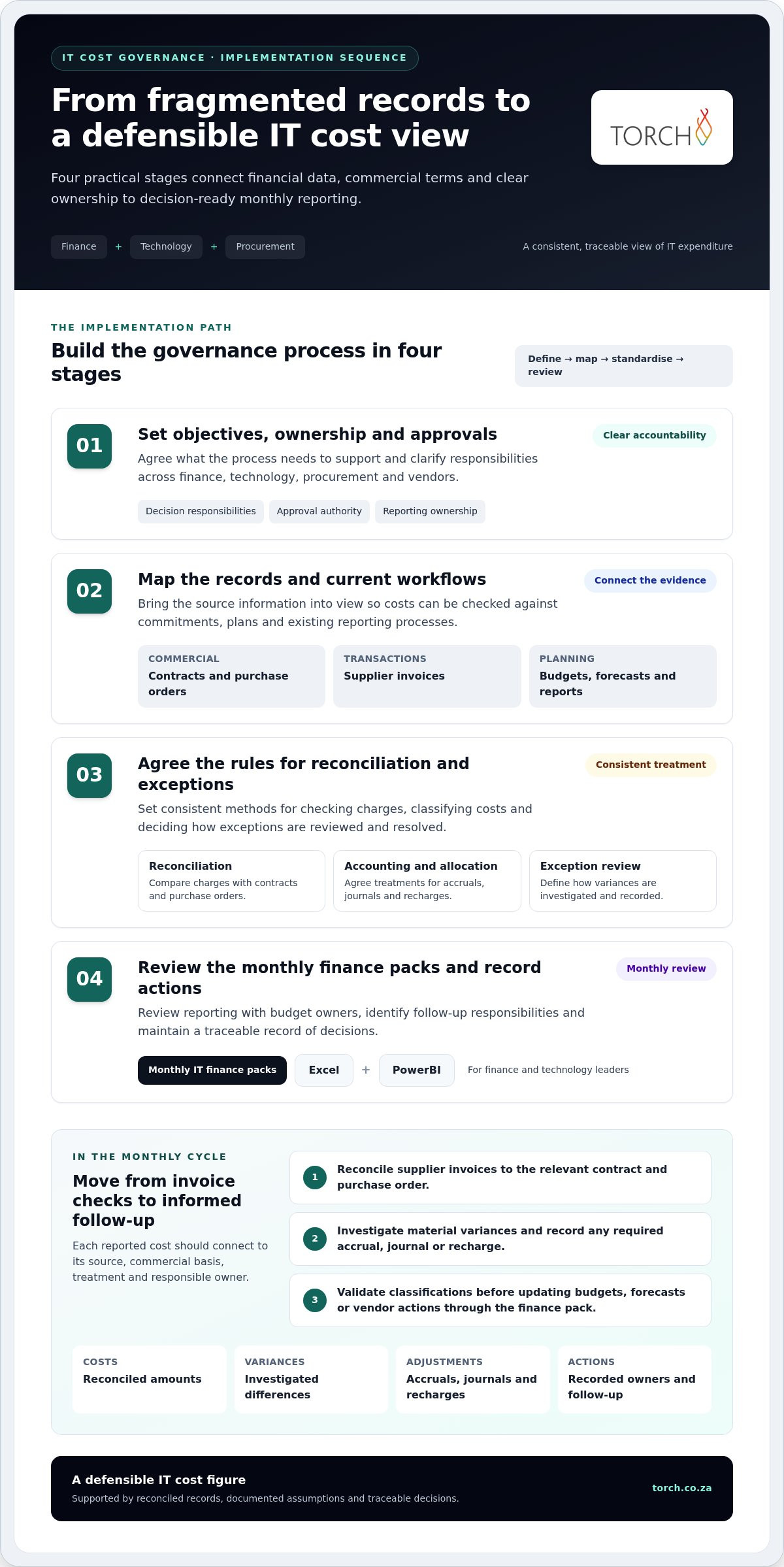
Implementation establishes the information, responsibilities and review practices required for consistent IT cost governance. A defined sequence moves the organisation from fragmented records to decision-ready monthly reporting.
- Set objectives, ownership and approval responsibilities across finance, technology, procurement and vendors.
- Map contracts, purchase orders, invoices, budgets, forecasts and existing reporting workflows.
- Agree reconciliation rules, accounting treatments, allocation rules and processes for reviewing exceptions.
- Review the monthly Excel and PowerBI finance packs with budget owners and record follow-up actions.
Start by reconciling supplier invoices to the relevant contract and purchase order, then investigate material variances and record any required accrual, journal or recharge. Validate classifications before using the monthly finance pack to update budgets, forecasts or vendor actions.
Managed IT FinOps works best when Torch’s analysis complements internal finance and technology context. Regular governance reviews connect reconciled costs to operational requirements, commercial decisions and approved priorities.
Torch’s integrated managed advisory services
Torch is an independent managed advisory partner with six integrated service lines: Telecom Expense Management (TEM), Technology Lifecycle Management (TLM), Unified Endpoint Management (UEM), IT FinOps, IT Asset Management (ITAM) and Security Operations (SecOps). Torch has saved R667.5M+ since 2004 across 12 African countries.
Verified results include R38.4M saved over 26 months for a South African insurer, PwC-audited; before Torch’s intervention, the IT team spent 22% of its capacity on telecom administration. In banking, Torch saved R8.9M over 18 months, SBSA-verified. Torch is independent, carrier-agnostic and vendor-neutral, earning no commissions. Its ITAM offering is an ITAM service, not a platform.
Security governance also forms part of the integrated service model. Microsoft Security reports that 85% of ransomware entry points start from unmanaged devices, making managed endpoint and asset oversight an important part of IT governance.
Make IT cost governance part of the operating rhythm
The next step is to turn IT cost insight into a monthly operating practice. Assign clear ownership to reconciliations, variances, accounting adjustments, vendor actions and forecast updates, then establish when finance and technology leaders will review them.
Start with a governance gap that affects decision-making, such as an unexplained supplier charge, an unrecorded commitment or unclear ownership of a technology expense. Define the evidence required, the person responsible and how the outcome will inform the next finance pack.
As priorities evolve, revisit the controls, assumptions and reports that inform IT decisions. Consistent ownership and traceable evidence keep the reported IT cost accurate and defensible.
A consistent IT FinOps governance cycle gives finance and technology leaders a clear basis for managing expenditure and making informed decisions about technology priorities.