
Evaluating Unified Endpoint Management: ManageEngine vs Enterprise UEM Frameworks
The conversation around endpoint management is undergoing a significant transformation. What began as Mobile Device Management (MDM) to control corporate smartphones has evolved into a far more strategic discipline: Unified Endpoint Management (UEM). This shift is not merely about managing more device types; it is a fundamental change in how organisations approach security, financial control, and operational governance across their entire technology estate. For modern IT governance, two pillars are non-negotiable: absolute visibility over every asset and the unwavering control to enforce policy upon them.
From the perspective of a seasoned advisor—the Sage archetype—mid-to-large businesses in South Africa must look beyond simple toolsets. The objective is not just to deploy software but to establish a governed estate where every endpoint, from a server to a smartphone, operates within a defined framework of accountability. This distinction is critical. Tools designed for small-to-medium enterprises (SMEs) often excel at specific tasks, but they can lack the architectural depth required for high-governance enterprise platforms, which are built to integrate with complex identity, security, and financial systems.
The Core Dilemma: Tactical Patching vs Strategic Governance
The choice between a solution like ManageEngine and a broader enterprise UEM framework, such as Microsoft Intune or VMware Workspace ONE, represents a classic strategic dilemma. It is a choice between a powerful tactical tool and a comprehensive strategic framework.
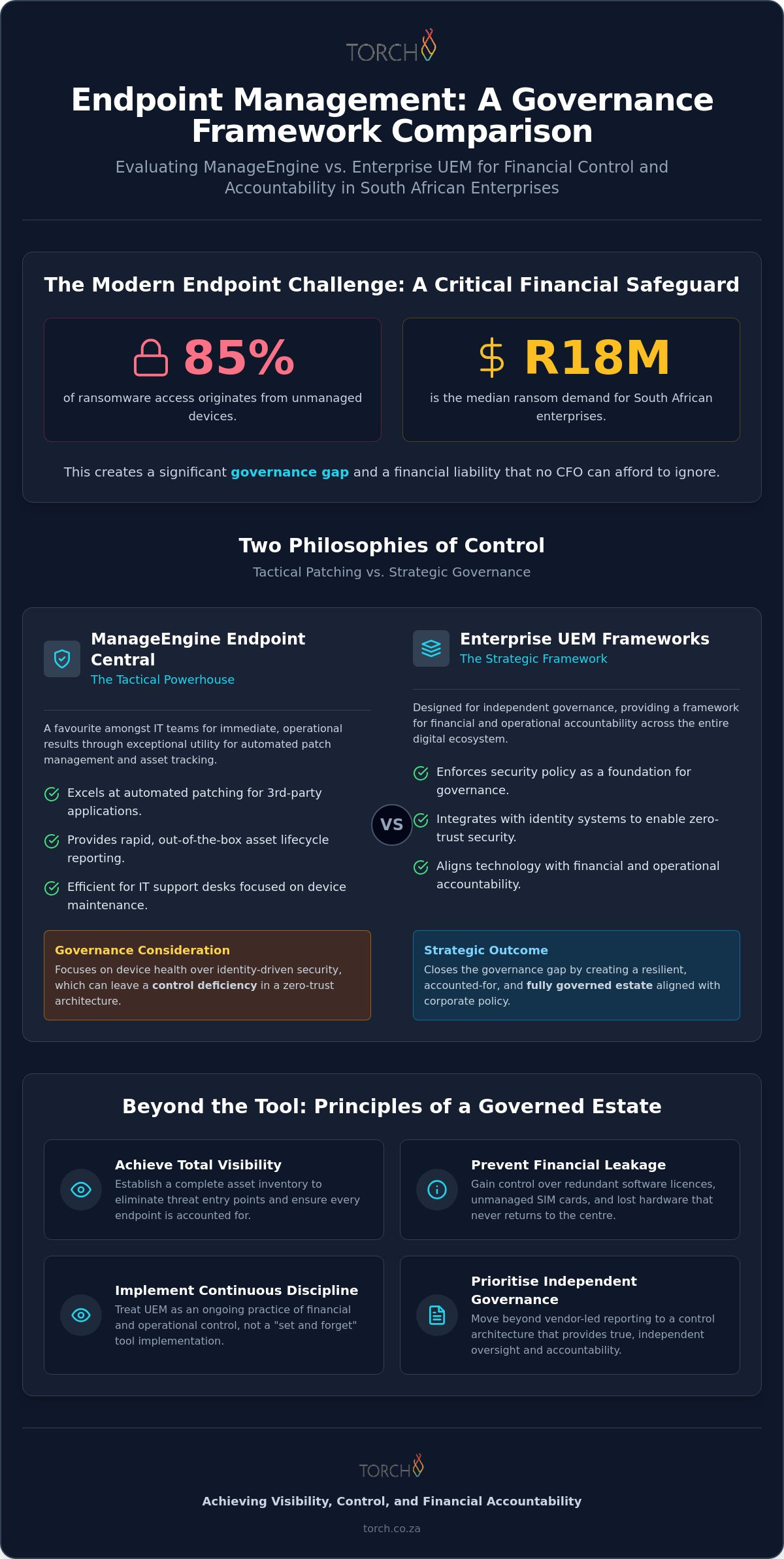
- ManageEngine as a tactical powerhouse: ManageEngine’s Endpoint Central is frequently positioned as a formidable solution for patch management, software deployment, and IT asset tracking. It provides IT administrators with direct, hands-on tools to solve immediate operational challenges efficiently.
- Enterprise UEM as a strategic framework: In contrast, platforms like Intune and Workspace ONE are designed as strategic frameworks for identity-led security. They integrate deeply into the corporate ecosystem (e.g., Microsoft 365, Azure Active Directory) to enforce security policies based on user identity, device health, and location.
- The “governance gap”: This strategic divergence often creates a “governance gap.” This occurs when a powerful tactical tool is implemented without a corresponding policy framework to guide its use. An organisation may be excellent at patching vulnerabilities but still lack control over who can access sensitive data from which device, creating a significant, unmanaged risk exposure.
Why Enterprise Scale Demands More Than Just a Dashboard
In complex, remote, and hybrid work environments, the fallacy of “set and forget” in endpoint management becomes dangerously apparent. A dashboard showing green checkmarks offers a false sense of security if it is not underpinned by continuous operational discipline. Unmanaged or poorly managed devices inevitably create “silent financial leakage” through redundant software licensing, underutilised hardware, and asset loss.
Ultimately, Unified Endpoint Management is a continuous discipline of financial and operational control, executed through technology to ensure every asset is secure, compliant, and commercially optimised throughout its lifecycle.
Core Functional Comparison: Patching, Security, and Integration
When evaluating UEM platforms, decision-makers must look beyond feature lists and assess how each solution integrates into their existing operational and commercial structures. The comparison between ManageEngine Endpoint Central and enterprise alternatives like Microsoft Intune highlights fundamental differences in approach, particularly in automation, security philosophy, and total cost of ownership.
- Automation and Integration: The key difference often lies in comparing the stand-alone automation capabilities of ManageEngine against the deep, native integration of Microsoft Intune within the M365 ecosystem. One offers powerful, self-contained workflows, whilst the other leverages a vast, interconnected security and identity fabric.
- Multi-OS Environments: Both categories of tools provide support for diverse operating systems, including Windows, macOS, Linux, iOS, and Android. The crucial differentiator is not *if* they support them, but *how* deeply the policy enforcement and security controls are integrated across these disparate platforms.
- The “Caregiver” Aspect: For already overburdened internal IT teams, the level of support and ease of management is a critical factor. Which platform provides the most intuitive interface, the most reliable automation, and the most effective support to alleviate the operational strain on your team?
* Commercial Optimisation: Selecting a platform should not be a purely technical decision. It must involve commercial optimisation—aligning the choice with existing enterprise agreements (such as a Microsoft Enterprise Agreement) to maximise value and minimise redundant expenditure.
ManageEngine Endpoint Central: The Patching Specialist
ManageEngine has built a strong reputation as a comprehensive, all-in-one solution for endpoint management, particularly for organisations prioritising operational efficiency and granular control over patching and software deployment.
- Marketed Strengths: The platform is commonly marketed for its strengths in third-party application patching and its robust remote troubleshooting capabilities, which are highly valued by South African support desks managing geographically dispersed users.
- Reporting Value: Its “out-of-the-box” reporting is often cited as a key benefit, providing clear and immediate insights for IT asset lifecycle management and basic compliance checks.
- Identified Limitations: However, when measured against the requirements of a complex, identity-driven zero-trust architecture, its capabilities may be more limited than top-tier enterprise alternatives that are natively integrated with identity providers like Azure AD.
Enterprise UEM Alternatives: Deep Integration and Security
Enterprise-grade UEM platforms are designed not as stand-alone tools but as integral components of a wider security and productivity ecosystem. Their primary value proposition is seamless integration and identity-driven policy enforcement.
- Leveraging Existing Spend: For organisations already invested in Microsoft 365 (E3/E5 licenses), leveraging the included Microsoft Intune capabilities can eliminate additional software spend and consolidate vendor relationships, a key tenet of IT FinOps.
- Identity-Driven Security: The true power of these platforms lies in enforcing conditional access policies. This allows organisations to grant or block access to corporate resources based on a real-time assessment of user identity, device compliance, location, and application, which is essential for securing dispersed workforces.
- The Complexity Challenge: This power comes with complexity. Without expert oversight and a clear governance framework, these tools often lead to “operational drift,” where initial configurations become outdated, policies are inconsistently applied, and the platform’s full security potential is never realised.
Is your UEM strategy built for governance or just for visibility?
An effective endpoint strategy requires more than a dashboard. It demands a framework for financial, commercial, and operational control.
The Cost of Ownership and Managed Risk Exposure in South Africa
The decision between UEM platforms cannot be based on the initial license fee alone. A comprehensive analysis of the total cost of ownership (TCO) must account for the costs of implementation, ongoing management, and, most importantly, the cost of unmanaged risk. In the South African context, this risk is increasingly defined by the dual threats of ransomware and regulatory non-compliance.
- Beyond the License Fee: TCO includes the internal human resources required to manage the platform, the cost of training, and the potential need for third-party expertise to configure and maintain complex policy sets.
- Independent Governance and Financial Leakage: Independent governance directly reduces financial leakage. By enforcing strict policies on all endpoints, organisations can prevent unmanaged SIM cards from consuming corporate data and ensure that hardware assets are tracked, maintained, and recovered, preventing loss.
- Ransomware as a Board-Level Priority: The threat of ransomware has elevated endpoint security from an IT issue to a board-level financial priority. For South African CFOs, the potential cost of a breach is a material risk to the business that must be actively managed.
- The “Hero” Archetype: A well-governed UEM programme acts as the “Hero” for the corporate budget. By correcting overspending, eliminating redundant licensing, and preventing costly security incidents, it rescues capital that can be reallocated to strategic growth initiatives.
Financial Control: Licensing vs Operational Execution
Mitigating Ransomware and Compliance Risk
The data from the front lines of cybersecurity is unequivocal. Unmanaged and unpatched devices are the primary entry point for attackers. A robust UEM strategy is no longer optional; it is the primary defence against catastrophic financial and reputational damage.
- The Initial Access Vector: A staggering 85% of initial ransomware access starts from unmanaged or poorly managed devices. This single statistic underscores the critical importance of complete endpoint visibility and control.
- The Cost of an Incident: For South African businesses, the average recovery cost following a significant ransomware incident is approximately R24 million. This figure, which includes ransom payments, system remediation, and lost revenue, demonstrates that the investment in a governed UEM solution is fractional compared to the cost of a breach.
- POPIA Compliance: A governed UEM platform is essential for maintaining compliance with the Protection of Personal Information Act (POPIA). By enforcing encryption, controlling application access, and enabling remote data wipes on lost or stolen devices, UEM provides the automated governance and data protection mechanisms required to meet regulatory obligations.
Beyond the Tool: Implementing Independent Governance with Torch
The central thesis for any UEM evaluation is this: a platform is merely a dashboard, but governance is the execution of accountability. The most sophisticated tool in the world is ineffective without the specialised expertise and dedicated resources to manage it. This is the “execution gap” that many South African enterprises face—they have the license but lack the internal capacity to achieve a truly governed state. This is where independent, expert-led governance becomes the critical success factor.
- Bridging the Finance and IT Gap: True control is achieved when Finance and IT are aligned. An independent governance partner translates technical endpoint data into clear commercial and financial outcomes, ensuring that both departments are working towards the same goal of a secure, compliant, and cost-optimised estate.
- Closing the “Control Deficiency”: Many organisations suffer from a “control deficiency,” where the responsibility for managing the UEM platform is an unfunded mandate for an already stretched IT team. Outsourcing the day-to-day management and execution to a specialised partner closes this gap, transforming the UEM platform from a passive reporting tool into an active control system.
Torch’s Governance Framework: Unifying Financial, Commercial, and Operational Security
Torch provides a proven framework that combines technology with embedded managed services. This model moves beyond simple monitoring and reporting; our embedded specialists actively execute tasks, resolve issues, and enforce policies within your chosen UEM platform. This ensures that the promise of the technology—complete visibility and control—is fully realised through a unified approach that integrates financial oversight, commercial optimisation, and operational security into a single, managed discipline.
The Advantage of Carrier-Agnostic Advisory
To receive truly objective advice, your UEM partner should be independent of your hardware or connectivity provider. A carrier-agnostic advisor works solely in your interest, free from the sales quotas or vendor biases that can compromise strategic decisions. This independence provides significant value through objective market intelligence, enabling you to renegotiate enterprise software and telecom contracts from a position of strength. Torch’s approach to Unified Endpoint Management is built on this principle of independent, expert-led governance.
Next Steps for CFOs and CIOs
For leadership teams evaluating their UEM strategy, the path forward must be clear and decisive. The goal is to move from identifying a challenge to making a final procurement decision in a structured and timely manner, typically within six weeks. Before committing to any platform, it is crucial to identify the “hybrid nuances” of your workforce—the specific mix of corporate-owned, BYOD, and remote-first devices that define your unique operational landscape. This analysis ensures the chosen solution is perfectly matched to your real-world requirements.
For further context on selecting the right strategic partner versus merely a tool vendor, the Brightfin vs Torch Services comparison provides a useful framework for evaluation.
Frequently Asked Questions (FAQs)
- Is ManageEngine considered a true enterprise-grade UEM solution?
- ManageEngine Endpoint Central is a powerful and comprehensive endpoint management tool that serves many large organisations effectively. However, whether it qualifies as “enterprise-grade” depends on the specific definition. For organisations requiring deep, native integration with identity-driven security ecosystems like Microsoft 365, platforms like Intune or Workspace ONE are often considered more aligned with a top-tier enterprise strategy.
- Can I use Microsoft Intune to replace ManageEngine for all endpoint tasks?
- In many cases, yes. Microsoft Intune offers a robust set of features for device enrolment, policy enforcement, application deployment, and compliance. However, some organisations may find that ManageEngine offers more granular control or superior functionality for specific tasks, such as third-party application patching. A thorough evaluation is needed to identify any potential feature gaps based on your specific requirements.
- How does UEM help in reducing ransomware risk for South African businesses?
- UEM is a primary defence against ransomware. It ensures all endpoints have the latest security patches, enforces mandatory security configurations (like encryption and endpoint protection), restricts unauthorised software, and provides the ability to isolate or wipe a compromised device remotely. By eliminating the unmanaged devices where 85% of breaches originate, UEM significantly reduces the attack surface available to threat actors.
- What is the difference between a UEM platform and UEM as a managed service?
- A UEM platform is the software tool itself (e.g., Intune, Workspace ONE, ManageEngine). UEM as a managed service is the operational execution layer provided by a third-party expert like Torch. The managed service provider uses the platform on your behalf to implement, manage, monitor, and enforce your endpoint governance policies, bridging the gap between having a tool and achieving a governed state.
- Does ManageEngine support POPIA compliance requirements?
- A tool like ManageEngine provides features that can be used to *support* POPIA compliance. For example, it can enforce device encryption, track assets containing personal information, and generate reports for audits. However, no tool by itself “is” compliant. Achieving and maintaining POPIA compliance depends entirely on how the tool is configured and integrated into a broader governance, risk, and compliance (GRC) framework.
- Can a UEM solution help manage corporate mobile data costs in South Africa?
- Absolutely. A UEM solution can enforce policies to prevent excessive data consumption on corporate-liable devices. This includes blocking data-heavy streaming apps, setting data usage alerts and caps, and automatically switching devices to Wi-Fi when available. This provides financial control over one of the most common sources of telecom expense leakage.
Secure your endpoints. Control your costs. Govern your estate.
Move beyond the dashboard and implement a framework for true financial and operational control over your entire technology estate.