
What if your IT costs are rising not because procurement negotiated poorly, but because agreed savings are quietly leaking away? Better rates can be undermined by cloud services with limited oversight, mobile charges that are hard to verify and manual invoice checks that consume already stretched IT teams. These are some of the challenges in IT procurement and sourcing that can leave decision-makers without a clear view of what they’re paying for.
The pressure is growing. Gartner forecasts that South African IT spending will rise by 19.8% in 2026 to US$28.1 billion, approximately R472 billion, with data centre systems spending projected to grow by 90.6% (reported by TechCentral, July 2026). As investment expands, so does the need for financial control and accountability, independent benchmarking and managed risk exposure across devices and services.
This article explores how to identify governance gaps and restore visibility across enterprise IT and telecom estates. It examines why savings can erode after contract negotiations, how structural controls support sustainable commercial optimisation, and how stronger endpoint oversight can help mitigate security risks. The aim is a more confident procurement approach, grounded in evidence rather than fragmented data or manual reconciliation.
Key Takeaways
- Understand why SaaS and mobile-first estates make traditional purchasing controls harder to apply, and where procurement workflows may need to adapt.
- Identify silent leakage in billing and usage, then strengthen oversight with clear ownership and independent governance.
- See how carrier-agnostic benchmarking can provide a more objective basis for assessing contract terms and renewal decisions.
- Learn how to spot contractual risks, including auto-renewal clauses that can limit flexibility and weaken commercial accountability.
- Explore how the challenges in IT procurement and sourcing can be addressed through joined-up governance, including FinOps, TEM and UEM.
The Evolving Landscape of IT Procurement and Sourcing Challenges
IT procurement has moved well beyond periodic hardware purchases. Organisations now manage a changing mix of cloud services, software subscriptions, mobile devices and traditional infrastructure—often sourcing core equipment from specialist hardware and networking vendors alongside numerous digital service providers. These challenges in IT procurement and sourcing arise when purchasing controls designed for one-off transactions are applied to services whose users, consumption and costs change continuously.
Traditional workflows typically centre on approval, purchase order and contract. That sequence remains useful, but it doesn’t provide ongoing visibility into subscription changes, consumption or whether an asset is still needed. A service can be approved once, then continue generating charges as teams grow, change roles or stop using it. Procurement needs to connect the initial decision with what happens throughout the service’s lifecycle.
The Complexity of Multi-Vendor Hybrid Estates
Managing a hybrid estate across multiple suppliers and markets adds coordination demands. Contract terms, billing arrangements, renewal dates and local operating needs may differ. Asset information may also sit across finance records, procurement files, IT systems and supplier portals. Without a maintained, shared view, it becomes difficult to confirm who owns a service, which contract governs it or whether the cost reflects current use.
In this context, commercial optimisation means aligning supplier terms, service levels and actual consumption across a multi-vendor estate, so spending remains accountable to business needs.
The Shift from Transactional to Lifecycle Procurement
The “buy and forget” model creates exposure when real-world use diverges from the original purchase. For example, a team might retain software seats after staff move roles, or mobile services might remain active after a device is no longer required. These illustrative scenarios show why approval alone cannot provide lasting financial control and accountability.
For CFOs, economic volatility makes it more important to explain not just what technology costs, but what business need it supports and how that value is monitored. Procurement is therefore a strategic financial responsibility, not merely an administrative stage. A useful foundation is understanding procurement processes and evolution, then adapting governance to ongoing service consumption.
Connecting purchasing decisions with IT FinOps supports continuous budget oversight by bringing usage and spend into regular review. IT FinOps governance can help teams track consumption against budgets, investigate material changes and improve financial visibility. Independent governance adds a further layer of vendor accountability: it helps compare contracted terms with charges and actual use, giving procurement, finance and IT a clearer basis for decisions throughout the service lifecycle.
Identifying Governance Gaps: Where IT Budgets Suffer Silent Leakage
Silent leakage is the gradual, often hard-to-see drain on budgets caused by billing discrepancies, unused services and activity that falls outside routine oversight. It can emerge after a purchase, during the “run” phase, when invoices and actual usage need to be checked over time. The challenges in IT procurement and sourcing aren’t limited to securing a fair price at the outset; they also include maintaining financial control and accountability once services are in use.
Finding leakage in spend and usage
A supplier can explain its own charges, while independent governance gives an organisation a separate view of whether billed services match agreed terms and recorded use. This isn’t an accusation of supplier misconduct. It recognises that reviewing contracts, asset records and usage data provides a distinct perspective.
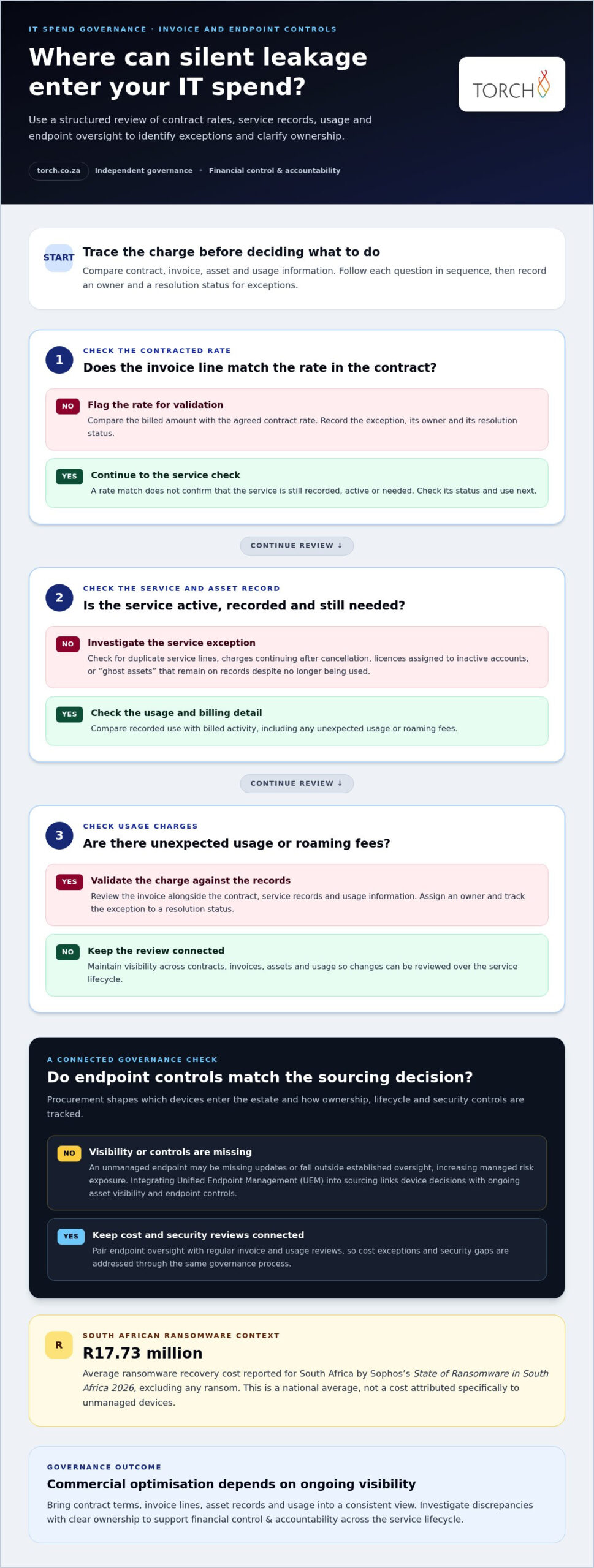
Common discrepancies to investigate include duplicate service lines, charges continuing after cancellation, incorrect rates against contracted terms, unexpected roaming or usage fees, and licences assigned to inactive accounts. Decentralised software purchasing can also leave teams paying for overlapping tools or “ghost assets” that remain on records despite no longer being used. Purpose-built BI models can bring contract, invoice, asset and usage information into a more consistent view, helping teams prioritise anomalies for validation. For example, compare invoice line items with contract rates and service records, then check whether any exceptions have a clear owner and resolution status.
Connect procurement controls to endpoint security
Procurement decisions shape which devices enter the estate and how their ownership, lifecycle and security controls are tracked. An unmanaged endpoint may be missing updates or fall outside established oversight, increasing managed risk exposure. The financial consequences of a cyber incident can be substantial: Sophos’s State of Ransomware in South Africa 2026 report puts the average ransomware recovery cost at over R17 million, excluding any ransom. This is a national average, not a cost attributed specifically to unmanaged devices.
Integrating Unified Endpoint Management into sourcing helps link device decisions with ongoing asset visibility and endpoint controls. Pair that discipline with regular invoice and usage reviews, so cost exceptions and security gaps are addressed through the same governance process. Clear ownership helps finance, procurement and IT teams follow through on exceptions and maintain visibility as the estate changes.
Navigating Market Benchmarking and Contractual Complexity
Contract negotiations are harder to assess when internal teams lack objective, carrier-agnostic comparison data. A quoted rate may appear competitive, yet its value depends on the full commercial picture: service requirements, usage patterns, contract terms and charges that appear after implementation. Comparing like with like gives procurement a stronger basis for questioning assumptions and evaluating trade-offs.
Scenario modelling is valuable before committing to a long-term RFP or agreement. Model different demand levels, service configurations and contract durations against the organisation’s actual requirements. This helps decision-makers see how terms may perform as usage changes, rather than judging an offer solely by its initial price. These are practical responses to the challenges in IT procurement and sourcing, where contract decisions must account for both present needs and ongoing financial control.
Use benchmarking to strengthen negotiations
TorchLight™ supports market benchmarking by giving internal teams an independent view of telecom costs and commercial terms. Rather than treating a “standard” rate as the natural ceiling, teams can assess whether pricing and services align with comparable requirements and their own usage evidence. Torch Services reports 27.5% savings through independent, carrier-agnostic negotiation. This is a reported outcome, not a guaranteed result for every organisation or estate.
Contract audits should also look for silent leakage, because billing or usage discrepancies can reveal where a contract’s expected value is being eroded in practice. That evidence helps procurement distinguish between a rate that needs renegotiation and a control issue that needs to be corrected.
Replace passive renewals with a roadmap
Evergreen clauses can extend agreements automatically unless notice is given within a specified period. If renewal dates and notice windows aren’t visible to the right teams, an organisation may lose the opportunity to review terms before another contract period begins. Loyalty can then become costly, not because a supplier relationship has no value, but because its commercial fit hasn’t been reassessed.
Build a renewal roadmap that records contract owners, notice deadlines, usage reviews and decision dates. Begin the review early enough to compare the existing arrangement with forecast requirements and consider alternative scenarios. Linking financial oversight to IT FinOps services can help connect contract decisions with ongoing budget monitoring, rather than treating renewal as an isolated procurement event.
Implementing a Governance-Led Framework for Sustainable Optimisation
Lasting commercial optimisation needs more than a dashboard that reports spend. It requires clear ownership, regular review and action when data points to a control gap. A joined-up governance approach connects FinOps, Telecom Expense Management (TEM) and Unified Endpoint Management (UEM), so financial oversight, telecom charges and endpoint controls inform one another. These capabilities can work alongside IT asset management and other relevant controls rather than operating as separate processes.
Reporting shows where attention may be needed. Embedded execution helps teams investigate exceptions, reconcile charges, update records and track whether corrective actions have been completed. That distinction matters: insight without follow-through can leave the same leakage in place month after month. A managed approach can also ease pressure on internal teams by supporting the operational work behind financial control and accountability.
This is the practical response to the challenges in IT procurement and sourcing: turn fragmented information into decisions, assign responsibility for acting on it, and measure whether the change has addressed the underlying issue. Torch reports more than R667.5M saved since 2004 across 12 African countries, reflecting work across the African market rather than a guaranteed outcome for any one organisation.
Make vendor accountability measurable
Contract governance is stronger when performance expectations are specific and reviewable. Procurement teams can define relevant service measures, reporting arrangements, escalation routes and remedies for agreed failures with legal and commercial stakeholders. Clear evidence requirements also help parties resolve billing or service disputes on facts rather than assumptions.
Independent governance gives the organisation an objective perspective when assessing supplier performance, including in carrier discussions. For ongoing budget oversight, IT FinOps support can help connect financial information with review and action. A disciplined framework doesn’t remove the need for internal decisions; it equips decision-makers to make them with better visibility and clearer accountability.
Make Governance the Next Procurement Decision
Treat oversight as part of the commercial decision, not an administrative task to revisit after contracts are signed. Assign clear ownership for spend, renewals and endpoint controls, then establish a review rhythm that turns exceptions into accountable action. This gives finance, procurement and IT a shared basis for decisions as services and business needs change.
The challenges in IT procurement and sourcing are complex, but progress can begin with a focused view of where visibility or accountability is weakest. Torch brings independent governance and more than 100 years of combined industry experience. Its risk-share model for Telecom Expense Management links fees to a percentage of verified savings, aligning the service with measurable commercial outcomes.
Start by identifying the governance gap with the greatest financial or operational impact, then decide who will own resolving it. Stronger controls can support both commercial optimisation and managed risk exposure.
With a clear starting point and the right accountability in place, your organisation can build a more confident, sustainable approach to technology spend.
Frequently Asked Questions
What are the most common challenges in IT procurement and sourcing for 2026?
Common challenges include limited visibility across cloud, software and mobile spending, disconnected asset records, complex supplier terms and pressure to justify technology budgets. A useful first step is to map each major service to its budget owner, business purpose and source of spend data. This exposes where finance, procurement and IT rely on different records, and helps prioritise the gaps that most affect decision-making.
How does silent leakage affect my IT budget?
It can make forecasts less reliable and leave less budget available for planned priorities. For example, if actual usage and invoiced charges aren’t compared with the relevant agreement, finance may allocate funds based on an incomplete view of recurring commitments. Over time, that weakens confidence in budget-to-actual reporting. Reviewing recurring spend by service, cost centre and owner helps reveal where forecasts need adjustment or further investigation.
Why should we use an independent advisor instead of our telecom carrier?
An independent advisor can assess charges and commercial terms from the organisation’s perspective, without being responsible for the carrier’s revenue. That separate viewpoint can help procurement prepare evidence for a discussion, such as comparing billed services with contract terms and internal usage records. The aim isn’t to assume a carrier is wrong, but to support a clear, evidence-based conversation and strengthen vendor accountability.
What is the difference between IT procurement and IT financial governance?
IT procurement covers the process of identifying a need, evaluating options, agreeing terms and acquiring a service or asset. IT financial governance provides ongoing oversight of the resulting commitments and spend. For example, procurement may approve a software subscription, while governance tracks its budget, ownership and financial performance after purchase. Connecting the two helps ensure that an approved decision remains visible and accountable as business needs change.
What did Torch’s analysis find about active management?
Torch reports 19.6% savings through active management, including ongoing adjustment of subscriptions. Practical steps include checking whether plans match current usage, removing services that are no longer needed, reviewing assignment records and investigating unusual charges. This is a reported outcome, not a guaranteed saving for every organisation. Results depend on the estate, available data and the changes identified through review.
What security risks are associated with poor IT asset procurement?
Poor asset procurement can leave the organisation with devices that lack clear ownership, consistent security requirements or a managed retirement process. A device that remains in use without appropriate oversight may expose business information if it’s lost, shared or no longer maintained. Include security and lifecycle requirements in purchasing decisions, record who is responsible for each endpoint, and ensure devices can be monitored and managed throughout their working life.