
Outsourcing IT expense management should never mean outsourcing accountability. For South African enterprises, outsourced IT expense management works when independent governance turns fragmented costs across vendors, users, devices and budgets into clear decisions and accountable action.
The challenge is familiar: internal teams spend valuable time reconciling expenditure, while reports flag variances without identifying who must resolve them. The answer is to define decision rights, ownership and oversight from the outset, keeping strategic accountability with the people who understand your business.
This guide explains how to assess an outsourced model, decide which activities belong with an external partner and which should remain internal, and establish practical controls for review and remediation. It also shows how financial oversight can support commercial optimisation, operational efficiency and managed risk exposure, including where IT asset and endpoint governance intersect with expenditure. The aim is to make sure visibility leads to action, not another report to reconcile.
Key Takeaways
- Treat outsourced IT expense management as a governance model, with clear financial control and accountability rather than a simple transfer of tasks.
- Build a repeatable process that moves from spend and asset information to variance analysis, assigned owners and tracked actions.
- Set the scope deliberately by identifying which spend categories, users, vendors and assets are covered.
- Keep recurring financial oversight distinct from one-off procurement and contract decisions, with decision rights defined for each.
- Assess how independent governance can connect financial visibility with commercial optimisation and managed risk exposure.
Why outsourced IT expense management is a governance decision, not just a resourcing choice
Technology expenditure can be spread across supplier invoices, individual usage, device and asset records, and budgets held by different teams. The organisation still needs a clear answer to a basic question: who is responsible for investigating a variance and deciding what happens next? Without that ownership, added capacity may shift tasks without improving financial control and accountability.
Outsourced IT expense management brings external expertise to spend visibility, analysis, independent governance and agreed operational work, within decision rights and oversight retained by the organisation. The distinction matters. Software can organise information, an approval workflow can route a request, and a report can identify an exception. None ensures by itself that someone investigates the cause, assigns an owner or follows through on an agreed response.
Which enterprise expense-management problems can outsourcing address?
Fragmented records make it harder to connect an invoice with who used a service, the asset it relates to and the budget that should carry the expense. Manual reconciliation can take time away from finance and technology teams who need to interpret trends, test assumptions and inform business decisions.
For example, a variance may appear in a report but remain unresolved if no team owns the investigation. An outsourced partner can support the agreed process for analysing it, recording its status and escalating decisions outside its authority. For telecom-related spend, Telecom Expense Management provides structured oversight of expenditure and usage.
What should remain under internal control?
External support should strengthen execution, not transfer enterprise authority. Leaders retain responsibility for budget approval, risk appetite, business priorities and material procurement decisions. They also remain accountable for organisational oversight and the outcomes of their decisions.
Define the boundaries in the governance model: what the partner may analyse or action, which exceptions need internal approval, who owns remediation and how unresolved matters are escalated. The outsourced partner then operates within that agreed remit. This adds execution capacity while internal leaders direct priorities and maintain oversight.
How outsourced IT expense management connects visibility, analysis, and action
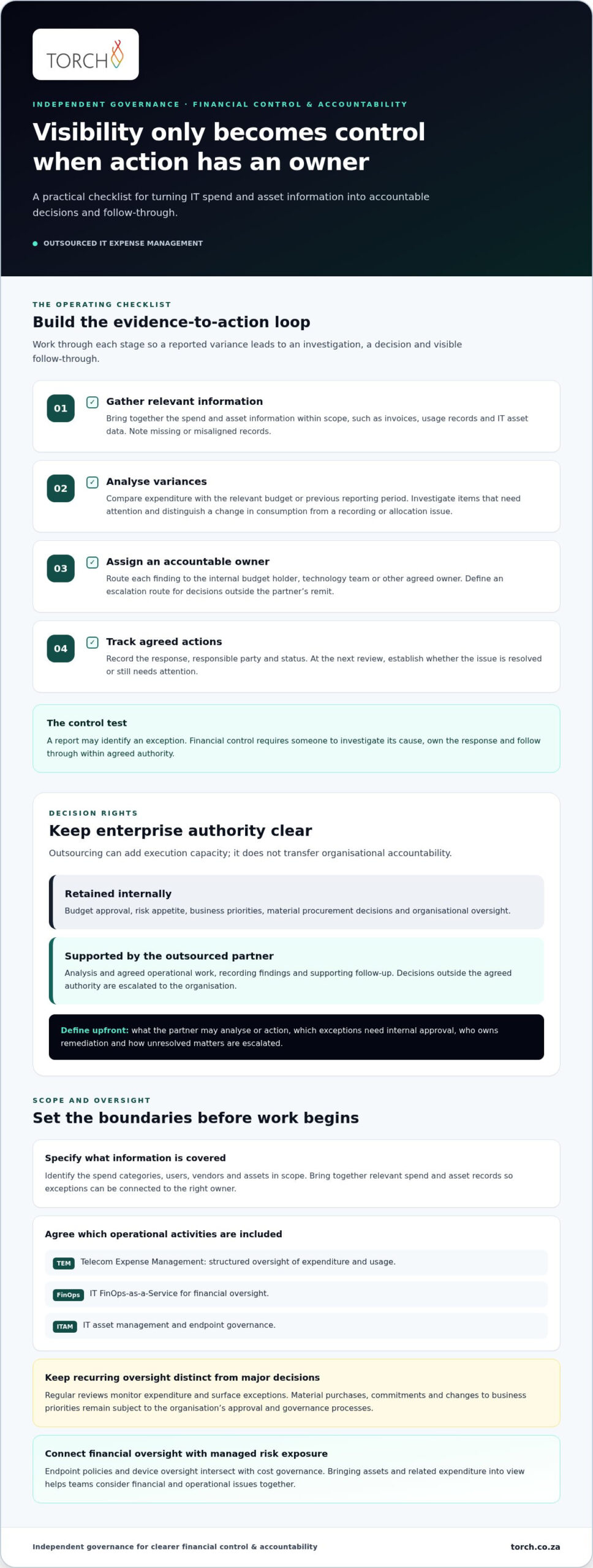
Visibility is the starting point, not the result. For outsourced IT expense management to support financial control, information must move through a defined process: from evidence to analysis, an accountable decision and follow-through. Without that final step, reporting may reveal a variance but leave its cause and resolution uncertain.
Visibility shows where expenditure sits; financial control requires an accountable owner to assess the insight and act within agreed authority.
- Gather relevant information. Bring together the spend and asset information within scope, such as invoices, usage records and IT asset data. Note where records are missing or do not align.
- Analyse variances. Compare expenditure with the relevant budget or previous reporting period, then identify items that need investigation. This can help distinguish a change in consumption from a recording or allocation issue.
- Assign an owner. Direct each finding to the internal budget holder, technology team or other agreed owner. Set an escalation route for decisions beyond the outsourced partner’s remit.
- Track agreed actions. Record the response, responsible party and status so the next review can establish whether the issue was resolved or still needs attention.
Recurring oversight is different from episodic procurement or contract decisions. Regular reviews help monitor expenditure and surface exceptions. Material purchases, commitments and changes to business priorities remain subject to the organisation’s approval and governance processes.
What work may sit within an outsourced IT expense-management scope?
Depending on the agreed scope, operational support may include Telecom Expense Management (TEM), IT FinOps-as-a-Service, IT asset management and endpoint governance. For example, a review might bring a device record and its associated expenditure into view, then route a discrepancy to the owner responsible for resolving it. The partner can analyse information and support agreed follow-up, while strategic approvals remain internal.
Endpoint policies and device oversight also connect cost governance with managed risk exposure. Bringing assets and related expenditure into view helps teams consider financial and operational issues together, rather than treating device oversight as separate from financial management.
How do platforms and managed services work together?
Tools make information available; managed work gives it a route to action. Spotlight provides real-time financial oversight. Purpose-built BI models deliver deep analytical insights, while PowerBI integration supplies real-time analytics for strategic decision-making. These capabilities can support a review process, but accountability still depends on clear owners and agreed follow-through. Torch’s IT FinOps-as-a-Service connects financial oversight with this governance approach. A governance review can help clarify how the workflow fits your enterprise’s oversight needs.
How to assess an outsourced IT expense-management model
Start with the decisions the model needs to support, not with a platform demonstration. For outsourced IT expense management, leaders should establish a baseline, define the work, retain clear decision rights and agree how findings will be reported and acted on. This creates a practical basis for evaluating governance fit and delivery.
- Establish the baseline. Map available expenditure, budget, user, vendor and asset information. Record gaps in data quality or ownership so they can be addressed as part of the model.
- Define the scope. Specify which spend categories, users, vendors and assets are included. Distinguish recurring oversight from project-specific or procurement work.
- Assign decision rights. Identify who can investigate and coordinate operational follow-up, and who retains authority for approvals, policy, risk decisions and business priorities.
- Set reporting needs. Agree what information each audience needs, how exceptions will be explained and where unresolved issues will be escalated.
- Review actions. Check whether findings have owners, decisions are recorded and follow-through is visible at subsequent reviews.
How should leaders define scope and accountability?
Separate financial oversight from operational areas such as telecom expense management, endpoint governance, IT assets and user support. Name internal owners for approvals, policy decisions, escalations and business priorities. Agree what the partner may handle independently within its approved remit. If telecom spend is in scope, Torch’s telecom expense management overview outlines relevant activities.
Assess independence, implementation fit and communication alongside the scope itself. The model should work with existing finance, IT and procurement responsibilities, and present reporting in language each team can use to make decisions.
What evidence shows that governance is working?
Look for a traceable line from expenditure information to analysis, an assigned owner, a decision and documented follow-through. Useful measures include whether budget information is available for review, how exceptions are handled, whether ownership is recorded and whether actions are completed or escalated. Choose measures that fit your baseline and governance needs rather than adopting unsupported targets.
Illustrative example, not a Torch benchmark: a report flags an unexpected charge, identifies the relevant budget owner, records the decision to investigate and tracks the agreed response. That evidence is more useful than a variance report with no clear next step.
How Torch supports outsourced IT expense management through independent governance
External support should provide more than another view of the numbers. Torch Services is an independent, carrier-agnostic governance partner, not a connectivity provider. It helps enterprises strengthen financial control and accountability by connecting analysis with agreed operational work, while strategic authority stays with the organisation.
What makes Torch’s approach governance-led?
Independent advice gives finance and technology leaders an additional perspective on expenditure, ownership and control deficiencies. Torch Services includes Telecom Expense Management, IT FinOps-as-a-Service, Unified Endpoint Security & Management, asset management, purpose-built BI models and automated user support. Together, they support oversight of telecom expenditure, technology finances, endpoints and assets.
The focus is practical follow-through, not a dashboard alone. Financial insights can inform decisions, while managed services support agreed operational execution and escalation. Torch’s approach is designed to turn insights into actionable results through independent governance and financial control.
Torch Services reports R667.5M+ saved since 2004 across 12 African countries. This is a company-wide proof point, not a forecast or a promised outcome for an individual enterprise. The relevance of a governance model depends on the organisation’s scope, baseline, priorities and agreed actions.
What is a practical next step for enterprise leaders?
CFOs, CIOs, finance leaders and procurement teams can clarify where external support fits their governance priorities. Start by identifying the expenditure and assets in scope, internal decision owners, reporting needs, escalation routes and how operational support should work alongside existing teams.
The purpose is to understand the organisation’s requirements and identify a suitable governance approach, not to promise a specific saving. Clear boundaries and shared expectations give internal leaders and an external partner a sound basis for accountability and commercial optimisation.
Make financial governance part of how the business moves forward
Strong financial governance should adapt as the enterprise changes. Revisit whether oversight still supports the organisation’s direction as technology use and business needs evolve.
This helps leaders make deliberate choices about where to focus attention and how to support sound commercial decisions. The goal is not to add process for its own sake, but to keep outsourced IT expense management aligned with the way the business operates.
If your finance, IT and procurement teams are considering their next steps, a focused conversation can clarify the priorities that matter most to your organisation.
A considered approach can help your organisation move forward with greater confidence.
Frequently Asked Questions
Is outsourced IT expense management suitable for a large enterprise?
It can be, particularly when an enterprise wants more consistent oversight across business units or operating entities. Start with a defined part of the estate, assess how the process fits existing workflows, then decide whether to extend it. This helps identify differences such as distinct cost-centre structures or reporting practices before setting a broader operating model.
Can an organisation outsource IT expense management without losing control?
Yes. Retain an internal record of approvals and material changes, including the rationale, approver and date, in line with existing processes. This allows leaders to review how decisions were reached, not just their current status. Agreeing how records are maintained and accessed also keeps outsourced work connected to internal assurance and finance practices.
How should a business compare outsourced IT expense management with software alone?
Compare the full operating effort behind each option. Consider who will maintain source information, manage user access, resolve data-quality issues and adapt reports as business structures change. Also consider how the organisation can retrieve and use its information as processes evolve. These questions distinguish a tool’s capabilities from the internal work needed to make them useful, without assuming either approach guarantees a particular financial result.
What information should a business prepare before discussing outsourced IT expense management?
Alongside relevant records, prepare a short guide to internal terminology: how teams define cost centres, users, assets and expense categories. Note the reporting calendar, the audiences for existing reports and any known limitations in source data. This helps prevent teams from interpreting the same field differently and keeps an initial discussion focused on practical requirements.
Does outsourced IT expense management include endpoint security?
Not by default. Distinguish oversight of device-related expenditure from the controls intended to protect devices and information. If endpoint security is in scope, define the endpoint objectives, policy ownership, exception handling and the teams responsible for security decisions. Torch’s Unified Endpoint Security & Management offering addresses endpoint management and security, while the organisation should align requirements with its internal security governance.
How can a business assess whether an outsourced IT expense-management engagement is working?
Check whether the agreed process remains usable as the organisation changes. Review whether new cost centres or business units appear in reporting, whether stakeholders can interpret the outputs and whether recurring data-quality issues are being identified. Feedback from the teams using the information can show when the engagement needs adjustment, even if its original measures remain unchanged.