
For Chief Financial Officers and Procurement Directors, the term “software asset management” often evokes images of IT teams creating complex inventories—spreadsheets filled with software versions and installation dates. Whilst technically accurate, this view misses the strategic imperative. A true software asset management framework is not a technical list; it is a financial governance discipline designed to eliminate silent financial leakage and provide defensible data for board-level reporting.
Without this framework, enterprises face uncontrolled spending, significant compliance risks, and a persistent “governance gap” between IT operations and financial oversight. This guide explains how to move beyond simple software tracking and build a robust framework that delivers total visibility, commercial optimisation, and sustainable control over your complex software estate.
The Governance Gap: Why Your Software Asset Management Framework Matters
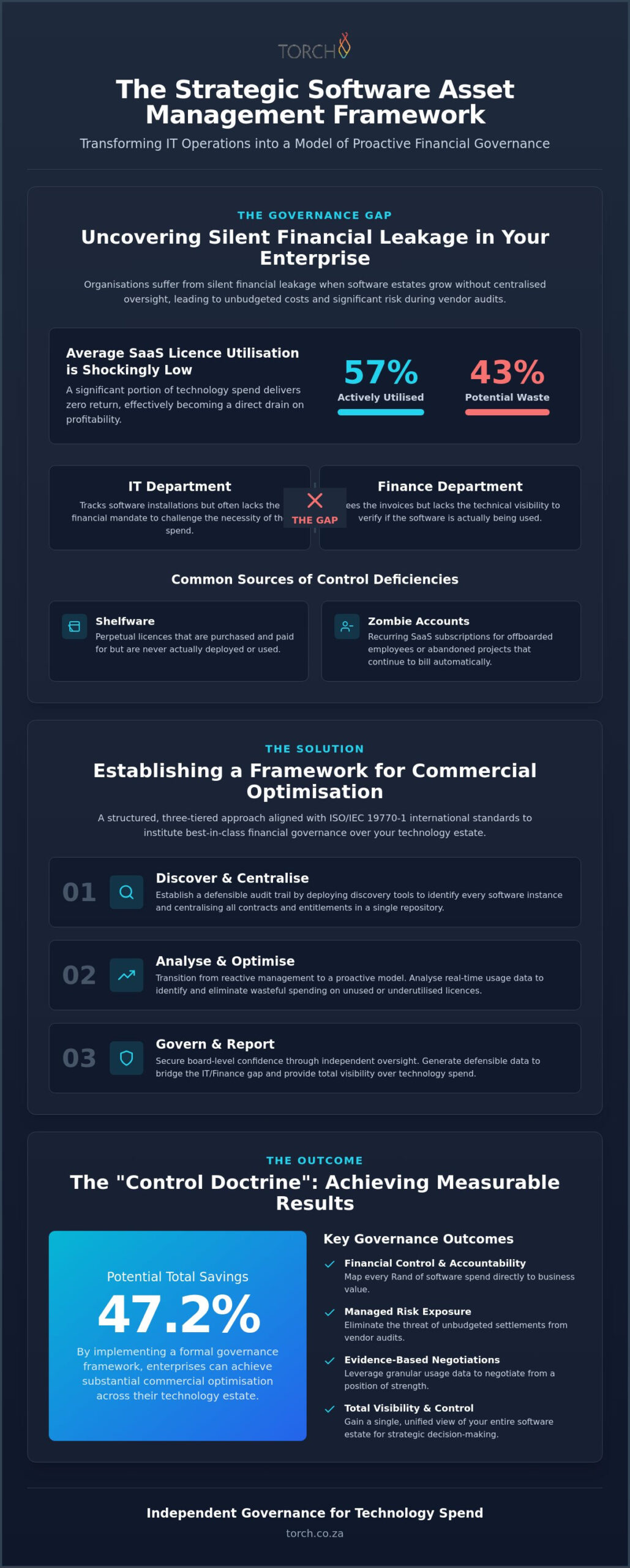
A software asset management framework is a structured set of policies, processes, and technologies for managing, controlling, and protecting an organisation’s software assets throughout their entire lifecycle. Its primary goal is to shift software management from a reactive, technical task into a proactive, strategic function of financial governance. When this function is absent, a critical governance gap emerges: IT teams may track what is installed, but the Finance department lacks the mandate and the data to challenge the commercial value or necessity of that spend.
The primary consequence of this gap is “silent financial leakage”—a continuous drain on resources caused by unmanaged and underutilised software. This includes:
- Unused Licences: Paying for software that is never deployed or is assigned to employees who no longer need it. Industry analysis consistently shows significant under-utilisation of SaaS licences in large enterprises.
- Redundant Applications: Multiple departments purchasing different software tools that serve the same function, leading to duplicated costs and data silos.
- Decentralised Purchasing: The rise of “shadow IT,” where individual business units procure their own software, has exacerbated the lack of central oversight, making it nearly impossible to track total spend with a single vendor.
A formal software licence compliance audit is a critical component of closing this gap. It provides an objective, data-driven baseline of what you own versus what you use, empowering financial leaders to make informed decisions rather than relying on departmental anecdotes.
The Financial Impact of Control Deficiencies
The absence of a robust SAM framework translates directly into financial unpredictability and waste. Unmanaged software estates lead to significant budget variances as unpredicted renewals and true-up costs from vendors appear without warning. This lack of foresight undermines financial planning and erodes trust in IT’s ability to manage its budget.
Two common sources of this waste are “shelfware” and “zombie accounts.” Shelfware refers to perpetual software licences that are purchased but never deployed, sitting unused on a digital shelf whilst their maintenance and support fees accumulate. In the SaaS world, the equivalent is the zombie account—active subscriptions assigned to former employees or automated systems that no longer exist. These accounts can trigger monthly recurring charges for years if not identified and decommissioned.
Beyond direct financial waste, these control deficiencies create significant operational risk. Unmanaged software and shadow IT often exist outside of standard patching and security protocols. This makes them prime targets for cyber-attacks, with unmanaged endpoints being a common entry point for ransomware. Effective software asset governance is therefore not just a financial discipline; it is a foundational component of a robust cybersecurity posture and a crucial element for achieving complete enterprise IT spend visibility.
Moving from Inventory to Independent Governance
Many organisations believe they have SAM covered because they use an IT asset management (ITAM) tool. However, ITAM is primarily focused on creating an inventory—tracking the location and configuration of assets. It answers the question, “What do we have and where is it?”
Strategic financial governance, by contrast, asks more critical commercial questions: “Are we paying the right price? Do we need this asset at all? Are we compliant with our contract terms?” This requires a shift in mindset, championed by the CFO, to establish independent oversight over technology contracts and vendor relationships. It’s about imposing financial rigour on IT procurement and management.
This governance-led approach is a core principle of the IT FinOps framework, which seeks to bring financial accountability and cloud-style economic thinking to all areas of IT spend. By treating SAM as a FinOps discipline, organisations can align technology expenditure with business value and ensure every pound spent on software is justified, optimised, and controlled.
Establishing a Framework for Commercial Optimisation
A successful software asset management framework is built on an architecture of financial, commercial, and operational control. It moves beyond simple compliance to actively pursue commercial optimisation, ensuring the organisation not only uses what it pays for but also pays a fair market price for it.
This is especially critical given the market’s shift from perpetual licensing to consumption-based SaaS and cloud models. Whilst offering flexibility, these models can introduce unpredictable costs and vendor lock-in if not governed effectively. A key function of the framework is to benchmark all commercial terms—from per-user pricing to contractual clauses—against independent market intelligence. This defensible financial data empowers procurement teams during vendor negotiations, transforming the conversation from a simple renewal to a strategic discussion about value and price.
Navigating Complex Software Licence Structures
Software vendors employ a bewildering array of licensing models, each with its own set of risks and compliance pitfalls. Common models include:
- Per-User: Seemingly simple, but complexities arise with different user types (e.g., full access vs. read-only) and shared accounts.
- Per-Core/Per-Processor: Common in data centre environments, where the cost is tied to the underlying hardware’s processing power. Virtualisation can make this incredibly complex to track accurately.
- Consumption-Based: Used in cloud and SaaS, where costs are tied to usage metrics like data storage, API calls, or compute hours. This model requires continuous monitoring to prevent runaway spend.
A particularly high-risk area is “indirect access,” where a third-party application accesses data within a large ERP system (like SAP or Oracle). Even if the user of the third-party app doesn’t have a direct ERP login, vendors may argue that this constitutes use and demand significant licensing fees. Having clear visibility into data flows and system integrations is essential to mitigate this financial exposure. This is where a comprehensive Unified Endpoint Management (UEM) solution provides the granular visibility needed to map software installations and usage back to specific users and devices, enabling accurate licence allocation.
Mapping Usage to Entitlement
The core of licence optimisation is the process of reconciling entitlements (what you have the right to use) with consumption (what you are actually using). This begins by reconciling all purchase orders, contracts, and invoices with the active software instances discovered on the network. The goal is to create a single, unified view of your effective licensing position.
Once this baseline is established, the focus shifts to usage optimisation. This involves analysing how employees interact with the software and matching subscription tiers to their actual roles and requirements. For example, a user who only needs to view reports in a CRM system does not require the expensive “enterprise” tier licence assigned to a power user. Downgrading or reallocating these licences can yield immediate and substantial savings; for more complex environments, SpendLens AI allows you to explore Tiered SaaS Subscription Fees to ensure that your AI and cloud services are correctly tiered for your needs.
Crucially, this process must hold vendors accountable. An independent governance partner ensures that the vendor’s interpretation of complex contract clauses is challenged and that the data used for reconciliation is objective and accurate, not skewed in the vendor’s favour.
How to Execute a Software Licence Optimisation Audit
A software licence optimisation audit is a systematic project to establish a baseline of control. It is not a purely technical exercise but a cross-functional initiative involving Finance, IT, and Procurement. Following a structured, five-step process ensures the audit delivers actionable, commercial outcomes rather than just a data report.
- Step 1: Centralise the Estate. The first step is to create a single source of truth for all software entitlements. This involves aggregating all contracts, purchase orders, renewal notices, and other procurement records into a central repository. Without this commercial foundation, any technical discovery is meaningless.
- Step 2: Deploy Discovery Tools. Next, deploy agent-based or agentless discovery tools to scan every endpoint on the network—servers, desktops, laptops, and virtual machines. The goal is to identify every active software instance, including version numbers and last-used dates.
- Step 3: Conduct a Variance Analysis. With both entitlement and consumption data collected, a variance analysis is performed. This reconciliation process compares what you own against what is deployed and used, identifying specific areas of over-licensing (waste) or under-licensing (compliance risk).
- Step 4: Remediate Control Deficiencies. Armed with defensible data, the team can now take action. Remediation involves harvesting unused licences from inactive users, uninstalling unauthorised software, downgrading users to lower-cost subscription tiers, and negotiating with vendors to right-size contracts based on actual consumption.
- Step 5: Implement a Continuous Governance Cycle. Finally, the audit findings are used to establish a continuous governance cycle. This involves implementing new policies for software requests, automating joiner/mover/leaver processes, and producing monthly reports for financial stakeholders to prevent the estate from drifting back into an unmanaged state.
Steps 1 & 2: Discovering the Reality of Your Estate
For the discovery phase to be effective, it must be carrier-agnostic and comprehensive. Relying on a single vendor’s tool will likely miss software from other publishers and fail to provide a true, holistic view of the estate. The process must also be designed to uncover “shadow IT”—software procured and installed by business units without central IT’s knowledge. Bringing these assets under central governance is crucial for both cost control and security.
Modern, automated discovery tools are essential for reducing the manual burden on already over-extended IT and Finance teams. They can perform in minutes what would take weeks of manual effort, providing accurate, near-real-time data on software installations across thousands of endpoints.
Steps 3 & 4: Reconciling and Remediating Waste
The variance analysis will inevitably uncover “over-licensed” scenarios where the business is paying for capacity it does not need. A common example is retaining a premium software subscription for an employee who has left the company or changed roles. Licence harvesting is the process of identifying these unused licences and reallocating them to new users, thereby avoiding the cost of a new purchase.
This phase requires robust tools and a clear process for taking action. The data from the audit provides the business case for remediation, whether it’s uninstalling unauthorised software or engaging a vendor to renegotiate a contract. Torch’s suite of Technology Solutions includes proprietary intelligence engines like TorchLight and SpotLight, which are purpose-built to accelerate this discovery and reconciliation phase.
Step 5: Ensuring Continuous Financial Control
A one-time, “point-in-time” audit is not enough in today’s dynamic IT environments, especially with the prevalence of SaaS. Employee roles change, projects start and end, and new applications are adopted monthly. Without continuous governance, any savings achieved through an audit will quickly be lost to operational drift.
The key to sustainability is establishing a rhythm of financial oversight. This often takes the form of monthly IT finance packs that provide stakeholders with clear, concise reports on software spend, utilisation, and compliance. This data is not just for historical reporting; it is a strategic asset for preparing for upcoming contract renegotiations, allowing procurement teams to enter discussions armed with months of accurate usage data.
Bridging the Gap with Independent Governance
Many organisations invest in SAM tools with the expectation that the software alone will solve their challenges. However, tools are only as effective as the governance framework they operate within. A dashboard that reports a compliance issue is useful, but it does not resolve the underlying vendor dispute or renegotiate the contract. This is where the limitations of a software-only approach become clear.
True control requires a combination of technology, deep domain expertise, and independent oversight. Just as specialised firefighter retirement planning addresses the unique financial needs of those in the fire service, Torch, as a Sage archetype, provides clarity and insight into complex software estates, drawing on decades of market intelligence and benchmarking data. As a Hero, Torch actively rescues budgets from silent financial leakage, holding vendors accountable and ensuring our clients only pay for what they need and use. This approach is grounded in the Torch Control Doctrine: Control is the only sustainable form of optimisation.
Independent Advisory vs. Vendor-Led Audits
When facing a compliance audit, many software vendors will offer to conduct the audit themselves, sometimes framing it as a helpful, no-cost service. This presents a fundamental conflict of interest. A vendor’s primary objective is to maximise its revenue, not to help you optimise your spend. Allowing a vendor to validate your compliance is like letting a fox guard the henhouse.
Independent governance ensures that your interests are the priority. An objective third party provides the commercial leverage needed to challenge a vendor’s interpretation of ambiguous contract terms and ensures that any settlement is fair and based on objective data. Independent benchmarking against market rates gives you the power to negotiate from a position of strength, not desperation.
The Torch Approach: Embedded Execution
Torch delivers more than just a report; we provide embedded execution. Our managed services model means our specialists become an extension of your team, operationally embedded to manage the day-to-day complexities of your software estate. We don’t just identify vendor billing errors on a dashboard—we engage the vendors and resolve the disputes on your behalf.
By bridging the structural gap between Finance and IT, we provide a single, accountable partner for technology financial governance. We centralise the data, enforce the policies, and drive the commercial optimisations that your internal teams are too over-extended to manage. The result is sustainable control, defensible financial data, and the elimination of wasteful technology spending.
Ready to transform your software asset management from a technical chore into a strategic financial advantage?
Book a 30-minute governance review with Derek King — no obligation, no sales pitch.
Frequently Asked Questions (FAQs)
What is a software asset management framework?
A software asset management (SAM) framework is a comprehensive system of policies, processes, and technology used to track, manage, and optimise an organisation’s software licences and subscriptions. Unlike basic IT inventory, a true framework integrates financial, contractual, and operational data to provide governance, control risk, and eliminate wasteful spending.
How does a software licence compliance audit reduce IT spend?
A software licence audit reduces IT spend by identifying discrepancies between the software licences an organisation owns and the software it actually uses. It uncovers “silent financial leakage” from unused software (shelfware), over-licensed users, and redundant applications. By remediating these issues—for example, by harvesting and reallocating licences—organisations can avoid new purchases and right-size vendor contracts, leading to direct cost savings.
What are the risks of a vendor-led software audit?
The primary risk of a vendor-led audit is the inherent conflict of interest. The vendor’s goal is to protect and increase its revenue, which can lead to aggressive interpretations of contract clauses, a focus on identifying non-compliance to generate penalties, and a lack of interest in finding optimisation opportunities for you. An independent audit ensures the process is objective and focused on your best interests.
How often should an enterprise perform a software self-audit?
Whilst a major, deep-dive audit may be conducted annually or biennially, the principles of SAM should be applied continuously. In a modern SaaS-driven environment, a “point-in-time” audit quickly becomes outdated. Best practice involves implementing a continuous governance cycle with monthly or quarterly reviews of spend, utilisation, and compliance to prevent operational drift and maintain control.
What is the difference between SAM tools and managed governance services?
SAM tools are software platforms that automate the discovery and inventory of software assets. They provide data. Managed governance services, like those offered by Torch, combine technology with human expertise and execution. A managed service provider interprets the data, manages vendor relationships, resolves disputes, drives contract negotiations, and embeds processes within your organisation to ensure sustainable control. The service provides the outcome, not just the dashboard.
How does IT FinOps improve software licence optimisation?
IT FinOps is a cultural and operational practice that brings financial accountability to technology spending. It improves software licence optimisation by treating software as a variable, value-driven expense rather than a fixed, uncontrollable cost. By applying FinOps principles, organisations continuously analyse software usage against business value, fostering collaboration between Finance, IT, and business units to ensure that every pound spent on software is necessary, efficient, and aligned with strategic goals.