
For South African enterprises, Information and Communications Technology (ICT) is the engine of growth. Yet for many CFOs and CIOs, it is also a source of uncontrolled expenditure and operational risk. Opaque carrier billing, complex multi-vendor contracts, and siloed data between IT and Finance create visibility gaps where millions of Rand are lost to waste and inefficiency. This guide provides a strategic framework for mastering telecom expense management South Africa for 2026, moving beyond simple invoice auditing to achieve total ICT governance.
The objective is no longer just to cut costs reactively. It is to gain proactive control over your entire technology landscape, align spend with business value, and fortify your organisation against both financial leakage and security threats. Here, we outline how to achieve this through a modern, data-driven approach.
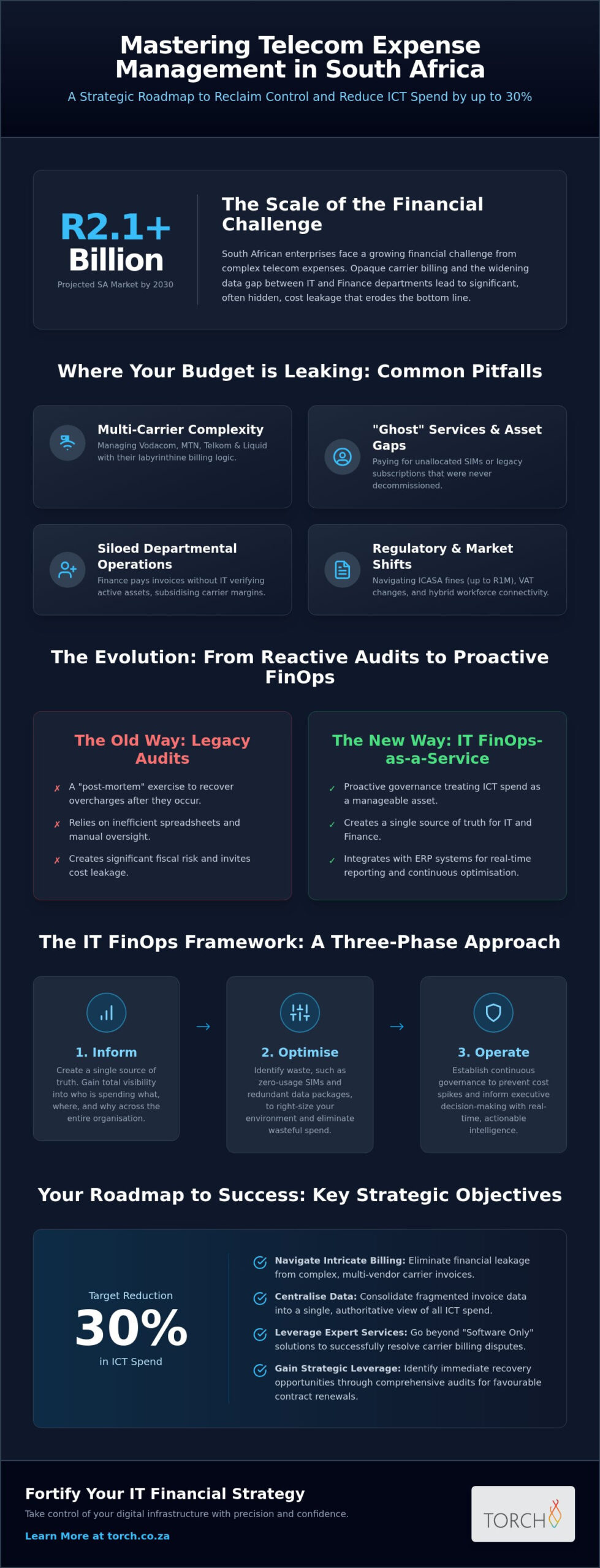
Navigating Telecom Expense Management in South Africa’s 2026 Landscape
The South African enterprise telecom market is a complex ecosystem. Managing a mix of services from major carriers like Vodacom, MTN, Telkom, and Liquid Intelligent Technologies—each with unique billing formats and contract structures—presents a significant administrative challenge. In an environment increasingly dominated by 5G connectivity and IoT deployments, traditional methods of manual auditing with spreadsheets are no longer viable. They are too slow, too prone to error, and incapable of providing the strategic insights needed for effective governance.
- Multi-Carrier Complexity: Juggling distinct contracts, billing cycles, and support channels for Vodacom, MTN, Telkom, and others creates data silos and prevents a unified view of total ICT spend.
- The Limits of Manual Auditing: With thousands of SIMs, IT assets, mobile devices, and cloud services, manual checks cannot scale. They miss nuanced billing errors and fail to provide the data needed for proactive optimisation in 5G and IoT-heavy environments.
- From Cost-Cutting to Governance: The focus must shift from chasing historical billing errors to implementing forward-looking policies that prevent overspending and align technology usage with corporate strategy.
- Regulatory Oversight: Evolving regulations from ICASA and compliance requirements under acts like POPIA add layers of complexity to contract transparency and data management, demanding a more structured approach.
The Cost of Visibility Gaps
Without a centralised, accurate view of your ICT landscape, financial leakage is inevitable. "Contract creep"- the gradual accumulation of unmanaged services, incorrect tariffs, and auto-renewing subscriptions, quietly erodes budgets. The problem is compounded by unallocated SIM cards, lost IT assets, and "ghost" services, where the organisation continues to pay for assets that are inactive or assigned to former employees. These issues represent a direct and preventable drain on resources. To close these gaps, Finance and IT departments must align their data and processes, creating a single source of truth for all technology assets and expenses.
Regulatory and Market Shifts
From Legacy Audits to IT FinOps: The Evolution of TEM
Historically, Telecom Expense Management (TEM) focused on auditing carrier invoices to find billing errors. While important, this is a reactive and limited view. The modern approach embeds TEM within the broader discipline of IT FinOps (Financial Operations). This evolution represents a fundamental shift from a tactical, cost-cutting activity to a strategic, value-driven practice. IT FinOps provides a cultural and operational framework for organisations to get the most business value out of their technology spend.
By converging asset management with expense management, enterprises can make data-driven decisions throughout the IT procurement lifecycle. This links the physical or digital asset directly to its financial impact, creating a clear line of sight between endpoint governance and financial accountability. When you know what you have, where it is, and how it is being used, you can control what you spend.
The FinOps Framework for Telecom
Applying the three core pillars of the FinOps framework—Inform, Optimise, and Operate—transforms telecom management from a clerical task into a strategic function.
- Inform: This is the foundation. It involves gaining complete visibility by consolidating all ICT spend data from every carrier and vendor into a single, accessible platform. This "single source of truth" allows for accurate reporting, showback, and chargeback. For maximum impact, IT FinOps platforms should integrate with corporate ERP systems to provide real-time financial reporting to business leaders.
- Optimise: With clear visibility, you can identify opportunities to reduce waste. This includes rightsizing data plans, eliminating unused services, negotiating better rates based on actual usage data, and enforcing usage policies.
- Operate: This pillar focuses on continuous improvement. It involves automating processes like invoice reconciliation, user recharges, and policy alerts. By embedding these automated controls into daily operations, the organisation builds a culture of financial accountability across its technology functions.
Asset Management and Security
Managed Services vs SaaS: Selecting the Right Strategic Partner
When implementing a TEM solution, organisations face a critical choice: license a Software-as-a-Service (SaaS) platform to manage in-house, or engage a managed services partner. While a SaaS tool provides the software, it often leaves the heavy lifting of data integration, carrier disputes, and strategic analysis to your internal teams. This is the "Software Only" trap, and it frequently fails in the complex South African market where deep local expertise is non-negotiable.
A managed service, by contrast, combines a powerful platform with a team of dedicated experts who handle the administrative burden. They manage carrier relationships, resolve billing disputes, and provide strategic recommendations. Crucially, a vendor-neutral managed services partner acts solely in your best interest. Because they are independent of ISPs and mobile carriers, their recommendations are driven by one goal: maximising your savings. When evaluating partners, assess their local presence, scalability, and independence to ensure they align with your long-term strategic objectives.
The Total Cost of Ownership (TCO) Comparison
A simple comparison of platform fees versus managed service costs can be misleading. A true Total Cost of Ownership (TCO) analysis must account for the internal resources required to operate a SaaS platform effectively. This includes the time your IT and finance staff spend learning the software, processing invoices, and disputing errors with carriers. A managed service offloads this entire operational overhead.
Furthermore, the return on investment (ROI) extends beyond direct cost savings. According to Torch’s 2026 White Paper, "Governed vs Unmanaged ," which analysed 71 months of South African financial-services billing data, a fully governed environment delivers average total savings of 47.2%. This figure is composed of 19.6% from active management (policy enforcement, optimisation) and an additional 27.5% from independent, data-driven contract negotiation. A managed service partner also mitigates risk by providing expert Service Level Agreement (SLA) enforcement, ensuring you receive the service levels you pay for.
South African Expertise Matters
Global TEM platforms often lack the nuance required to operate effectively in South Africa. Each local carrier has unique billing formats, complex dispute resolution processes, and specific contractual clauses. A partner with deep-rooted South African expertise and direct relationships with local telcos can navigate this landscape far more effectively. They understand the intricacies of local billing and have established channels for escalating and resolving issues quickly. This local knowledge also extends to customising Business Intelligence (BI) models to align with South African corporate tax structures and accounting standards, ensuring the data is not just accurate but also relevant and actionable for local financial reporting.
The Enterprise Roadmap: Uncovering Hidden Savings in ICT Spend
Achieving control over your ICT spend is a systematic process. This five-step roadmap provides a clear path from initial audit to a state of continuous, automated governance.
- Step 1: The ICT Audit. The first step is a comprehensive audit of your entire ICT environment. This diagnostic process identifies immediate recovery opportunities, such as billing errors and unused services, and benchmarks your current spending against optimised models.
- Step 2: Centralising Spend Data. Consolidate all invoices, contracts, and asset data from every provider into a single, unified platform. This breaks down data silos and creates the foundational visibility required for effective management.
- Step 3: Policy Enforcement. With clear data, you can establish and enforce corporate usage policies. This involves setting rules for data consumption, roaming, and application usage, with automated alerts to prevent cost overruns before they occur.
- Step 4: Continuous Optimisation. Governance is not a one-time event. Use purpose-built BI models and analytics to continuously analyse usage patterns, identify optimisation opportunities, and refine service tiers and contracts to align with changing business needs.
- Step 5: Operational Excellence. The final step is to fully integrate TEM into your monthly financial processes. Automate the reconciliation and recharge of costs to the correct cost centres or users, transforming a cumbersome manual task into a seamless, efficient workflow.
Auditing for Quick Wins
The initial audit phase almost always reveals immediate savings. The most common sources of waste are zero-usage SIMs, incorrect roaming charges, and mismatches between contracted services and billed services. For instance, one Torch client identified and deactivated 340 inactive SIMs in the first month alone. To identify "ghost" services, cross-reference your active employee directory and asset register against the carrier’s list of active services on your invoice. Any service not assigned to a current employee or a designated operational device is a candidate for immediate deactivation. The process of recovering these funds involves formally lodging disputes with carriers, backed by detailed evidence from the audit—a task best handled by an experienced partner.
Long-term Governance Strategies
Beyond the initial wins, long-term value comes from embedding governance into your operations. Automating user support for routine telecom queries (e.g., SIM swaps, tariff changes) frees up your internal IT team to focus on strategic initiatives. Using purpose-built BI models allows you to accurately forecast future technology spend, improving budget certainty. Finally, regular, automated auditing of your technology asset register ensures continuous compliance with both internal policies and external regulations, creating a resilient and efficient ICT environment.
Fortifying Your IT Financial Strategy with Torch Services
Standard TEM platforms provide data. Torch Services delivers outcomes. Our approach uncovers hidden savings that traditional software and manual processes miss because we combine a powerful asset management platform with expert, independent managed services. We tailor our IT FinOps-as-a-Service model specifically to the challenges and opportunities within the South African enterprise landscape. By integrating endpoint governance, security, and financial management, we help you achieve a state of total operational efficiency.
Our track record demonstrates the power of this approach. We have delivered R8.9 million in savings over 18 months for a major bank (SBSA-verified) and R38.4 million over 26 months for a leading insurer (PwC-audited). Our commitment is to manage Every User. Every Issue. Every Day.
Why African Enterprises Choose Torch
Our value proposition is built on three core pillars that differentiate us in the market:
- Independence and Objectivity: Torch Services is 100% carrier-agnostic. We take no commissions or incentives from any network operator or vendor. Our recommendations are driven by a single metric: what is best for our client’s bottom line. This makes us a true strategic partner, not just another supplier.
- Focus on Verifiable Outcomes: We don’t just provide dashboards; we deliver savings. With over R667.5 million in total client savings recovered since 2004 across 12 African countries, our focus is on tangible financial results and improved operational control.
- Deep Local Expertise: We have an unparalleled understanding of the local carrier landscape, billing systems, and regulatory environment. This on-the-ground knowledge allows us to resolve issues and negotiate contracts with a level of effectiveness that global providers cannot match.
Next Steps to Strategic ICT Control
Taking control of your technology spend begins with a single step. By initiating a professional ICT spend audit with the Torch team, you can gain immediate insight into your savings potential. We will guide you through the process of preparing your data for a seamless transition to a fully managed TEM model, putting you on the path to sustainable cost optimisation and strategic governance.
Organise a consultation with Torch Services to eliminate wasteful IT spending
Frequently Asked Questions
**What is the difference between TEM and IT FinOps?
**
Traditional Telecom Expense Management (TEM) is a subset of IT FinOps. TEM focuses specifically on managing the costs associated with telecommunications services (mobile, fixed-line). IT FinOps is a broader strategic framework and cultural practice that applies financial accountability to the entire cloud and IT spending ecosystem, bringing together technology, finance, and business teams to master the unit economics of technology for business advantage.
**How much can a South African business typically save through TEM?
**
The savings potential is significant. According to Torch’s 2026 White Paper, "Governed vs Unmanaged," an analysis of South African enterprise data showed that a governed environment with active management and independent negotiation delivers average total savings of 47.2% compared to an unmanaged one.
**Can Torch Services manage multiple carriers like Vodacom and MTN simultaneously?
**
Yes. A core strength of our service is consolidating data and managing relationships across all major South African carriers, including Vodacom, MTN, Telkom, and Liquid. We provide a single platform and a single point of contact for your entire multi-carrier telecom estate.
**How does automated user support improve IT operational efficiency?
**
Automated user support handles high-volume, low-complexity IT and telecom requests (like SIM swaps, password resets, or tariff queries) through a self-service portal or automated workflow. This frees up skilled internal IT personnel from routine administrative tasks, allowing them to focus on high-value strategic projects that drive the business forward.
**Is it better to use a global TEM platform or a local South African partner?
**
While global platforms can be powerful, a local partner with deep South African expertise is often more effective. Local partners understand the unique billing formats, dispute processes, and contractual nuances of carriers like Vodacom and MTN. This specialised knowledge leads to faster issue resolution and better negotiation outcomes.
**What are the most common billing errors found in South African telecom invoices?
**
The most frequent errors include charges for inactive or "ghost" SIMs, incorrect tariff plans being applied, inaccurate roaming charges, and failure to apply contractual discounts or credits. Mismatches between the services contracted and the services billed are also a common source of overspending.
**How long does it take to see a return on investment from TEM services?
**
A return on investment can often be seen within the first few months. The initial audit phase typically uncovers immediate savings ("quick wins") from deactivating unused services and correcting major billing errors, which can often offset the cost of the service very quickly.
**Does Torch Services handle fixed-line and cloud costs as well as mobile?
**
Yes. Our IT FinOps-as-a-Service model is designed to provide a unified view of all technology spend. We manage mobile, fixed-line, IoT, and cloud costs within a single governance framework, giving you complete visibility and control over your entire enterprise ICT landscape.