
Lower IT spend doesn’t start with a blanket budget cut. Effective technology budget optimisation techniques connect each investment to a business objective, expose avoidable costs and support regular spending reviews. The aim is to fund what the organisation needs, not simply spend less.
It’s reasonable to start with visible expenses such as hardware purchases and maintenance fees. But the full cost also includes downtime, urgent replacements and assets that are underused or poorly tracked. Cutting too quickly can create new costs, especially if it weakens security or disrupts essential work.
This guide explains IT spend optimisation and how to assess costs across technology assets. It also shows when maintaining, upgrading or extending a hardware or software lifecycle can make better commercial sense than replacing equipment or making indiscriminate cuts. The result is a more considered approach to technology budgets in South Africa, with clearer choices about where to control spending and where investment remains necessary.
Key Takeaways
- Connect each technology investment to a business goal, then use regular reviews to adjust forecasts as priorities change.
- Assess the full cost of hardware, including maintenance, downtime and urgent replacements, rather than focusing on purchase price alone.
- Compare the cost and operational risk of extending an asset’s lifecycle with replacing it; upgrades or repurposing may offer a better fit.
- Find waste in underused assets, overlapping tools and vendor arrangements before making cuts that could undermine performance or security.
- Use clearer asset and IT expense oversight to identify where specialist support could strengthen cost allocation and accountability.
1. What Is IT Spend Optimization?
IT spend optimisation is the disciplined process of aligning technology expenditure with business outcomes. For a South African organisation, that means forecasting costs in rand, checking investments against priorities and adjusting plans as needs change. Each budget line should support a defined outcome, such as secure remote work, reliable customer service or faster processing. If no team can explain its purpose, investigate before renewing or expanding it.
Start forecasting with current commitments, not last year’s totals alone. Record recurring subscriptions, hardware purchases, support agreements, cloud workloads and planned projects. Ask each budget owner to identify the business objective, expected timing and operational dependencies. This makes it easier to distinguish a necessary project from an unused licence or duplicated tool. Review actual spending against the forecast regularly, and update assumptions when workloads or priorities shift.
Cloud cost optimisation has no universal reduction target. Results depend on workload patterns, existing capacity and how closely resources match demand. Compare usage with provisioned capacity, right-size instances, scale resources as demand changes, and switch off idle non-production environments where appropriate. Track the cost and service impact of each adjustment before applying it more widely.
Cybersecurity deserves explicit budget priority. A low-cost plan can create greater financial exposure if it leaves critical systems or devices unmanaged. With 85% of ransomware incidents involving unmanaged devices, the link between cost and risk is direct. Map security investments to business risks, such as protecting customer information, controlling access and maintaining essential operations. Assess whether proposed spending strengthens prevention, monitoring or recovery. Automation can make routine controls more consistent, while security reviews help identify gaps before they become costly incidents.
South African budgets should account for applicable tax treatment, internal procurement approvals and exchange-rate exposure. These factors depend on the transaction, purchasing process and whether supplier charges are in rand or foreign currency. Ask finance and procurement teams to model the relevant treatment and approval path before committing funds. For foreign-currency subscriptions, forecast how exchange-rate movements could affect the rand amount at renewal instead of assuming today’s conversion will hold.
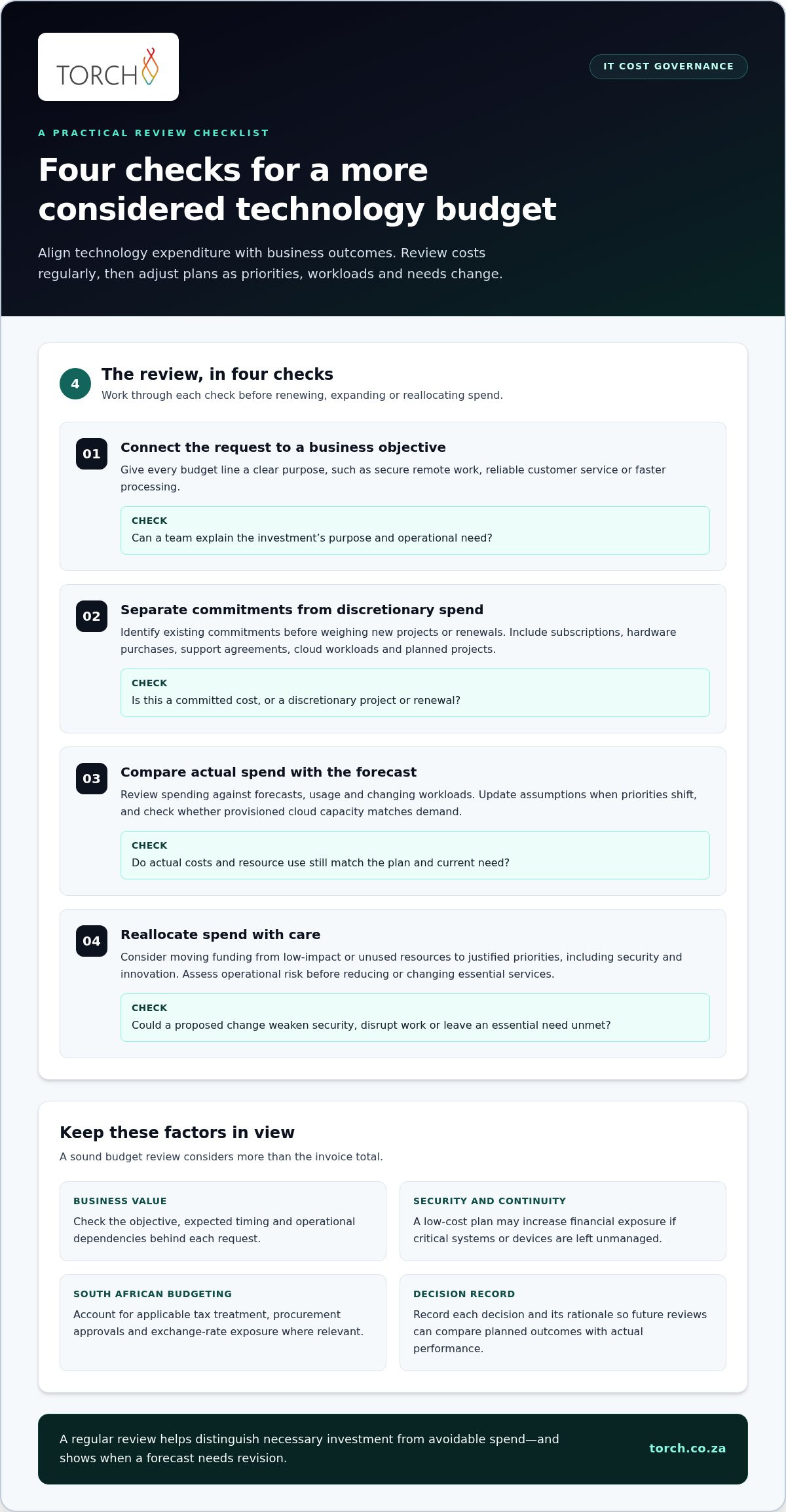
Use these technology budget optimisation techniques to rank investments by business value, risk and timing. A practical review can proceed in four steps:
- Link each request to a business objective or measurable operational need.
- Separate committed costs from discretionary projects and renewals.
- Compare actual spend with forecasts, usage and changing workloads.
- Reallocate funding from low-impact or unused resources to justified priorities, including security and innovation.
This approach makes budgeting an ongoing management process. It helps leaders explain why an investment remains necessary, where eliminating waste is appropriate and when a forecast needs revision. Record each decision and its rationale so future reviews can compare planned outcomes with actual performance.
2. Hardware costs, maintenance fees, downtime and urgent replacement parts
A hardware purchase is only one part of infrastructure cost. Record the purchase as capital expenditure (CAPEX), then include ongoing operating expenditure (OPEX), such as support, maintenance, power, software and connectivity. Direct costs attach to a device or contract; indirect costs include staff time spent troubleshooting and work delayed during outages. An urgent replacement, for example, can also require configuration, data transfer and extra support.
Build an asset-level view before approving replacements. Match each device to an owner, location, business purpose and support arrangement. Compare maintenance terms with manufacturer recommendations and consider the operational impact of failure. An older server supporting a critical workload may warrant planned maintenance; an unused device may be suitable for redeployment or retirement. This separates necessary investment from costs that persist simply because nobody reviewed them.
Software licences create a similar hidden-cost challenge. Compare assigned licences with actual use, and remove access when roles change or staff leave. Check whether teams have duplicate tools or tiers with overlapping features. For example, a department paying for advanced features it never uses could move to a more suitable tier at renewal. Review licence records alongside hardware and cloud usage, rather than treating each invoice as a separate issue.
Buy hardware when ownership, configuration and long-term use suit the organisation’s needs. Leasing or device-as-a-service can spread payments and support refresh planning, but compare the full contract cost, service scope, exit terms and end-of-term asset treatment before choosing. The right option depends on cash-flow priorities, usage stability, support requirements and the level of control needed over devices.
Cloud rightsizing aligns provisioned capacity with actual workloads, reducing spend on unused resources while protecting performance. Reserved instances may suit predictable, sustained workloads; scheduling can reduce charges by stopping non-production resources when teams don’t need them. Review workload patterns and service requirements before making changes, then monitor cost and performance together.
Before negotiating software, cloud, telecom and hardware contracts, consolidate usage and purchase records. Use them to challenge unused capacity, overlapping services, unclear charges and terms that no longer match requirements. Ask vendors to price the scope the organisation needs, then assess the full commercial terms, not just the headline rate.
- Separate purchase costs from maintenance, support and operating expenses.
- Link each asset to its owner, purpose and support arrangement.
- Use actual licence and workload activity to identify unused capacity.
- Compare downtime exposure and contract terms before changing maintenance or replacement plans.
A governance review can help organise these records into a clearer view of technology costs and contract commitments.
3. Extending hardware and software lifecycles
Replacement dates alone don’t show whether an asset remains useful. Assess condition, performance, security support and business dependency before setting retirement plans. A laptop that still meets a team’s requirements, for example, may remain in service after routine maintenance. A device that can’t receive essential security updates presents a different risk. Separate the decision to extend the life of useful equipment from the decision to accept unmanaged risk.
Use a lifecycle record to connect each device with its owner, purpose, location and support status. Compare actual performance with the requirements of the workloads it serves. A server running a stable internal application may be suitable for continued use, while one struggling with peak demand may need an upgrade or replacement. Document the reason for each decision so future reviews can distinguish strategic extensions from delays caused by missing information.
Software lifecycles need the same discipline. Track product versions, renewal dates, vendor support and dependencies between applications. Before extending a software contract, establish whether the current version receives required updates and remains compatible with connected systems. Review user activity and reclaim licences that are no longer needed. If a team uses only basic functions, compare its requirements with available licence tiers instead of renewing every licence unchanged.
Monitoring can reveal inefficiencies before they lead to an unnecessary purchase. Review device performance, recurring faults, storage pressure and service desk patterns alongside application usage. Repeated problems on one device type, for example, may indicate a configuration issue rather than the end of its useful life. Conversely, rising repair needs or unsupported software can make continued operation costly or unsafe. Use the evidence to choose between maintenance, upgrading, repurposing and replacement.
A practical lifecycle review can follow a consistent sequence:
- Confirm the asset’s owner, business purpose and workload.
- Check support status, security updates and compatibility.
- Compare performance and maintenance history with operational needs.
- Record whether to retain, upgrade, redeploy or retire the asset.
Apply the same review to shared platforms and software contracts. Map dependencies before consolidating tools, since removing one platform may affect workflows elsewhere. ISO/IEC 19770 and ITIL 4 can serve as references when shaping asset and service management practices. For example, a business can use its asset records to plan procurement, track lifecycle changes and document decommissioning. This creates a clearer basis for deciding which investments support ongoing operations and which can be deferred without compromising security or service delivery.
4. Spend optimisation versus cost cutting
cost cutting asks where expenditure can be removed; spend optimisation asks what each rand delivers. The distinction matters when a blanket reduction affects systems that support customer service, security or essential workloads. A stronger approach assesses each expense against business value, operating risk and performance, then redirects funding from low-impact areas to justified priorities.
Start with a decision, not a percentage target. For each technology expense, record its purpose, users, operational dependency and expected outcome. For example, if two teams use overlapping software platforms, compare their functions and service needs before deciding whether to consolidate. Removing a subscription may save money, but only if the remaining platform supports the work without creating new inefficiencies.
Measure the effect of a proposed change before treating it as a saving. Compare the current baseline with expected and actual outcomes, using relevant indicators such as expenditure, return on investment, system uptime and performance. If reducing support expenditure leads to longer disruptions, the apparent saving may shift costs into lost productivity. Keep the original objective in view, so efficiency is assessed alongside service quality and managed risk.
Some practices create lasting savings by simplifying the technology estate. Consolidate tools with overlapping features where teams can work effectively on a common platform. Review cloud capacity against workloads and reduce resources that remain idle. Examine vendor contracts at renewal to ensure scope, usage and terms still match business requirements. Give each change an accountable owner and a review point.
Cost cutting can weaken security if it removes controls without assessing exposure. Before reducing security or support investment, identify the systems, data and users affected. Consider whether a lower-cost configuration maintains appropriate protection and operational coverage. If a change increases exposure, compare that risk with the proposed saving and document the decision for future budget reviews.
Use a simple comparison to distinguish optimisation from indiscriminate reductions:
- Purpose: retain funding for investments tied to a business outcome.
- Evidence: use usage, contract and performance records to identify waste.
- Trade-off: assess service, security and productivity impacts alongside savings.
- Follow-through: monitor results and adjust the change if performance declines.
In practice, prioritise changes that streamline delivery without undermining essential outcomes. If an unused tool can be removed safely, eliminate its spend. If a system supports a critical workload, improve how it is used before cutting its budget. This disciplined approach makes savings a way to fund higher-value initiatives, rather than an end in themselves.
Torch Services: Telecom Expense Management
Torch provides Telecom Expense Management as an independent advisory partner to help organisations govern telecom expenditure. Torch is carrier-agnostic and vendor-neutral, with no carrier commissions. The business has operated in South Africa for over 20 years and reports R667.5M+ saved since 2004 across 12 African countries.
Torch’s ITAM service maintains an asset register, assigns assets to cost centres and tracks their lifecycle from procurement to decommissioning. As an advisory partner, Torch helps organisations bring IT asset management, Unified Endpoint Security & Management and IT FinOps-as-a-Service together, with assets linked to owners and cost centres. Boost provides automated user support for routine requests.
Contact Torch Services to discuss how its services can support your technology cost governance priorities.
Turn budget decisions into an ongoing discipline
Make technology spending decisions part of routine operational governance. Assign an accountable owner to each major cost area, record the rationale for significant changes and agree how teams will report exceptions. This creates a useful decision trail when priorities shift, contracts come up for renewal or an investment needs reassessment.
Apply technology budget optimisation techniques as a repeatable management practice, not a one-off exercise. Bring technology, procurement and finance perspectives into the same discussion so changes reflect operational needs as well as budget expectations. Clear ownership helps leaders distinguish a genuine control issue from a necessary investment and gives teams a practical basis for action.
A considered next step can turn budget visibility into better decisions over time. With clear ownership and an agreed review process, your organisation can strengthen oversight while keeping technology aligned with the work it needs to support.
Frequently Asked Questions
What Is IT Spend Optimisation?
IT spend optimisation is the ongoing governance of technology expenditure, keeping it aligned with organisational needs. It includes deciding who can approve purchases, how renewals are reviewed and when an existing investment should be reassessed. For example, a project sponsor can document expected benefits before approval, then compare them with actual results after implementation. This creates a decision record that supports future planning and clarifies responsibility.
What are the challenges facing IT budget optimisation?
Common challenges include fragmented ownership, incomplete records and commitments spread across departments. One team might pay for a cloud service that another uses, while neither oversees it. Staff changes can also leave subscriptions active without a clear owner. Named budget owners and a shared record of contracts, renewals and business dependencies help expose these gaps and coordinate decisions across finance, procurement and IT.
What are the best technology budget optimisation techniques for businesses?
Effective methods begin with clear decision rights and consistent evidence. Assign an owner to each major technology category, set approval criteria for new commitments and schedule renewal decisions early enough for careful review. A project request, for example, can identify its sponsor, intended users, dependencies and success measure. This gives approvers a consistent basis for comparing proposals and helps prevent urgent renewals from bypassing normal oversight.
How can organisations audit IT spending and identify unused software licences?
Combine procurement records, supplier invoices, identity records and software usage reports in a single review. Match each licence to a named user, department and current role, then investigate accounts with no recent activity or unclear ownership. Confirm that apparent inactivity doesn’t reflect seasonal work or approved leave before reallocating access. Record each cancellation or reassignment with its approval and effective date to create a traceable basis for later reviews.
What steps can businesses use to build an IT budget and forecast technology costs?
Build the forecast from a documented register of assumptions. Include renewal dates, planned projects, staffing changes, supplier pricing terms and dependencies that could affect timing. Separate committed expenditure from proposals, then prepare scenarios for changes such as delayed hiring or a project moving into another quarter. Assign an owner to each assumption and update it when circumstances change. This makes forecast movements explainable instead of leaving differences unexplained at year-end.
How can organisations measure technology budget savings and ROI?
Set a baseline before changing a service or contract, including its full operating cost and relevant performance measures. After implementation, compare actual expenditure with that baseline and account for transition, support and ongoing costs. Assess return on investment against the intended business benefit, such as improved process capacity or fewer service interruptions. Track service quality alongside savings so a lower invoice isn’t treated as success if operational outcomes deteriorate.