
For Chief Financial Officers and IT leaders across Africa, the monthly telecom invoice represents a significant and often opaque operational expense. Buried within thousands of line items are the subtle but persistent financial drains of unverified contracts, dormant connections, and misaligned tariffs—a phenomenon known as “silent leakage.” Whilst many enterprises believe their carrier-provided dashboards offer sufficient oversight, these tools rarely provide the independent validation required to identify systemic overspending.
A telecom expense management audit is not merely a search for billing errors; it is a rigorous diagnostic of your organisation’s financial governance maturity. It moves beyond reactive bill-checking to establish a framework of control, accountability, and sustainable optimisation. This checklist provides a structured approach to uncovering hidden costs, strengthening commercial leverage, and aligning your telecom estate with strategic financial objectives for 2026 and beyond.
The Anatomy of Silent Leakage in Enterprise Telecom
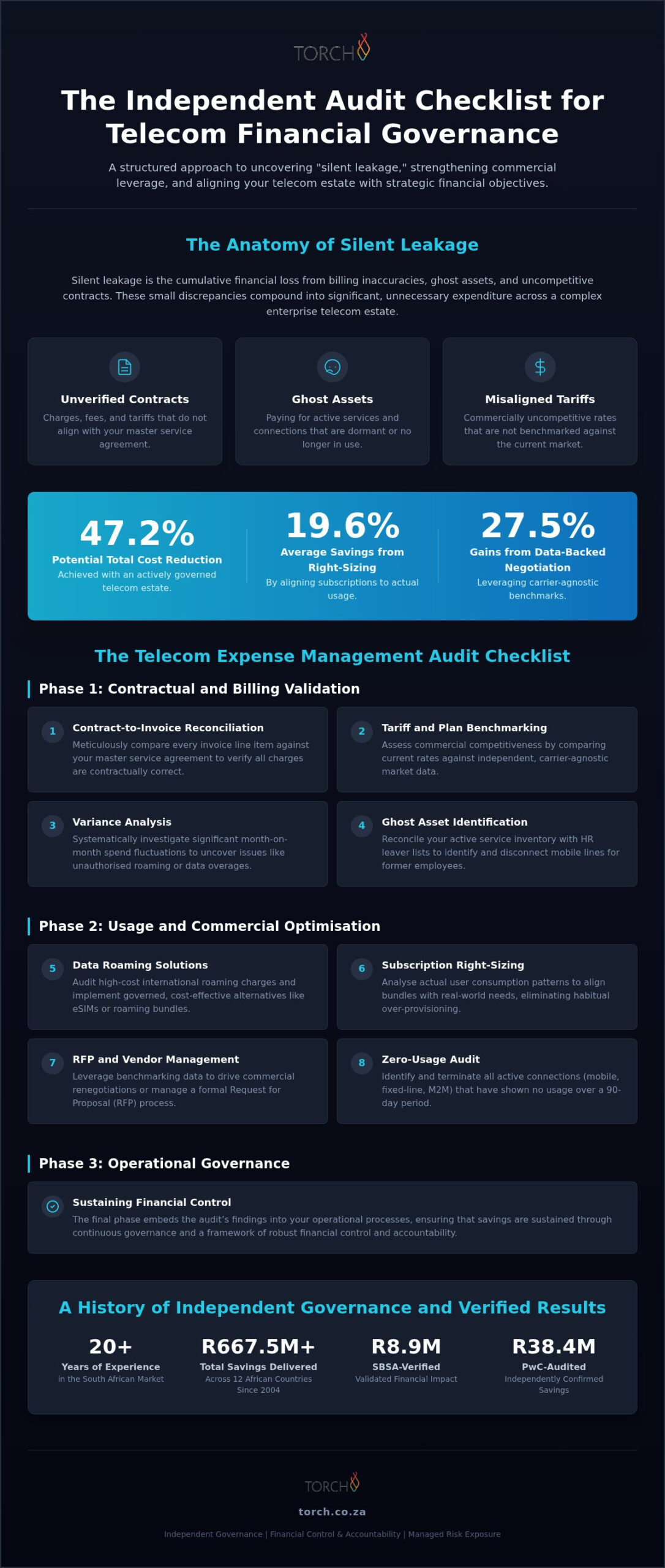
Silent leakage is the cumulative financial loss resulting from billing inaccuracies, ghost assets, and commercially uncompetitive contracts that go unchallenged. In a complex enterprise environment with multiple vendors, thousands of endpoints, and operations spanning the African continent, these small discrepancies compound into significant, unnecessary expenditure. Carrier-provided dashboards, while useful for surface-level reporting, are insufficient for true governance. They report on what you have spent but cannot independently validate whether that spend is contractually compliant or commercially optimal.
To achieve genuine financial control, an organisation needs a carrier-agnostic benchmark—an objective measure of market-related pricing and service levels. This independent oversight is a powerful lever to transform your telecom estate from a reactive cost centre into a strategically managed asset.
Why Internal Audits Often Fail to Capture Savings
Many organisations attempt to manage telecom expenses internally, but these efforts often fall short for several structural reasons. Firstly, relying on a carrier to audit their own revenue creates an inherent conflict of interest. Secondly, the sheer volume of data makes manual invoice matching an unsustainable burden on already overstretched IT and Finance teams, leaving little time for strategic analysis. Finally, internal teams lack access to the proprietary competitive intelligence needed to confidently renegotiate contracts. Without a real-time view of market rates, like that provided by Torch’s TorchLight™ engine, they are negotiating from a position of weakness.
The Financial Impact of Unmanaged Estates
The financial stakes are substantial. Our analysis, based on over 20 years of experience in the South African market, shows that actively governed telecom estates can achieve up to 47.2% in total cost reduction compared to their unmanaged counterparts. This is not a one-time saving but the result of sustained financial discipline. For instance, the continuous process of adjusting subscriptions to match actual usage consistently delivers 19.6% in savings alone. By implementing a robust IT FinOps framework, organisations can restore board-level confidence that every Rand spent on technology is validated, optimised, and accounted for.
The 10-Point Telecom Expense Management Audit Checklist
A comprehensive telecom expense management audit provides a structured framework for a complete review of your estate. Its goal is to establish a “Single Source of Truth” for all assets, contracts, and connections, enabling sustainable optimisation through commercial renegotiation and usage alignment rather than relying on sporadic, one-time fixes.
This checklist is organised into three distinct phases, moving from foundational validation to strategic optimisation and ongoing governance.
Phase 1: Contractual and Billing Validation
This initial phase focuses on establishing a baseline of truth by ensuring that what you are being billed for aligns perfectly with what you agreed to pay.
- Contract-to-Invoice Reconciliation: The foundational step is to meticulously compare every line item on every invoice against your master service agreement (MSA). This process verifies that all charges, fees, and tariffs are contractually correct.
- Tariff and Plan Benchmarking: Once contractual compliance is confirmed, the next step is to assess commercial competitiveness. Compare your current rates for voice, data, and fixed-line services against independent, carrier-agnostic market data to identify opportunities for renegotiation.
- Variance Analysis: Systematically identify and investigate significant month-on-month fluctuations in spend. This forensic analysis can uncover issues such as unauthorised international roaming, data overages, or newly activated services that fall outside of policy.
- Ghost Asset Identification: A common source of leakage is paying for services that are no longer in use. This audit point involves reconciling your active service inventory with your HR leaver lists to identify and disconnect mobile lines for employees who have left the organisation.
Phase 2: Usage and Commercial Optimisation
With a validated baseline, the focus shifts to optimising how services are consumed and leveraging data-driven insights to improve your commercial position.
- Data Roaming Solutions: Audit high-cost international roaming charges across the user base. Identify frequent travellers and implement governed, cost-effective alternatives such as eSIMs or specialised roaming bundles to prevent bill shock.
- Subscription Right-Sizing: Analyse actual user consumption patterns for voice and data. Aligning bundles with real-world needs to eliminate habitual over-provisioning is a powerful lever, consistently delivering an average of 19.6% in savings.
- RFP and Vendor Management: Leverage carrier-agnostic benchmarking data to drive commercial renegotiations or manage a formal Request for Proposal (RFP) process. A data-backed negotiation strategy can yield gains of up to 27.5%.
- Zero-Usage Audit: Identify and terminate all active connections—mobile, fixed-line, or M2M—that have shown no usage over a defined period (typically 90 days) but continue to incur monthly rental fees.
Phase 3: Operational Governance
The final phase embeds the audit’s findings into your operational processes, ensuring that savings are sustained through ongoing control and accountability.
- Cost-Centre Allocation: Automate the allocation of every Rand of telecom spend to the correct department, project, or individual. Platforms like SpotLight™ provide the visibility needed to make every business unit accountable for its consumption.
- Policy Compliance: Audit the entire estate against your corporate mobility, BYOD (Bring Your Own Device), and acceptable use policies. This ensures that device procurement, usage, and security protocols are being consistently enforced.
Beyond Billing: Integrating Endpoint Security into Your Audit
A telecom audit that focuses solely on billing is incomplete. The devices generating those costs represent a significant security risk if left unmanaged. An effective governance framework must therefore integrate financial oversight with robust endpoint security, arguing that you cannot truly control the cost of an asset if you cannot control the asset itself. Unified Endpoint Management (UEM) serves as a critical pillar of both financial and security control.
Unmanaged mobile devices create “shadow IT” vulnerabilities and costs. Without central oversight, these endpoints become potential entry points for cyber threats, turning a simple mobile phone into a significant liability. Mitigating ransomware risk is a direct and measurable financial byproduct of rigorous asset governance.
The R18 Million Risk: Ransomware and Unmanaged Endpoints
The threat is not abstract; it carries a quantifiable financial risk. According to industry data, 85% of ransomware entry points originate from unmanaged devices. When a single data breach in South Africa can cost an average of R49 million, the investment in proactive endpoint governance becomes a clear strategic imperative. A UEM platform enforces policy compliance, ensures all devices are patched and secure, and provides critical capabilities like remote-wipe for lost or stolen company phones, directly reducing your organisation’s attack surface.
Cradle-to-Grave Asset Governance
True financial control requires managing the entire lifecycle of a corporate device, from procurement and deployment to secure retirement and disposal. This “cradle-to-grave” approach ensures that every asset is tracked, secured, and accounted for throughout its operational life. Modern solutions like zero-touch deployment enable IT teams to configure and ship devices directly to a hybrid workforce without manual intervention, ensuring they are secure and policy-compliant from the moment they are switched on. This direct link between asset tracking and financial management is essential for eliminating the “phantom” expenses associated with lost, stolen, or retired devices that remain on the billing cycle.
Sustainable Optimisation: Executing the Audit with FinOps-as-a-Service
The 10-point checklist defines *what* needs to be done, but the challenge for most enterprises is *how* to execute it consistently. This is where a managed service model provides the necessary expertise, technology, and resources. Instead of a one-off audit, Torch provides a continuous governance framework built on our Six Integrated Service Lines, which combine FinOps, TEM, and UEM into a single, cohesive programme.
This integrated approach relieves the burden on your internal IT and Finance teams, moving them from low-value administrative tasks to high-value strategic oversight. Furthermore, our risk-share pricing model for many TEM services ensures our incentives are directly aligned with yours—we only succeed when we deliver verified, sustainable savings to your bottom line.
The Role of Proprietary Intelligence: TorchLight™ and SpotLight™
Effective governance depends on superior data. Our proprietary technology platforms provide the intelligence that internal teams cannot access. TorchLight™, our competitive intelligence engine, delivers the market benchmarking and scenario modelling required to achieve an average of 27.5% in negotiation gains. It allows you to enter vendor discussions with full knowledge of what constitutes a fair market rate. Simultaneously, our SpotLight™ platform provides CFOs and business unit leaders with real-time, granular visibility into their technology spend, offering budget-vs-actual oversight and automated cost-centre allocation. This ecosystem is further supported by Boost™, our automated user support tool, which reduces administrative overhead by empowering employees to manage common requests themselves.
Next Steps: From Audit to Governance
Executing this checklist is the first step toward transforming your telecom estate from an unmanaged liability into a governed, optimised, and secure asset. With a track record of saving enterprises over R667.5M across Africa since 2004, our governance-led methodology is proven to deliver structural control and lasting financial benefits. The journey begins with understanding your organisation’s current control deficiencies and building a roadmap for mature financial governance.
To begin identifying your organisation’s most significant governance gaps, we invite you to book a 30-minute governance review with our CEO, Derek King. This no-obligation session is designed to provide immediate insight into your potential for optimisation.
Frequently Asked Questions
How much can a telecom expense management audit typically save my business?
Whilst every estate is different, our data shows that actively governed enterprises achieve up to 47.2% in total cost reduction. These savings are driven by a combination of contract renegotiation (27.5% gains), continuous subscription right-sizing (19.6% savings), and the elimination of billing errors and ghost assets.
Why should we use an independent advisor instead of our carrier’s reporting tools?
Carriers have a vested interest in maintaining their revenue and cannot provide objective, independent validation of their own billing. An independent advisor like Torch works exclusively for you, using proprietary market intelligence to ensure your contracts are competitive and your invoices are accurate, free from any conflict of interest.
How often should a large enterprise conduct a telecom audit?
A one-time audit can deliver initial savings, but the market, your contracts, and your user needs are constantly changing. We recommend a continuous governance model where auditing and optimisation are ongoing monthly disciplines, ensuring that savings are sustained and new leakages are prevented before they escalate.
What is the difference between a one-time audit and FinOps-as-a-Service?
A one-time audit is a project with a defined start and end, focused on finding historical errors and immediate savings. FinOps-as-a-Service is an ongoing managed service that embeds financial discipline into your daily operations. It includes continuous auditing, budgeting, forecasting, variance analysis, and vendor management to ensure sustained financial control.
How do unmanaged mobile devices increase our ransomware risk?
Unmanaged devices often lack the latest security patches, are not configured to corporate security standards, and may have unauthorised applications installed. This makes them easy targets for attackers. With 85% of ransomware attacks originating at the endpoint, an unmanaged device is a significant and unnecessary security vulnerability.
Can Torch help manage telecom estates across multiple African countries?
Yes. With over 20 years of experience and a track record of delivering over R667.5M in verified savings, Torch has deep expertise in managing complex, multi-vendor telecom estates across 12 different African countries. We understand the unique regulatory and commercial challenges of the region.