
For South African enterprises planning for 2026, the term ‘IT managed services’ is undergoing a fundamental redefinition. The traditional model, focused on reactive support and infrastructure uptime, is no longer sufficient to address the complex commercial and security challenges of the modern technology estate. Today, leadership teams are grappling with sprawling hybrid workforces, silent financial leakage in procurement, and the persistent threat of ransomware originating from unmanaged endpoints. In this environment, the conversation must shift from technical availability to strategic governance.
This analysis explores the evolution of managed IT governance services in South Africa, moving beyond the break-fix helpdesk to a discipline rooted in financial accountability, operational control, and commercial optimisation. We will examine why CFOs, CIOs, and procurement directors are now seeking partners who can provide not just support, but sovereign, independent oversight of their entire technology lifecycle.
The Shift in IT Managed Services: From Support to Governance
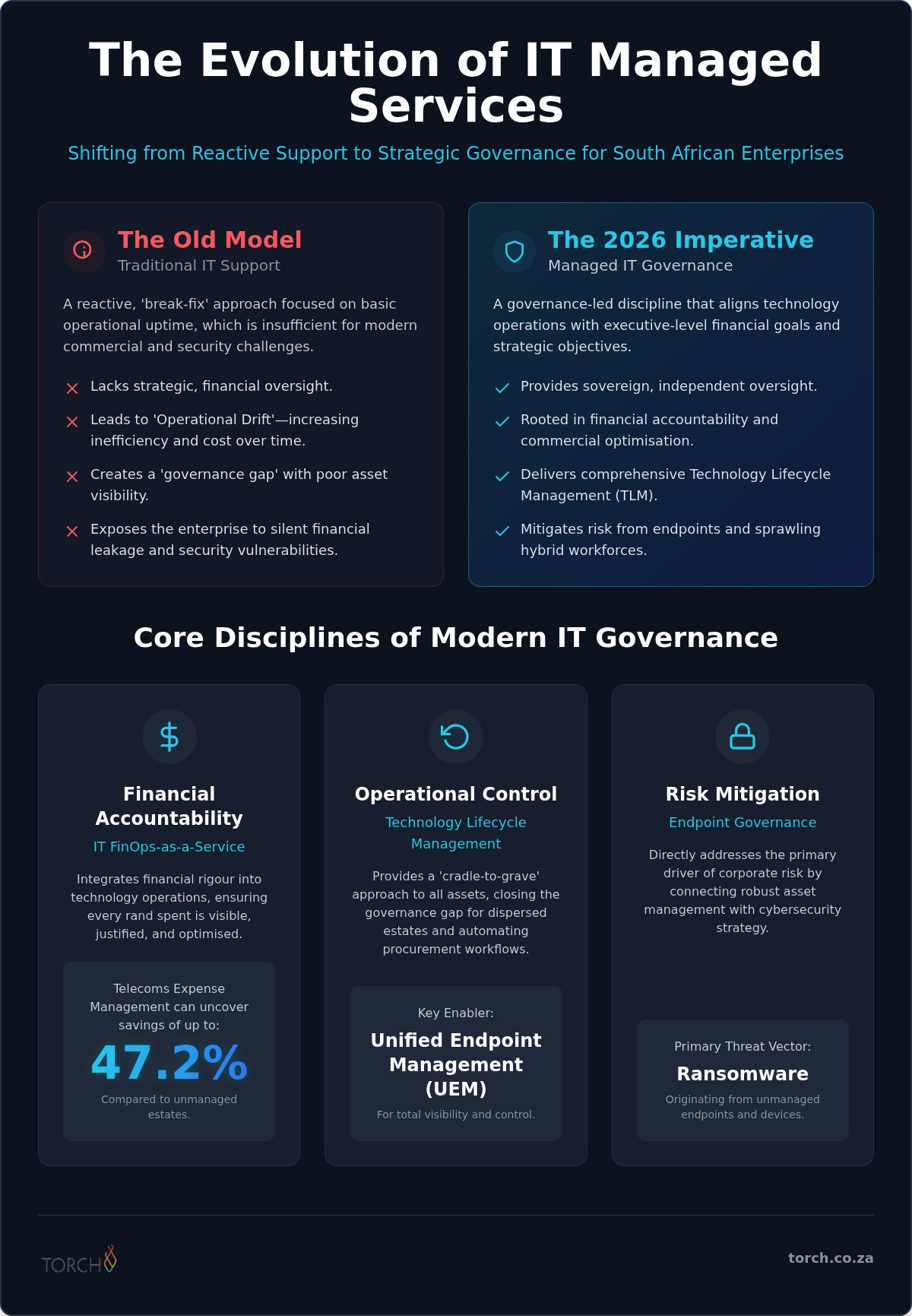
In the 2026 South African context, IT managed services are best defined as a governance-led discipline. This marks a significant departure from the conventional ‘break-fix’ model, which primarily functioned as an outsourced helpdesk. The traditional approach, whilst valuable for maintaining operational uptime, fails to address the strategic imperatives of financial control and risk mitigation in an increasingly complex technology landscape. The proliferation of dispersed workforces and cloud services has rendered simple monitoring insufficient for genuine enterprise control.
Addressing the Complexity of Dispersed South African Estates
Managing technology assets across geographically diverse remote and office-based locations presents a formidable challenge for South African enterprises. As teams become more distributed, the visibility gap widens, leaving internal IT departments over-extended by manual tracking and reactive problem-solving. This creates a critical ‘governance gap’—the space between ensuring technical availability and enforcing true financial accountability. When an organisation cannot accurately track what assets it owns, who is using them, and how much they cost, it loses the ability to make informed strategic decisions.
The Move Toward Technology Lifecycle Management
To close this governance gap, leading organisations are adopting a cradle-to-grave approach to their technology assets. Technology Lifecycle Management (TLM) ensures that every device, service, and software licence is procured, managed, and retired in a way that maximises value and minimises risk. This strategic framework reduces the administrative burden on HR and Finance departments by automating procurement workflows, enforcing usage policies, and providing a single source of truth for the entire asset estate. The technical foundation for this shift is a mature Unified Endpoint Management (UEM) platform, which provides the necessary visibility and control to execute a comprehensive lifecycle strategy.
Financial Accountability through IT FinOps-as-a-Service
As technology spend becomes a more significant line item on the corporate balance sheet, the need for financial rigour has never been greater. This has led to the emergence of IT FinOps-as-a-Service, a specialised discipline designed to provide South African enterprises with granular financial control over their technology investments. Unlike basic IT consulting, which often overlooks financial detail, FinOps focuses on the commercial realities of technology ownership. It integrates financial management principles directly into the technology operations workflow, ensuring every rand spent is visible, justified, and optimised.
Core to this discipline are processes like meticulous invoice reconciliation and variance analysis, which act as a vital defence against billing errors and unauthorised spend. This proactive approach identifies and rectifies ‘silent financial leakage’—the incremental, often unnoticed, overspending that occurs in unmanaged IT procurement and billing cycles. By implementing expert-led financial operations, organisations can restore board-level confidence, providing defensible data that stands up to scrutiny and empowers strategic financial planning.
Uncovering Hidden Savings in Telecom Expense Management
The telecommunications estate is frequently one of the largest sources of unmanaged financial leakage. Our analysis of actively governed estates shows a total savings potential of up to 47.2% compared to their unmanaged counterparts. This is because carrier-provided reporting is inherently insufficient for objective validation; it often lacks the detail needed for comprehensive contract audits and billing verification. An independent partner specialising in Telecoms Expense Management (TEM) provides the necessary commercial leverage and market intelligence to ensure that billing is accurate and contracts are aligned with market best practices. This discipline moves beyond simple cost-cutting to deliver sustainable commercial optimisation.
Restoring CFO Confidence with Defensible Financial Data
IT FinOps bridges the critical gap between raw technical spend data and the structured financial reporting required by corporate leadership. It provides CFOs with the real-time visibility needed for precise budget-versus-actual oversight and accurate cost centre allocation. While a dashboard can highlight a problem, a true governance framework ensures it is resolved through expert execution. This hands-on approach to financial management transforms data from a passive indicator into an active tool for enforcing accountability and driving commercial performance, giving financial leaders the defensible data they need to guide the organisation effectively.
Furthermore, as organisations begin to integrate decentralised technologies to streamline transactions, ecosystems such as Fuse are emerging to provide the low-cost, last-mile payment infrastructure required for Web3 applications, necessitating a similar level of rigorous governance to maintain financial integrity.
Endpoint Governance: Mitigating Ransomware and Operational Risk
The connection between asset management and cybersecurity is no longer theoretical; it is a primary driver of corporate risk. Industry data consistently shows a direct link between unmanaged devices and security breaches, with research indicating that up to 85% of ransomware entries occur at these vulnerable endpoints. For South African businesses, where the workforce is increasingly mobile and reliant on a mix of corporate and personal devices, this presents a significant threat. An organisation’s security posture is only as strong as its visibility into its technology assets.
The challenge is compounded by the prevalence of Bring Your Own Device (BYOD) policies, where an estimated 70% of personal devices used for work remain unmanaged and outside the scope of corporate security controls. This reality demands a shift in perspective: endpoint governance is not merely a technical security function but a commercial imperative. It is about mitigating the direct financial and operational fallout of a security incident by establishing control over every device that accesses corporate data.
The Link Between Asset Management and Security
A robust asset management strategy directly reduces the attack surface available to malicious actors. By implementing automated asset tracking, organisations can ensure that every endpoint is known, monitored, and compliant with security policies. This allows for the consistent enforcement of critical controls, such as patching, software updates, and access rights, across the entire national workforce. Viewing IT Asset Management as a core risk mitigation strategy is fundamental to building a defensible security posture in 2026.
Managing Operational Risk in 2026
The financial consequences of a security breach are severe. According to recent industry reporting from sources like Check Point Research, the average recovery cost for a South African ransomware incident, excluding the ransom itself, is now approximately R24 million. This figure underscores the importance of proactive risk management. An embedded execution partner resolves security gaps before they can be exploited, moving beyond passive alerts to active remediation. Independent security monitoring dashboards provide objective oversight, giving leadership the assurance that risks are not just being identified, but effectively neutralised.
Selecting a Sovereign Managed Partner for 2026
As enterprises re-evaluate their IT partnerships for 2026, the criteria for selection must evolve. The most critical attribute of a modern managed services partner is carrier-agnostic independence. A partner who is not tied to any single network operator or vendor is uniquely positioned to provide objective advice and act solely in the client’s best interest. This independence is the cornerstone of the Torch Control Doctrine, which posits that effective control is the foundation of sustainable optimisation. Without control, any attempt at optimisation is temporary and superficial.
When evaluating a potential partner, the focus should be on their ability to provide commercial leverage against major South African carriers through independent benchmarking and deep market expertise. Furthermore, for complex estates, high-touch managed services that combine expert oversight with powerful technology platforms consistently deliver superior outcomes compared to software-only solutions, which often leave the burden of execution on already-strained internal teams.
Why Independence is Non-Negotiable
Allowing a carrier to validate its own revenue or audit its own bills for a client is a clear conflict of interest. True financial governance requires an independent third party to scrutinise invoices, benchmark contract terms, and challenge discrepancies. An independent partner leverages proprietary market intelligence and benchmarking data to ensure that contract renegotiations are conducted from a position of strength. This sovereign approach ensures that all recommendations are objective and aligned with achieving the best possible commercial outcome for your organisation. This is the scope of service a truly independent partner provides, encompassing a full suite of governance products and offerings.
Evaluating Managed Services for Future-Readiness
For CFOs and CIOs, the evaluation checklist for a 2026-ready partner should be governance-centric. Does the prospective partner offer IT FinOps, TEM, and UEM under a single, unified governance framework? This integration is key to achieving holistic control. The conversation must also shift from traditional, input-based Service Level Agreements (SLAs) to outcome-focused Governance Objectives that are tied to the financial and operational health of the enterprise. In the 2026 market, visibility without control is merely a spectator sport; true partnership delivers the expertise and execution required to turn insight into action.
Frequently Asked Questions
- What is the difference between IT support and IT managed services in South Africa?
Traditional IT support is reactive, focusing on fixing technical issues as they arise (the ‘break-fix’ model). Modern IT managed services in South Africa have evolved into a proactive, governance-led discipline that includes financial oversight (FinOps), asset lifecycle management, and strategic risk mitigation to ensure the entire technology estate is optimised for commercial performance and security. - Why is carrier independence important for telecom expense management?
Carrier independence is crucial because it eliminates conflicts of interest. An independent partner works exclusively for you, not the network operator. They use objective market data and benchmarking to audit carrier bills, negotiate contracts, and ensure you receive the most favourable terms, preventing overcharges and ensuring financial accountability. - How does IT FinOps-as-a-Service help reduce wasteful technology spending?
IT FinOps-as-a-Service applies financial management principles to your technology spend. It identifies ‘silent financial leakage’ by meticulously reconciling invoices, analysing variances, and optimising procurement workflows. This provides granular visibility and control, ensuring that all technology expenditure is justified, efficient, and aligned with business objectives. - Can managed services help mitigate the risk of ransomware in South African businesses?
Yes. A modern managed service focused on governance directly mitigates ransomware risk by enforcing robust Unified Endpoint Management (UEM). By ensuring all devices accessing the network are visible, managed, and compliant with security policies, it closes the primary entry point for attacks—the unmanaged endpoint. - Is a software platform enough for enterprise IT governance?
While a software platform provides visibility, it is often insufficient on its own. True governance requires expert execution to interpret data, manage vendors, resolve discrepancies, and enforce policies. A high-touch managed service combines a powerful platform with dedicated experts who handle the day-to-day operational burdens, turning visibility into control. - How much can a business save by actively governing its telecom estate?
Our analysis shows that enterprises with actively governed telecom estates can achieve total savings of up to 47.2% compared to unmanaged environments. These savings come from correcting billing errors, optimising plans, decommissioning unused services, and negotiating better contract terms through independent, data-driven insights.
Ready to move from reactive support to proactive governance?