
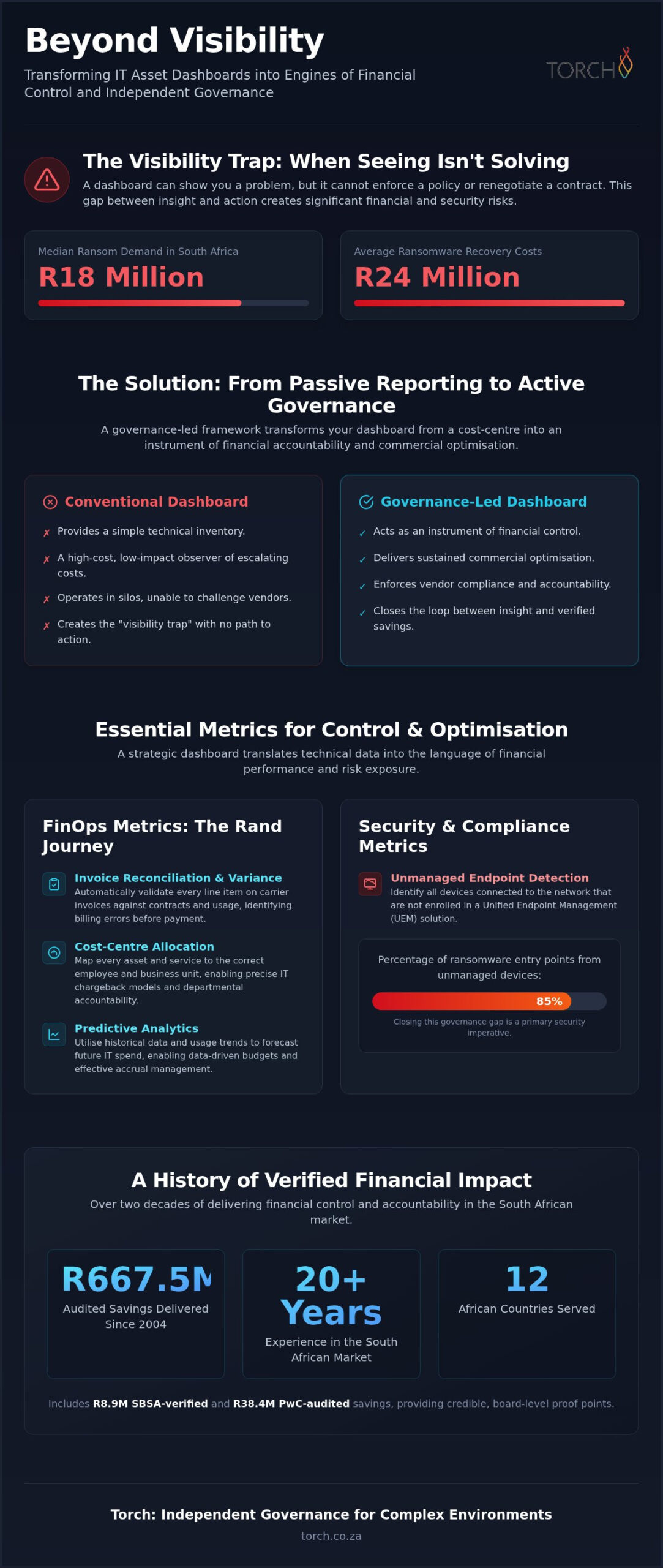
For many CFOs and CIOs, the modern it asset management reporting dashboard promises a single source of truth—a centralised view of every device, licence, and subscription across the enterprise. Yet, despite this unprecedented visibility, IT budgets continue to suffer from silent financial leakage, and security risks multiply. With the median ransom demand in South Africa reaching R18 million and average recovery costs soaring to R24 million, the financial and operational risks tied to unmanaged IT assets have never been higher.
The problem is not the data; it is the gap between insight and action. A dashboard can show you that costs are rising, but it cannot renegotiate a carrier contract on your behalf. It can flag an unmanaged device, but it cannot enforce a security policy to neutralise the threat. This is the visibility trap: believing that seeing a problem is the same as having the power to solve it.
This article explores how to move beyond passive observation. We will detail the framework required to transform your IT asset management reporting dashboard from a simple reporting tool into a dynamic engine for financial control, risk mitigation, and independent governance.
Beyond Visibility: Why Your IT Asset Management Reporting Dashboard Needs Governance
A conventional dashboard provides a technical inventory. A governance-led dashboard, however, is an instrument of financial control and accountability. It connects every Rand of IT spend to a specific user, cost centre, and business outcome, transforming raw data into boardroom-level financial intelligence. Without a layer of independent governance, even the most sophisticated dashboard becomes a high-cost, low-impact observer of escalating costs and unmitigated risks.
This is where the concept of “independent governance” becomes critical. It refers to an objective, carrier-agnostic framework that validates vendor invoices, benchmarks commercial agreements, and enforces operational policies. This external layer of accountability ensures that the insights revealed by your dashboard are acted upon, closing the loop between data and verified savings.
A governance-led IT asset management reporting dashboard is a system of financial accountability that translates asset visibility into sustained commercial optimisation by enforcing vendor compliance and eliminating budgetary leakage.
The Silent Leakage Problem in IT Procurement
Corporate budgets are silently drained by factors that standard reporting tools often miss. Unmanaged auto-renewals for SaaS subscriptions, billing errors in complex telecom contracts, and payment for “ghost assets”—devices and services assigned to former employees—all contribute to significant financial waste. Internal audits may catch some discrepancies, but they frequently lack the specialised tools and real-time data to uncover systemic issues.
An effective dashboard, powered by a governance framework, brings these hidden costs to light. More importantly, it provides the ammunition needed to challenge them. Internal procurement teams often operate without access to carrier-agnostic benchmarking data, making it difficult to know if they are receiving competitive rates. An independent governance partner leverages market intelligence to ensure your contracts are not just accurate but also commercially optimised.
From Data Points to Strategic Imperatives
The language of IT—metrics like uptime, device count, and data usage—does not always translate effectively in the boardroom. A strategic it asset management reporting dashboard reframes these data points into the language of financial performance: budget vs. actual spend, cost-centre variance, and risk exposure in Rands.
In a multi-vendor environment, carrier-agnostic oversight is essential. Each vendor has its own billing format, contract structure, and reporting system, creating a complex and fragmented landscape. A governance-led platform consolidates this information, providing a unified view that exposes cost-saving opportunities and contractual inconsistencies. This structural control delivers savings that a simple, vendor-provided dashboard cannot, creating a sustainable model for financial discipline.
Essential Metrics for Commercial Optimisation and Risk Mitigation
To be effective, an it asset management reporting dashboard must track metrics that drive both commercial optimisation and risk mitigation. It is not enough to simply list assets; the goal is to understand their financial and security impact throughout their lifecycle. This requires a focus on the “Rand Journey”—tracking every Rand from procurement to retirement to ensure maximum value and minimum risk.
For the CFO, the most critical metric is budget-vs-actual oversight. Real-time visibility into spending patterns provides the confidence to forecast accurately, manage accruals, and prevent unexpected budget overruns. When the dashboard can demonstrate fiscal discipline, it builds trust and strengthens the strategic partnership between IT and Finance.
FinOps Metrics: Tracking the Rand Journey
True financial control is achieved at a granular level. A governance-led dashboard must facilitate rigorous FinOps practices, including:
- Invoice Reconciliation and Variance Analysis: Automatically validating every line item on a carrier invoice against contractual rates and actual usage data, down to the individual user level. This identifies billing errors before they are paid.
- Cost-Centre Allocation: Ensuring every asset—from a mobile phone to a software licence—is accurately mapped to the correct employee and business unit. This enables precise IT chargeback or showback models and fosters departmental accountability.
- Predictive Analytics: Using historical data and usage trends to forecast future IT spend. This allows finance teams to manage accruals more effectively and build data-driven budgets. For more on this, see our guide on IT FinOps.
Endpoint Security and Compliance Reporting
In hybrid and remote-work environments, the “governance gap” between company policy and user behaviour creates significant risk. An effective dashboard monitors key security metrics to close this gap, including:
- Unmanaged Endpoint Detection: Identifying all devices connected to the corporate network that are not enrolled in a Unified Endpoint Management (UEM) solution. Since 85% of ransomware entry points originate from unmanaged devices, closing this vulnerability is a top priority.
- Policy Enforcement and Compliance: Tracking the status of security policies, such as mandatory OS updates, encryption, and application blacklisting, across the entire device fleet.
- BYOD Security: Monitoring the selective wiping of corporate data from personal devices when an employee leaves the company, ensuring sensitive information is protected without impacting personal data.
Telecom Expense Management (TEM) Integration
For most South African enterprises, telecom spend is a major and often volatile component of the IT budget. Integrating TEM discipline into your asset dashboard is crucial for controlling these costs. Key metrics include:
- Real-Time Consumption Monitoring: Setting automated alerts for unusual data usage to prevent data-roaming bill shocks, especially for employees travelling internationally.
- Contract Benchmarking: Continuously comparing your contracted rates for voice, data, and fixed-line services against market-leading intelligence to identify renegotiation opportunities.
- Subscription Optimisation: Analysing usage patterns to right-size mobile plans, eliminating paying for excess data or features that employees do not use. This is a core pillar of effective Telecom Expense Management.
Implementing a Single Source of Truth: Data Integration and Accuracy
The value of an it asset management reporting dashboard is directly proportional to the quality of its data. Inaccurate or incomplete information leads to flawed decisions, financial leakage, and increased risk. Establishing a single source of truth requires a disciplined, four-step process to consolidate, validate, and maintain data integrity over time.
- Step 1: Consolidate Data: Aggregate asset information from disparate sources, including mobile carriers, software vendors, and internal systems like your ERP and Human Resource Management (HRM) platforms.
- Step 2: Eliminate “Ghost Assets”: Conduct a rigorous inventory validation process, using automated discovery tools to identify active assets and cross-referencing with HR data to remove devices assigned to former employees.
- Step 3: Map Assets to Cost Centres: Link every validated asset to a specific employee, department, and general ledger code to enable accurate financial reporting and chargeback models.
- Step 4: Establish a Continuous Audit Cycle: Implement automated processes and regular reviews to ensure the asset inventory remains accurate as employees join, leave, or change roles within the organisation.
Eliminating Ghost Assets and Financial Leakage
Paying for mobile contracts and software licences for employees who left the firm months ago is one of the most common forms of financial leakage. These “ghost assets” can accumulate rapidly, especially in large organisations with high staff turnover. Similarly, unmanaged endpoints on the corporate network—devices brought in by employees or contractors without IT’s knowledge—create unsecured entry points for cyberattacks.
Automated discovery tools are essential for identifying these rogue devices. A real-time governance platform like SpotLight™ provides the continuous visibility needed to prevent these errors from occurring. By integrating with HR systems, it can automatically trigger de-provisioning workflows when an employee is offboarded, ensuring services are terminated promptly.
Integrating ERP and HRM for Financial Discipline
For an asset dashboard to deliver true business value, it must “speak” the language of finance and HR. Integrating your IT asset database with your ERP and HRM systems is non-negotiable for achieving financial discipline. This integration automates critical processes, reduces manual effort, and ensures data consistency across the organisation.
When a new employee joins, the HRM system can trigger a workflow to procure and provision the necessary devices and software licences. When they leave, the same system can initiate the asset recovery and service termination process. This automation not only improves efficiency but also creates a clear, auditable trail for every asset, reinforcing the principles of strong IT FinOps.
From Insight to Impact: How Managed Services Close the Governance Loop
A dashboard alone is insufficient. It is a powerful diagnostic tool, but it cannot write the prescription or administer the cure. The reason many DIY dashboard initiatives fail to deliver a return on investment is the “execution gap”—the chasm between knowing what to do and having the capacity, expertise, and authority to do it. This is why actively governed estates achieve up to 47.2% total cost reduction, a figure unattainable through visibility alone.
Transitioning from passive observation to active governance is a critical step to truly protect IT budgets and drive sustainable commercial optimisation. The “Managed Governance” model bridges the execution gap by pairing a powerful technology platform with a dedicated team of experts who act on the data. Torch’s SpotLight™ platform serves as the engine for this high-touch service, providing the real-time data our analysts use to drive commercial outcomes.
Closing the Execution Gap with FinOps-as-a-Service
Under a managed governance model, the service provider becomes an extension of your team. Torch analysts, embedded within your organisation, take responsibility for resolving the issues the dashboard flags. This includes:
- Investigating billing anomalies and formally disputing incorrect charges with carriers.
- Renegotiating contracts using proprietary market intelligence to secure better rates.
- Managing the entire device lifecycle, from procurement to disposal.
This approach is often delivered via a risk-share model, where the provider is compensated based on a percentage of the verified cost reductions they achieve. This aligns incentives and ensures you only pay for tangible results. For example, a six-week engagement with the Tsogo Group defined a hybrid mobility model that not only cut costs but also delivered a data-backed procurement decision that satisfied rigorous CFO scrutiny.
The 2026 Roadmap for IT Asset Governance
The future of IT asset management is moving away from reactive reporting and toward proactive commercial optimisation. As SaaS, cloud, and telecom environments grow more complex, the need for independent, expert advisory becomes paramount. A strategic partner provides the objective oversight necessary to navigate complex licensing agreements and hold vendors accountable for their performance.
The goal is to build a system of structural control where financial discipline is embedded in your operational processes. An effective it asset management reporting dashboard is a cornerstone of this system, but it is the governance framework and execution capability that ultimately turn its insights into lasting impact. To explore how this model can be applied to your business, learn more about Torch’s products and services.
Frequently Asked Questions (FAQs)
Why is a dashboard not enough to control IT costs?
A dashboard provides visibility into potential problems, such as billing errors or underutilised assets, but it lacks the execution capability to resolve them. It can identify an overcharge, but it cannot manage the dispute process with the vendor. A managed governance service closes this gap by providing the expert resources to act on the insights, turning data into verified savings.
How does an IT asset management dashboard help with ransomware mitigation?
A key function of a governance-led dashboard is to identify unmanaged and non-compliant endpoints, which are primary entry points for ransomware. By providing real-time visibility into every device on the network and its security posture (e.g., patch status, encryption), the dashboard allows IT teams to proactively enforce security policies and neutralise threats before they can be exploited.
What is the difference between IT asset tracking and independent governance?
IT asset tracking is the process of inventorying hardware and software. It answers the question, “What do we have?” Independent governance is a framework of financial and operational control that answers the question, “Are we getting maximum value and minimum risk from what we have?” Governance includes vendor accountability, contract benchmarking, and policy enforcement—activities that go far beyond simple tracking.
Can a reporting dashboard help with POPIA compliance in South Africa?
Yes. A central component of the Protection of Personal Information Act (POPIA) is securing personal data. An IT asset management dashboard helps by ensuring all devices holding sensitive data are known, managed, and secured according to company policy. It enables organisations to demonstrate control over their endpoints, including the ability to remotely wipe data from lost or stolen devices, which is a critical compliance requirement.
How long does it take to see ROI from a governance-led dashboard?
While platform implementation times vary, the return on investment from a managed governance service can be rapid. Initial savings are often realised within the first 90 days through the identification of “quick wins” like terminating services for former employees and correcting major billing errors. Sustainable, long-term savings are achieved through ongoing contract optimisation and process improvements.
How do you detect billing errors in complex telecom contracts?
This is achieved by combining technology with expert analysis. A platform like SpotLight™ automates the validation of millions of line items on carrier invoices against contract terms, usage data, and inventory records. Any variance flags an error, which is then investigated by a TEM analyst who manages the dispute and credit recovery process with the carrier on the client’s behalf.