
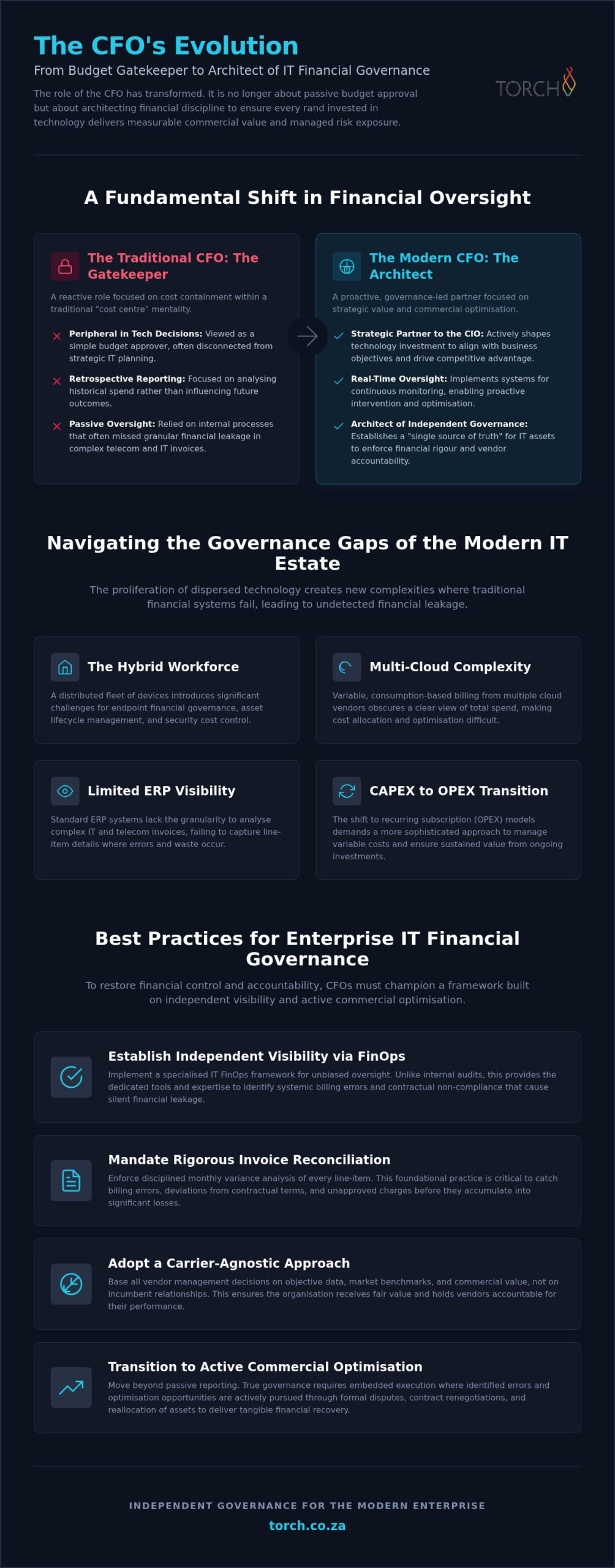
In the modern enterprise, the Chief Financial Officer (CFO) is no longer a peripheral figure in technology decisions. The traditional view of the CFO as a simple budget gatekeeper is obsolete. Today, the role of the CFO in IT financial management has evolved into that of a primary architect of financial discipline, a strategic partner who ensures that every rand invested in technology delivers measurable commercial value. This shift requires moving beyond a reactive “cost centre” mentality to a proactive, governance-led mindset focused on strategic optimisation.
As organisations navigate the complexities of dispersed technology estates in 2026—characterised by hybrid work, multi-cloud environments, and sophisticated software stacks—the challenge of maintaining financial control has intensified. Traditional Enterprise Resource Planning (ERP) systems, whilst essential for general accounting, often fail to capture the granular nuances of IT and telecom spend. This creates a governance gap where significant financial leakage can occur silently and undetected. The modern CFO must therefore evolve from a passive budget approver to an active architect of independent IT financial governance to eliminate this waste and restore confidence in technology spend.
The Evolving Role of the CFO in IT Governance
The contemporary CFO is now the primary architect of IT financial discipline within the enterprise. This represents a fundamental shift away from viewing technology as a necessary but burdensome cost centre. Instead, the strategic CFO champions a value-oriented mindset, framing IT investment as a critical enabler of business objectives, innovation, and competitive advantage. However, this strategic role is complicated by the modern technology landscape. The proliferation of hybrid work models and cloud services has created highly dispersed and dynamic IT estates, making centralised financial oversight more challenging than ever before. Standard ERP systems, which are excellent for tracking predictable, consolidated expenses, lack the specialised functionality to analyse the variable, line-item details of complex telecom invoices or cloud consumption, leaving significant governance gaps.
Beyond Budget Approval: The CFO as a Strategic Partner
The most effective CFOs have moved far beyond passive oversight and simple budget approvals. Their role is now one of active commercial optimisation, where they partner with the CIO and other department heads to scrutinise technology spend and drive accountability. A cornerstone of this approach is establishing a “single source of truth” for all IT and telecom assets. This centralised, accurate inventory provides the foundational data needed for effective governance, enabling the organisation to track assets, manage lifecycles, and align costs with actual usage. The modern CFO is best defined as a governance-led leader in technology procurement, ensuring that financial rigour and commercial strategy are embedded in every stage of the IT lifecycle, from sourcing to retirement.
Navigating the Complexity of the Modern IT Estate
The rise of the hybrid workforce has fundamentally altered how organisations procure, manage, and secure technology, placing new demands on endpoint financial governance. CFOs must now account for a distributed fleet of devices, each with its own cost, security, and lifecycle implications. This complexity is compounded by the broader market transition from capital expenditure (CAPEX) models, such as purchasing on-premise servers, to operational expenditure (OPEX)-heavy models dominated by recurring subscription and consumption-based services. Effectively governing this new financial paradigm requires deep, demonstrated expertise in corporate financial leadership. It demands a sophisticated understanding of how to manage variable costs, enforce vendor accountability, and ensure that OPEX-based investments deliver sustained value without spiralling out of control.
IT Financial Management Best Practices for Enterprise Governance
To master the modern technology estate, CFOs must champion a set of best practices designed to instil discipline and transparency. This begins with implementing a carrier-agnostic approach to vendor management, which ensures that all decisions are based on objective data and commercial value, not on incumbent relationships. The next critical step is establishing independent visibility through dedicated IT FinOps frameworks. Unlike internal processes that may lack the necessary tools or expertise, a specialised FinOps function provides unbiased oversight into how and where technology budget is being spent. This framework mandates rigorous monthly invoice reconciliation and variance analysis to catch billing errors and deviations from contractual terms. Ultimately, these practices enable the finance function to move from retrospective reporting, which only describes past expenditure, to real-time spend oversight that allows for proactive intervention and continuous optimisation.
Establishing Independent Visibility and Vendor Accountability
Many enterprises rely on internal audits to control IT spend, yet these processes often fail to detect the silent leakage caused by systemic billing errors and contractual non-compliance. Internal teams may lack the specialised tools or the granular, line-item focus required to identify subtle but costly discrepancies in complex carrier invoices. True accountability requires independent, data-backed validation. By leveraging competitive intelligence to benchmark IT contracts against market rates, CFOs can ensure their organisation is receiving fair value. This objective, third-party validation empowers the enterprise to hold carriers and vendors accountable for their billing accuracy and service delivery, transforming the vendor relationship from a transactional one to a transparent partnership governed by clear, enforceable metrics.
Transitioning from Reporting to Active Commercial Optimisation
Dashboards and financial reports are valuable for visualising spend, but they are only the first step in achieving genuine financial control. Visibility without action is a passive exercise; true IT financial management requires active commercial optimisation. This means establishing processes for embedded execution, where identified billing errors and optimisation opportunities are not just flagged but are actively pursued and resolved. Whether it involves formally lodging disputes with carriers, renegotiating contract terms, or reallocating underutilised licenses, the focus must be on tangible recovery and cost realignment. This approach transforms governance from a periodic review into a sustained, structural discipline that delivers continuous financial benefits and embeds a culture of accountability across the organisation.
Identifying and Closing IT Governance Gaps
A primary challenge for CFOs is uncovering the hidden costs of “silent leakage” that erode technology budgets over time. This financial drain often occurs in complex telecom estates, where systemic over-billing, unused services, and misaligned tariffs can go unnoticed for years. Similarly, the rise of unmanaged endpoints and “shadow IT”—where employees use unapproved software and devices—creates significant financial and security risks. A critical governance gap often exists between the procurement team’s decisions and the reality of day-to-day consumption, leading to wasted expenditure on shelfware and underutilised assets. Implementing a robust Telecom Expense Management (TEM) framework is a proven strategy to close these gaps, systematically identifying and recovering wasted budget to be reinvested in strategic initiatives.
Eliminating Silent Leakage in Telecom and Cloud Spend
Silent leakage is fuelled by common but often overlooked issues that drain enterprise IT budgets annually. These include incorrect tariff applications, charges for ceased services, and failures to apply negotiated volume discounts. Manually auditing thousands of line items to find these errors is impractical for most internal teams. This is where automated tools like SpotLight™ provide a distinct advantage, offering real-time consumption monitoring and invoice validation to flag anomalies as they occur. Furthermore, sophisticated scenario modelling for costs like mobile data roaming and device lifecycle management allows CFOs to forecast future spend accurately and develop proactive policies that prevent cost overruns before they happen. For a deeper analysis of these hidden costs, explore our executive guide to financial governance in IT procurement.
Managing Ransomware Risk through Asset Governance
There is a direct and critical link between financial oversight and cybersecurity. A lack of rigorous asset governance creates vulnerabilities that threat actors are quick to exploit. Unmanaged, unpatched, or retired-but-not-decommissioned devices serve as the primary entry point for ransomware and other malware. By implementing a Unified Endpoint Management (UEM) solution, organisations can enforce security compliance across their entire device fleet, ensuring that every endpoint adheres to corporate policy. This protects not only sensitive data but also the corporate budget, as the financial and operational impact of a successful ransomware attack can be catastrophic. For the modern CFO, asset governance is therefore a dual mandate: it is a pillar of both financial control and risk mitigation.
Implementing a Sustainable FinOps and ITFM Framework
For the CFO, the ultimate goal is to build a sustainable framework that restores complete confidence in the organisation’s technology spend. This roadmap begins with a clear vision for financial discipline that extends beyond the finance department, fostering a collaborative culture with IT, HR, and procurement. A key strategy for success is leveraging risk-share commercial models with managed service partners. This approach aligns the partner’s incentives directly with the client’s cost-saving outcomes, ensuring a shared commitment to achieving tangible results. Finally, the success of any IT Financial Management (ITFM) initiative must be measured and communicated effectively. By tracking the ROI of managed governance services and presenting clear, data-driven reports to the board, the CFO can demonstrate the strategic value of financial discipline in technology.
The FinOps Readiness Assessment: A Diagnostic Approach
The first step towards mature governance is understanding your current capabilities. A FinOps Readiness Assessment offers a structured, diagnostic approach to this challenge. In as little as 20 minutes, this evaluation can benchmark your organisation’s current governance maturity against industry best practices, highlighting specific areas of weakness and opportunity. This process is designed to identify immediate “low-hanging fruit” for commercial optimisation—quick wins that can generate immediate savings and build momentum for the broader program. The insights gained from the assessment are then used to establish meaningful Key Performance Indicators (KPIs) for board-level IT financial reporting, ensuring that progress is tracked against clear, strategic objectives.
Building a Culture of Financial Accountability
Sustainable governance is not just about tools and processes; it is about people and culture. A successful ITFM framework empowers employees by providing them with the resources they need to be productive without creating unnecessary financial risk. This can be achieved through automated user support and self-service portals that streamline device requests and troubleshooting, guided by predefined financial policies. By outsourcing the administrative burden of asset tracking, invoice processing, and vendor disputes to a managed services partner, internal IT teams are freed to focus on strategic, value-adding initiatives. This creates a virtuous cycle of efficiency and accountability that permeates the entire organisation.
Next steps: Request a no-cost telecom billing audit to uncover hidden savings and quantify the potential for commercial optimisation in your organisation.
Frequently Asked Questions (FAQs)
What is the difference between IT financial management and simple accounting?
Simple accounting focuses on recording and reporting historical IT expenditures, treating technology as a cost to be tracked. IT Financial Management (ITFM), in contrast, is a forward-looking strategic discipline. It involves actively governing, analysing, and optimising technology spend to ensure it aligns with business goals, drives value, and operates with maximum commercial efficiency.
Why should a CFO insist on carrier-agnostic telecom auditing?
A CFO should insist on carrier-agnostic auditing to ensure objectivity and eliminate conflicts of interest. Audits performed by a carrier or a reseller may overlook errors that benefit them. An independent, carrier-agnostic partner works exclusively for your organisation, using specialised tools and market intelligence to validate every charge and ensure your contracts are enforced correctly, maximising savings and accountability.
How does FinOps help in managing hybrid workforce technology costs?
FinOps provides a framework for managing the variable and distributed technology costs associated with a hybrid workforce. It establishes policies for device procurement, data usage, and software licensing, and it uses real-time monitoring to track consumption against budgets. This allows organisations to provide employees with the tools they need while maintaining strict financial control and preventing cost overruns.
What are the most common billing errors found in enterprise telecom invoices?
The most common billing errors include charges for services that have been cancelled but not removed from the bill, incorrect tariff plans being applied to users, failure to apply contracted volume discounts, and charges for features or add-ons that were never requested. These errors often recur monthly and can accumulate into significant financial losses if not detected and resolved.
Can IT financial governance actually reduce ransomware risk?
Yes, absolutely. Strong IT financial governance requires maintaining a complete and accurate inventory of all technology assets. This “single source of truth” is the foundation of effective security. By ensuring every device is known, managed, and compliant with security policies (like patching and access controls), financial governance directly closes the security gaps that unmanaged or “ghost” assets create, which are primary entry points for ransomware.
How long does it take to see results from a commercial optimisation program?
Initial results can often be seen within the first 60 to 90 days. A thorough billing audit against historical invoices can uncover immediate savings and recovery opportunities. Whilst deeper, structural optimisations like contract renegotiation may take longer, the initial diagnostic and recovery phase typically delivers a tangible return on investment very quickly, building a strong business case for continued governance.