
A pristine supplier dashboard rarely means your organisation is receiving the service it paid for. When enterprise teams treat tracking vendor performance metrics as an administrative reporting exercise, missed service level agreements slip past unnoticed and silent billing discrepancies compound month after month. You likely recognise the systemic friction: operational incident tickets accumulate in technical queues, whilst finance routinely signs off carrier invoices without any independent visibility into whether contractual obligations were actually delivered. Left unchecked, this control deficiency locks your business into degraded performance and uncompetitive auto-renewals.
Dashboards merely report historical symptoms; structural governance enforces contractual accountability. This guide provides an independent framework to eliminate billing disputes, automate service level verification, and establish disciplined financial control over technology spend. Ahead, we examine how to reconcile daily operational performance with monthly invoice approvals, recover entitled service credits, and secure measurable commercial optimisation across your supplier estate.
Key Takeaways
- Move beyond passive supplier reporting by treating vendor oversight as a continuous discipline of financial control and accountability.
- Establish objective benchmarks across operational, commercial, and risk criteria when tracking vendor performance metrics to prevent silent spend leakage.
- Implement a repeatable four-stage framework to digitise master service agreements and systematically enforce entitled service credits against monthly billing.
- Eliminate the structural conflict of interest inherent in vendor self-auditing through carrier-agnostic governance that satisfies board-level assurance standards.
Understanding Vendor Performance Metrics: Moving Beyond Basic Dashboards
Most corporate IT teams believe they manage supplier delivery effectively simply because they maintain a digital portal displaying service status indicators. True governance operates quite differently. Rigorous vendor tracking is the systematic, verified alignment between delivery and billing. Rather than treating this oversight as an administrative check-box, forward-thinking CFOs treat tracking vendor performance metrics as a continuous discipline of financial control and accountability. Basic operational portals report aggregated history; they do not uncover silent spend leakage or validate whether invoiced amounts match contracted service specifications.
A critical control deficiency arises when organisations confuse qualitative supplier relationship management with objective, quantitative contract validation. Having quarterly review lunches with key account managers does not ensure invoice accuracy. The corporate exposure compounds dramatically when enterprises rely on suppliers to self-report their own operational delivery. Expecting a vendor to audit their own performance outages and volunteer fee deductions creates an obvious structural conflict of interest. Effective oversight requires carrier-agnostic governance that independently scrutinises data points against commercial terms.
The Cost of Unmonitored Vendor Estates
When technology estates lack continuous financial reconciliation, contracts quietly drift. Organisations absorb unnoticed tariff escalations, undocumented service changes, and automatic contract renewals at uncompetitive legacy rates. In complex multi-carrier networks, carrier overcharges often masquerade as normal variable usage. Without independent oversight, your finance team pays for decommissioned circuits, misapplied connection tiers, and unearned management fees month after month.
The Three Pillars of Comprehensive Vendor Oversight
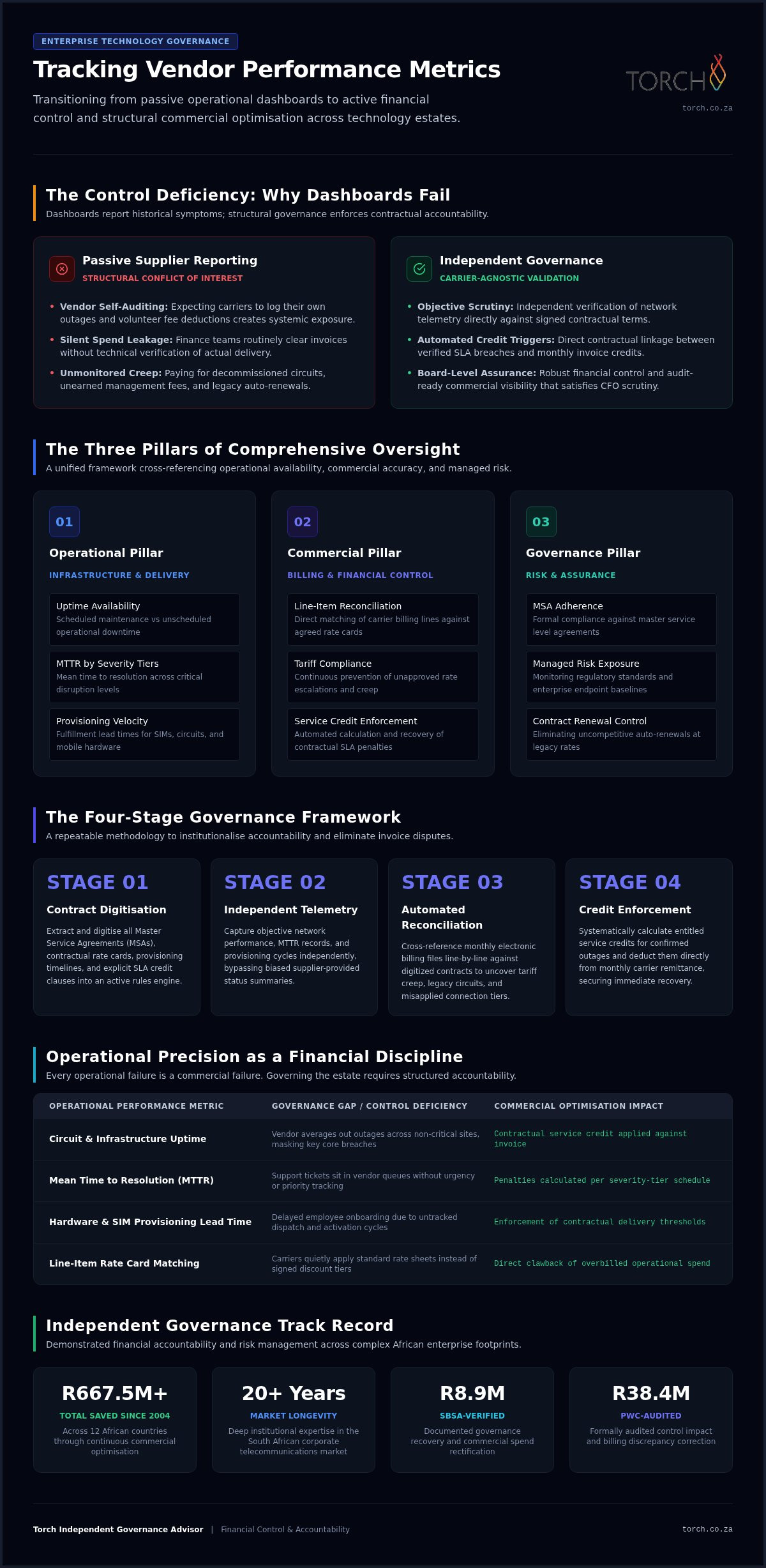
Establishing structural accountability across an IT and telecommunications footprint requires evaluating third parties through three interconnected disciplines:
- The Operational Pillar: Validates infrastructure availability against contractual service-level agreements (SLAs), tracking mean time to repair (MTTR), network throughput, and incident ticket resolution velocity.
- The Commercial Pillar: Enforces monthly line-item reconciliation, contractual tariff compliance, and the automated calculation and recovery of overdue service credits through structured telecoms expense management.
- The Governance Pillar: Monitors ongoing regulatory compliance, security baselines across enterprise endpoints, and formal adherence to master service agreements.
Mastering these three pillars transforms tracking vendor performance metrics from a passive status report into an active instrument of commercial optimisation, ensuring every invoiced rand reflects verified operational reality.
Essential Metrics for Enterprise Technology and Telecommunications Vendors
Subjective supplier scorecards fail because they isolate relationship sentiment from technical delivery and invoice reconciliation. In contrast, tracking vendor performance metrics requires an objective evaluation matrix that cross-references operational uptime, commercial billing integrity, and technical risk exposure. Billing precision is not a secondary finance task; it is a frontline operational service level. When a carrier commits to delivering bandwidth, fixed lines, or managed endpoints at an agreed rate, an inaccurate invoice represents a direct service delivery failure. Contractually, every verified service level breach must trigger an automated, direct financial credit against the corresponding monthly invoice.
Operational Service Levels: Availability, MTTR, and Provisioning
Measure operational performance by distinguishing between pre-approved scheduled maintenance and unscheduled operational downtime. Track Mean Time to Resolution (MTTR) against explicit severity tiers: critical business disruptions require immediate intervention, whilst standard requests follow defined technical queues. Additionally, track fulfillment lead times for SIM activations, mobile provisioning, and hardware rollouts against agreed contractual schedules to eliminate operational bottlenecks.
Commercial Governance: Billing Accuracy and Contractual Compliance
Maintain structural financial control by auditing key commercial indicators:
- Invoice Accuracy Rate: The percentage of monthly vendor billing lines that match master service agreement rate cards without disputed variances.
- Contract Compliance Variance: Quantitative measurement of unapproved price indexations, unauthorized tariff tiers, or out-of-bundle rate creep.
- Credit Recovery Velocity: The average business days required for a carrier or IT provider to credit verified overcharges back to your enterprise account.
Organisations managing hybrid carrier setups often benefit from an independent review; you can book a 30-minute governance review with Derek King to benchmark your billing dispute workflows against enterprise standards.
Risk and Endpoint Security Metrics
Third-party managed service providers and telecommunications vendors operating inside corporate estates introduce operational risk. Track vendor adherence against structured cybersecurity supply chain risk controls, including supplier access management, incident reporting, and configuration governance. Audit endpoint security patch latency, remote device configuration baselines, and subscription utilisation ratios to deactivate dormant accounts before automated renewal terms kick in. Rigorous oversight must also track compliance with statutory data privacy standards under South Africa’s Protection of Personal Information Act (POPIA), ensuring supplier systems process corporate information lawfully.
Consolidating these indicators ensures that tracking vendor performance metrics produces concrete financial accountability across your entire supplier footprint.
How to Implement a Continuous Vendor Tracking Framework
Establishing operational control over complex supplier portfolios requires moving from static contract storage to active financial enforcement. The objective is simple: translate static contractual clauses into dynamic, programmatic rules that monitor everyday delivery. This governance-led approach institutionalises continuous oversight to prevent multi-year cost creep and operational failures. Rather than conducting awkward, opinion-based Quarterly Business Reviews, tracking vendor performance metrics empowers executives to lead commercial discussions armed with indisputable operational telemetry.
Step 1: Extract Contractual Baselines and SLA Commitments
Begin by auditing active master service agreements, statements of work, and carrier schedules. You must pinpoint precise performance metrics, service credit calculation formulas, and notice periods for contract renewals. Suppliers frequently obscure terms with ambiguous phrases such as “best commercial effort” or vague exclusions around third-party infrastructure. Extract these commitments into a unified, digitised rulebook that defines unequivocal thresholds for performance breaches and associated financial penalties.
Step 2: Automate Telemetry and Invoice Data Ingestion
Do not depend on supplier-curated PDF summaries that gloss over service degradation. Ingest raw consumption and availability logs directly from infrastructure touchpoints, then ingest digital billing files down to the line-item level. Modern IT FinOps services cross-reference real-time consumption against agreed contractual rate cards. This automated reconciliation flags inactive connections, misallocated tariff structures, and billing inconsistencies before finance authorises payment.
Step 3: Enforce Financial Remedies and Service Credits
Identified breaches must trigger immediate commercial remedies. Operationalising this governance loop involves three core practices:
- Automated Dispute Lodging: Generate auditable dispute tickets immediately when telemetry reveals availability breaches or when invoice rates exceed contractual caps.
- Escrow and Credit Tracking: Log pending credit requests systematically, tracking supplier settlement times to ensure entitled rebates appear on subsequent billing runs.
- Data-Led Renewals: Feed empirical supplier scorecards into contract renegotiations, terminating non-performing services rather than drifting into unearned evergreen extensions.
When tracking vendor performance metrics functions as an automated operational rhythm, it closes historic governance gaps and establishes sustained, board-ready financial discipline.
Institutionalising Accountability Through Independent Governance
Internal IT and procurement teams rarely have the capacity or cross-market datasets required to police carrier delivery continuously. Expecting a supplier to uncover their own billing errors or voluntarily apply service credits introduces a glaring conflict of interest. Actively governed technology estates achieve up to 47.2% total cost reduction compared to unmanaged environments, primarily because independent oversight eliminates this self-auditing bias. When tracking vendor performance metrics moves from an ad-hoc administrative task to an institutionalised governance framework, operational friction transforms into sustainable financial control. The need for objective, client-side oversight is equally vital across wider digital systems; if your organisation is managing complex software modernisation, visit HRIS Audit to learn how dedicated transformation advisory ensures supplier delivery aligns with strategic requirements.
The Limitations of Internal Spreadsheets and Carrier Self-Audits
Manual spreadsheets inevitably buckle under the weight of enterprise billing files and distributed telemetry logs. More critically, carriers will not proactively audit their own monthly revenue streams to issue unprompted refunds. Managed telecoms expense management removes this internal operational burden by enforcing systematic, external invoice validation across all connection profiles.
Establishing Carrier-Agnostic Benchmarking and Leverage
Independent market telemetry provides enterprise procurement leaders with empirical negotiating leverage. Standard accounting reviews spot simple ledger variances, but they routinely overlook silent billing leakage like unapplied promotional tariffs or orphaned links. Combining commercial auditing with active device visibility through unified endpoint management ensures your organisation tracks utilisation and security posture in tandem, preventing unmonitored supplier drift.
Transforming Metrics into Sustainable Bottom-Line Impact
Establishing rigorous oversight yields proven financial returns. Over 20 years in the South African enterprise market, Torch has saved over R667.5M across 12 African countries since 2004, reinforced by verified track records including R38.4M PwC-audited and R8.9M SBSA-verified recoveries. By establishing carrier-agnostic tracking vendor performance metrics, organisations replace passive supplier trust with definitive financial accountability and lasting commercial optimisation.
Securing Structural Control Across Your Technology Estate
Operational monitoring without continuous billing reconciliation leaves enterprise budgets exposed to silent tariff creep and uncollected credits. Transitioning to a structured framework for tracking vendor performance metrics replaces vendor self-auditing with indisputable, telemetry-backed enforcement. By digitising master service agreements and actively reconciling operational uptime against line-item invoices, your leadership team gains total visibility over every supplier engagement.
With over 20 years in the South African enterprise market, Torch provides the carrier-agnostic governance needed to eliminate internal control deficiencies. This disciplined approach has delivered over R667.5M saved since 2004 across 12 African countries, reinforced by R38.4M PwC-audited and R8.9M SBSA-verified results. You don’t have to accept supplier ambiguity or contractual drift as an inevitable cost of doing business.
Book a 30-minute governance review with Derek King
Establishing independent governance today ensures your technology estate delivers genuine commercial optimisation and audit-ready financial accountability well into the future.
Frequently Asked Questions
How do vendor performance metrics differ from standard service level agreements?
Service level agreements define contractual commitments, whereas tracking vendor performance metrics involves continuous measurement of actual delivery against those standards. An agreement specifies required uptime or response times, but performance tracking independently records day-to-day operations and cross-references those logs against monthly billing. It bridges the gap between passive legal clauses and active financial accountability.
What is the most effective method for tracking technology vendor billing accuracy?
The most reliable method requires automated, line-item reconciliation between electronic carrier invoices, real-time consumption records, and negotiated rate cards. Relying on high-level ledger totals allows silent billing errors to slip through. Automated validation flags misapplied tariff plans, incorrect out-of-bundle rates, and charges for decommissioned services before accounts payable authorises payment.
Can an enterprise automate vendor performance tracking without expanding internal headcount?
How do unmonitored vendor performance metrics contribute to enterprise financial leakage?
Unmonitored suppliers continue to bill for services that breach availability thresholds without issuing the contractual service credits your organisation is owed. In addition, unmanaged estates suffer from silent tariff indexations, unallocated data lines, and automatic evergreen contract renewals. Independent oversight prevents this drift, helping actively governed technology portfolios achieve up to 47.2% total cost reduction.
What steps should an organisation take when a vendor repeatedly disputes performance data?
Replace qualitative discussions with carrier-agnostic, third-party telemetry. Capture raw network availability and incident ticket logs independently rather than relying on supplier-provided summaries. Presenting indisputable operational records alongside the precise service credit calculation formulas from your master agreement eliminates subjective debate and enforces contractual compliance.
How does independent governance improve vendor relationships compared to aggressive contract disputes?
Independent governance introduces transparent, objective data that removes emotion from supplier reviews. When both enterprise leaders and carrier account managers work from identical, empirical performance records, meetings shift from contentious arguments toward structured problem resolution. Establishing clear operational boundaries and verified metrics builds mutual respect and long-term commercial predictability.