
Beyond the Mobile: Understanding the Evolution from MDM to UEM
For years, Mobile Device Management (MDM) was the cornerstone of enterprise mobility, providing a necessary layer of control over the smartphones and tablets entering the corporate environment. It was a tactical solution for a specific problem: securing corporate data on mobile devices. However, the modern enterprise estate is no longer defined by a simple split between mobile and desktop. The strategic shift to hybrid work, accelerated in recent years, has dissolved the traditional office perimeter, creating a complex ecosystem of endpoints that legacy MDM was never designed to handle.
This is where Unified Endpoint Management (UEM) emerges not just as an upgrade, but as a fundamental shift in strategy. UEM represents the strategic consolidation of all IT assets—smartphones, tablets, laptops, desktops, and even IoT devices—under a single, cohesive governance framework. Whilst MDM manages a category of devices, UEM governs the entire digital estate. This evolution from simple management to what we term “Endpoint Governance” is critical for any organisation looking to maintain security, financial control, and operational agility in 2026 and beyond.
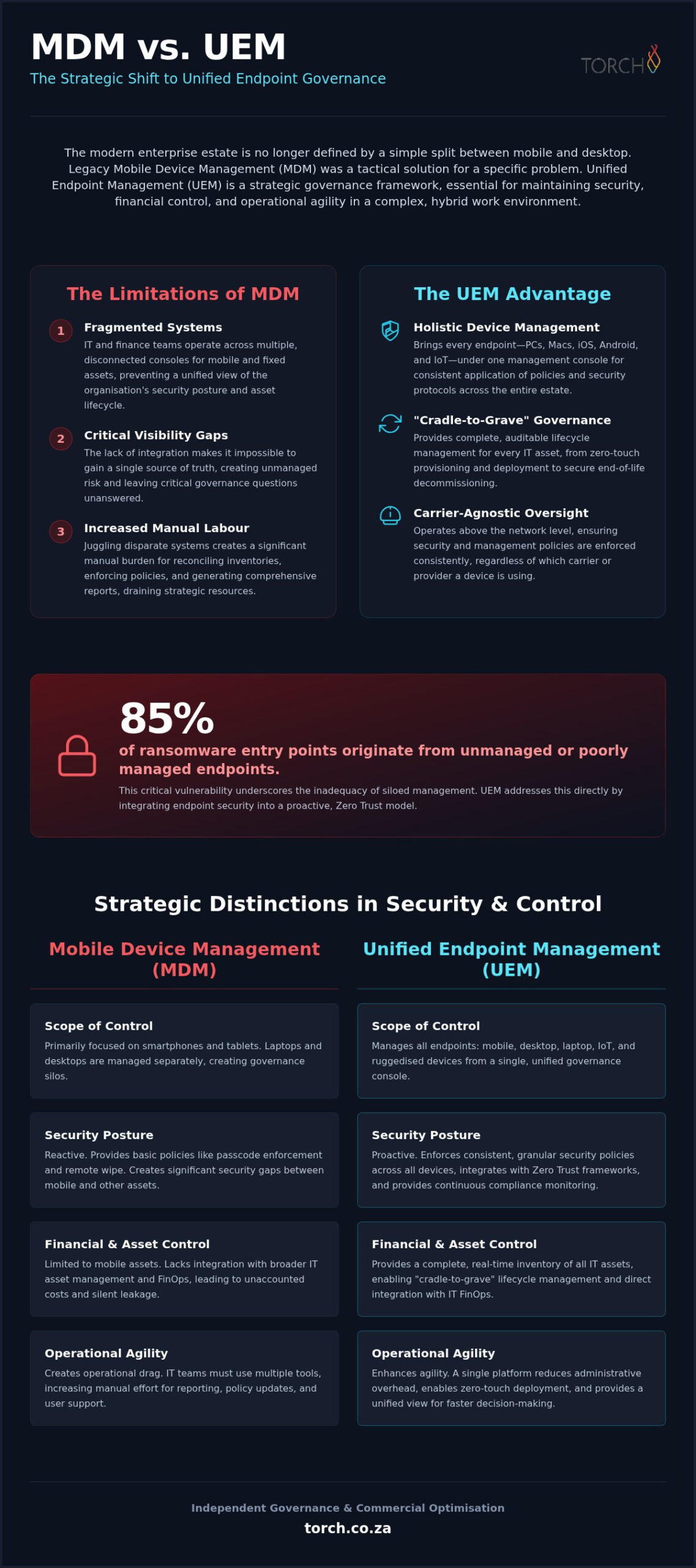
The Limitations of Traditional MDM
The primary weakness of a traditional MDM-only approach lies in its siloed nature. It creates an artificial divide between how mobile devices and fixed assets like desktops and laptops are managed, leading to significant operational challenges:
- Fragmented Systems: With MDM handling mobile devices and separate tools managing PCs and Macs, IT teams are forced to operate across multiple, disconnected consoles. This fragmentation prevents a unified view of the organisation’s security posture and asset lifecycle.
- Critical Visibility Gaps: When mobile and fixed assets are not integrated, it becomes impossible to get a single source of truth. An IT leader cannot confidently answer simple but critical questions like, “What is the security status of every device used by our finance team, regardless of type?” This gap is a primary source of unmanaged risk.
- Increased Manual Labour: Juggling disparate systems places a significant manual burden on IT and finance teams. Tasks like reconciling asset inventories and enforcing security policies become time-consuming, error-prone exercises; many businesses find that outsourcing these functions to a provider like Proactive Networking Ltd allows them to focus on higher-value strategic initiatives.
The UEM Advantage: A Single Source of Truth
Unified Endpoint Management dismantles these silos by creating a single pane of glass for the entire device ecosystem. This centralised control delivers profound strategic benefits that extend far beyond the capabilities of MDM.
- Holistic Device Management: UEM brings every endpoint—Windows PCs, Macs, iOS and Android devices, ruggedised handhelds, and IoT sensors—under one management console. This allows for the consistent application of policies, security protocols, and software updates across the entire estate.
- “Cradle-to-Grave” Lifecycle Governance: A robust UEM strategy provides complete lifecycle management for every IT asset. From zero-touch provisioning and deployment to mid-life software management and secure end-of-life decommissioning, every stage is governed and auditable. You can explore this further in our IT asset lifecycle management strategy guide.
- Carrier-Agnostic Oversight: True endpoint governance requires independence from network carriers. UEM provides a layer of control that operates above the network level, ensuring that security and management policies are enforced consistently, regardless of which mobile network or internet provider a device is using.
UEM vs MDM: Strategic Distinctions in Security and Control
To understand the strategic imperative of moving from MDM to UEM, it is essential to compare them not on features alone, but on their impact on core business outcomes: security posture, financial control, and operational agility. MDM is a reactive tool designed to solve a contained problem, whereas UEM is a proactive governance framework designed to manage systemic risk and opportunity.
The distinction is stark when considering modern security threats. Our client data reveals a critical vulnerability: an alarming 85% of ransomware entry points originate from unmanaged or poorly managed endpoints. This statistic underscores the inadequacy of siloed management in an environment where a single unsecured laptop can compromise the entire organisation. UEM directly addresses this by integrating endpoint security into a Zero Trust model, which operates on the principle of “never trust, always verify” for every device and user accessing corporate resources.
Here is a direct comparison of the two approaches:
| Area of Governance | Mobile Device Management (MDM) | Unified Endpoint Management (UEM) |
|---|---|---|
| Scope of Control | Primarily focused on smartphones and tablets. Laptops and desktops are managed separately, if at all. | Manages all endpoints: mobile, desktop, laptop, IoT, and ruggedised devices from a single console. |
| Security Posture | Reactive. Provides basic security policies like passcode enforcement and remote wipe for mobile devices. Creates security gaps between mobile and other assets. | Proactive. Enforces consistent, granular security policies across all devices, integrates with Zero Trust frameworks, and provides continuous compliance monitoring. |
| Financial & Asset Control | Limited to mobile assets. Lacks integration with broader IT asset management and financial operations (FinOps), leading to silent leakage. | Provides a complete, real-time inventory of all IT assets, enabling “cradle-to-grave” lifecycle management and direct integration with IT FinOps for accurate budget forecasting. |
| Operational Agility | Creates operational drag. IT teams must use multiple tools, increasing manual effort for reporting, policy updates, and user support. | Enhances agility. A single platform reduces administrative overhead, enables zero-touch deployment for new devices, and provides a unified view for faster decision-making. |
Fortifying the Estate Against Ransomware
With South African organisations facing an average of 2,145 cyber-attacks per week as of early 2026, the need for a fortified endpoint estate has never been more urgent. UEM moves security from a checklist item to a continuous, automated process. It enforces security baselines and policy compliance automatically, ensuring that every device—whether corporate-owned or BYOD—adheres to strict security standards before it can access the network. This includes enforcing encryption, managing application permissions, and deploying security patches without user intervention. The vision of “Zero-Touch” deployment, where a new device can be shipped directly to a user and automatically configured with all necessary security protocols upon its first connection, is a reality with UEM. Ultimately, UEM reduces ransomware exposure through continuous, automated monitoring and remediation of policy violations across every single endpoint. To further strengthen this posture, organisations often explore Managed extended Detection and Response (MXDR) to ensure comprehensive threat visibility across their entire digital infrastructure.
Financial Control and Asset Accountability
Beyond security, UEM instils a level of financial discipline that is impossible with fragmented tools. It provides a definitive, real-time asset register, which is the foundation for eliminating “silent leakage”—the wasteful spending on unused software licences, ghost assets, and inefficient hardware. By integrating this asset data with FinOps principles, CFOs and CIOs can achieve unparalleled accuracy in budget forecasting and cost allocation. This is not a theoretical benefit; our analysis shows that actively governed estates achieve up to 47.2% total cost reduction compared to their unmanaged equivalents. This control transforms IT from a cost centre into a strategically managed portfolio of assets.
Assessing Endpoint Governance: When Does Your Organisation Need UEM?
The transition from MDM to UEM becomes a strategic necessity when an organisation reaches a “Complexity Tipping Point.” This is typically characterised by managing over 100 devices, dealing with multiple hardware and software vendors, or supporting a geographically dispersed, hybrid workforce. At this scale, the inefficiencies and risks of a siloed approach begin to compound, creating a significant “governance gap.”
This gap is particularly pronounced in the African market, where unmanaged Bring Your Own Device (BYOD) policies can introduce substantial security and compliance risks. Without a UEM framework, organisations have little to no visibility or control over the personal devices accessing sensitive corporate data, leaving them exposed. The goal is to move beyond simply having tools and towards implementing the “structural control” required for sustainable optimisation and managed risk.
The “Governance Gap” Checklist
To determine if your organisation has outgrown its current management tools, consider these diagnostic questions for your IT and Finance leadership:
- Does your finance or IT team spend more than 10 hours a week on manual invoice reconciliation for mobile and IT services?
- Can you, with 100% certainty, identify the exact location, user, and security status of every laptop in your fleet right now?
- Are your mobile data costs frequently exceeding budget due to a lack of real-time visibility and enforceable usage policies?
- If a device is lost or stolen, can you selectively wipe corporate data from it without affecting personal data, especially on a BYOD device?
If the answer to any of these questions is “no” or “I’m not sure,” a significant governance gap likely exists.
Managed Risk vs. Unmanaged Exposure
It is crucial to differentiate between “having a tool” and “having a managed service.” Many organisations purchase a UEM software licence but lack the specialised resources to implement, manage, and optimise it effectively. This results in a powerful dashboard that no one is watching, leaving risks unaddressed. True endpoint governance comes from embedded execution—a managed service partner who not only reports on issues but actively remediates them. This approach transforms unmanaged exposure into managed risk, providing the assurance that policies are not just written down but are consistently enforced. Torch provides this level of active oversight through our dedicated Unified Endpoint Management services.
Securing the Hybrid Estate: Implementing UEM as a Financial Safeguard
At Torch, we view UEM not as a standalone product but as a critical component of a comprehensive governance strategy. Our approach is built on a three-pillar model where FinOps, Telecom Expense Management (TEM), and UEM work in unison. This integration ensures that decisions made about endpoint security are directly linked to financial accountability and operational efficiency. It allows an organisation to answer not just “Are we secure?” but also “Are we getting maximum value from our technology investments?”
Our proprietary technology, such as the SpotLight™ platform, provides the real-time governance visibility needed to make this model effective. It offers a unified view of spend, usage, and asset status, turning complex data into actionable intelligence for CFOs and CIOs. As an independent, carrier-agnostic advisor, our recommendations are based solely on our clients’ best interests, ensuring that the chosen UEM strategy delivers sustained optimisation, not just temporary fixes.
The Torch Approach to UEM Governance
Our managed service goes beyond simple software implementation. We embed our expertise within your organisation to deliver tangible outcomes.
- Integrated Support and Security: We integrate automated user support systems to resolve common issues efficiently, freeing up internal IT resources to focus on strategic projects whilst ensuring security protocols are maintained.
- Data-Driven Procurement: We leverage our TorchLight™ competitive intelligence engine to benchmark procurement decisions for new endpoints, ensuring you never overpay for hardware or software licences.
- Expert, Independent Advisory: We act as your independent, expert advisor, providing the objective financial oversight and vendor accountability required to ensure your technology investments deliver maximum value and are aligned with your strategic goals.
Measurable Outcomes of Unified Governance
Our governance-led approach delivers results that are both measurable and impactful. With over 100 years of combined industry experience, our track record includes more than R667.5M in verified savings for clients across 12 African countries since 2004. We pride ourselves on the speed and clarity of our decision-making; in one case, we helped a major hospitality group move from identifying a complex mobility challenge to executing a final, data-backed procurement decision in just six weeks.
Moving from the tactical limitations of MDM to the strategic control of UEM is no longer an option—it is a financial and security imperative for the modern enterprise. To understand the specific governance gaps within your own estate, we invite you to book a 30-minute governance review with Derek King and uncover the hidden opportunities for optimisation and control.