
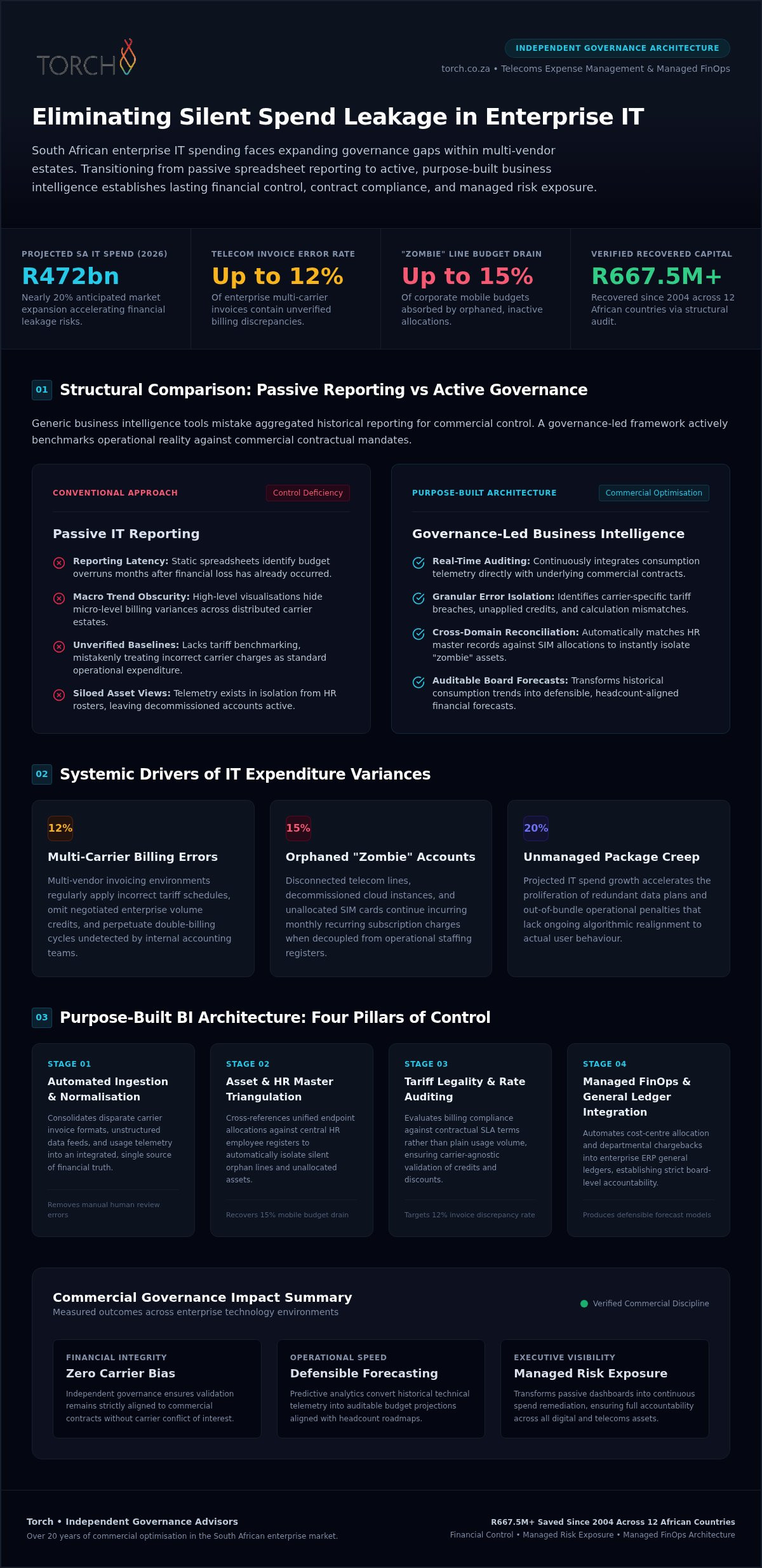
With South African IT spending projected to grow by nearly 20% to R472 billion in 2026, the risk of financial leakage has never been higher. Up to 12% of telecom invoices contain billing errors. For most CFOs, these operational variances remain obscured within fragmented multi-vendor billing and static spreadsheet reporting that identifies budget overruns months after the loss occurs. You likely recognise the frustration of attempting to translate technical consumption telemetry into actionable board-level financial accountability. By using BI to find IT savings opportunities, your organisation can bridge this gap, transforming passive data into a strategic asset for independent governance.
This guide explores how purpose-built business intelligence models uncover hidden IT variances and establish lasting financial control. We’ll examine the transition from passive reporting dashboards to active, governance-led spend remediation across all enterprise assets. With over R667.5M saved since 2004 across 12 African countries, we understand that true commercial optimisation requires more than just visibility. We’ll detail how to implement predictive analytics that produce defensible, auditable board-level budget forecasts, ensuring you maintain managed risk exposure in an increasingly complex environment.
Key Takeaways
- Contrast passive reporting visualisations with active governance models to resolve structural control deficiencies and hidden billing errors.
- Learn the strategic methodology of using BI to find IT savings opportunities by integrating billing validation with real-time consumption telemetry.
- Discover how cross-referencing asset inventories against HR master records isolates costly orphaned accounts that standard dashboards frequently overlook.
- Implement predictive analytics to transform historical expenditure into auditable, board-level budget forecasts aligned with headcount and project roadmaps.
- Establish a managed FinOps framework to bridge the persistent execution gap between technical data insights and decisive commercial remediation.
Why Generic Dashboards Fail to Uncover IT Spend Leakage
Standard enterprise dashboards often provide a false sense of security. They aggregate historical expenditure into neat visualisations, yet they rarely analyse whether those costs actually comply with underlying commercial contracts. This creates a governance gap where passive reporting is mistaken for control. Whilst Business Intelligence (BI) is a broad term for data analysis, a governance-led model differs fundamentally from passive reporting. Passive tools show you what happened; governance-focused BI shows you where the reality of your estate diverges from your financial and operational mandates.
The Structural Flaws of Passive IT Reporting
Spreadsheets and standard ERP charts introduce significant latency between the moment expenditure occurs and the point of managerial review. By the time a budget overrun appears on a monthly report, the financial leakage has already been sustained. These macro-level visualisations are designed to track broad trends, which means they naturally hide micro-level billing discrepancies across complex multi-carrier telecom estates. Without granular contract benchmarking, standard dashboards inadvertently validate incorrect supplier charges as normal baselines. This lack of precision is why using BI to find IT savings opportunities requires a shift toward models that integrate contract logic directly into the data stream.
Identifying Silent Leakage Across Distributed Technology Estates
Silent financial leakage accumulates undetected in multi-vendor environments through billing errors and unallocated costs. Unmanaged subscription creep and redundant data packages steadily erode enterprise operating margins, yet superficial metrics often obscure individual subscriber anomalies, unused cloud instances, and orphaned hardware connections. Internal finance teams, whilst diligent, often lack the carrier-agnostic validation tools required to catch sophisticated billing errors. Establishing systemic visibility requires moving beyond basic charts to specialised telecoms expense management governance frameworks. With over 20 years operating in the South African market, we have observed that resolving these governance gaps is an important way to support lasting financial control and accountability.
By replacing passive reporting with active commercial control, organisations can transition from merely observing spend to actively managing risk exposure. This proactive stance ensures that every Rand spent on technology is accounted for and validated against actual consumption and contract terms.
Evaluating Purpose-Built BI Models for IT Expense Management
Purpose-built models don’t just report; they integrate billing validation, asset inventories, and active consumption telemetry simultaneously. This multi-layered approach is the cornerstone of using BI to find IT savings opportunities. By cross-referencing HR master records against telecom line allocations, these models isolate costly orphaned accounts that standard tools miss. Independent analytical engines reveal unoptimised rate structures without carrier bias, ensuring that commercial optimisation remains the priority. This level of oversight provides the financial control and accountability required to manage complex, multi-vendor technology estates effectively.
Core Architectural Capabilities of Specialised IT BI
Automated data ingestion normalises disparate billing formats into a single source of truth, removing the manual burden from finance teams and reducing human error. Algorithmic tariff optimisation continuously matches historical user behaviour to ideal commercial packages, whilst direct integration with ERP general ledgers automates cost-centre allocation and departmental chargebacks. This level of Managed FinOps ensures every technology asset is governed by strict financial policy, rather than being left to passive observation.
Commercial Auditing Versus Basic Usage Tracking
Basic usage tracking measures gigabytes consumed, but commercial auditing validates tariff legality. It’s not enough to know how much data was used; you must verify that negotiated discounts and contractual credits are applied correctly. Enterprise governance demands linking software usage to physical hardware via unified endpoint management to ensure full estate accountability. This also connects financial control with endpoint security: an unmanaged or non-compliant endpoint can create avoidable cost exposure while increasing the organisation’s vulnerability to ransomware and related disruption. Reviewing endpoint compliance alongside spend data helps prioritise remediation according to both commercial impact and security risk; see the endpoint security checklist for a governance-led approach. Dynamic variance analysis flags consumption threshold breaches before month-end invoices are finalised, allowing for proactive spend remediation. To see how these models apply to your specific estate, you might consider booking a 30-minute governance review with Derek King. Flagging contract auto-renewal dates months in advance protects your future commercial negotiation leverage, keeping you in control of the multi-carrier landscape.
By focusing on commercial auditing rather than simple tracking, organisations can identify structural control deficiencies that lead to budget friction. This transition from passive reporting to active, independent governance is what enables a managed risk exposure that protects the bottom line.
Deploying Predictive Analytics for IT Budget Forecasting
Transforming historical expenditure into reliable forward-looking operational capital forecasts requires a structured approach. Standard tools often fail in volatile multi-carrier telecom and cloud environments, leaving technology leadership without practical budgeting workflows. By contrast, predictive algorithms model future consumption growth based on headcount expansion and project roadmaps, ensuring that financial expectations align with operational realities. This disciplined methodology underpins the process of using BI to find IT savings opportunities before budget overruns occur.
Step 1 to 3: Data Ingestion, Reconciliation, and Baseline Normalisation
The foundation of any robust forecast relies on clean data. First, ingest electronic data records from telecom providers, cloud vendors, and software suppliers to eliminate visibility gaps. Second, reconcile individual line-item charges against active procurement master services agreements and contracts. This step isolates billing errors and enforces contract compliance. Finally, establish clean historical baselines adjusted for non-recurring credits and seasonal operational fluctuations, creating a dependable foundation for future modelling.
Step 4 to 5: Predictive Variance Modelling and Financial Stress-Testing
Once baselines are secure, apply regression models to forecast capacity demands across corporate mobile and data estates. Scenario analysis evaluates the financial implications of hybrid-work mobility shifts and cloud migrations, allowing leadership to simulate commercial scenarios prior to major contractual vendor renegotiations. This process produces CFO-ready forecasts that align technical growth metrics directly with corporate financial targets. Proactive anomaly alerts notify procurement teams when consumption deviations signal emergent budget risks, keeping your managed risk exposure within acceptable tolerances. This structured approach mirrors the core principles of a mature FinOps governance framework, where financial control and accountability are embedded into daily operations.
By executing these steps, enterprise organisations can move away from reactive crisis management and toward a steady, predictable budgeting cycle. This proactive stance ensures that future infrastructure investments are fully governed, defensible, and optimised for long-term commercial efficiency.
Executing Structural Governance Through Managed FinOps
Analytical insights provide zero economic return unless coupled with decisive administrative and commercial remediation. Whilst many organisations successfully identify discrepancies, they often falter at the execution stage. Using BI to find IT savings opportunities is merely the diagnostic phase; the second, more critical phase is bridging the persistent execution gap between technical reporting and procurement through independent managed governance. This ensures that identified variances are actually recovered and that structural control deficiencies are permanently resolved.
Translating Analytical Variance into Contractual Recovery
Dedicated governance analysts pursue carrier billing disputes using immutable analytical evidence from purpose-built BI models. This process replaces speculative claims with data-driven accountability. Carrier-agnostic market benchmarking provides the empirical leverage required to renegotiate expiring master agreements effectively, ensuring your commercial terms remain competitive. It’s also vital to implement strict workflow governance to prevent redundant services from surviving employee offboarding cycles. Explore how proprietary technology solutions automate operational oversight across sprawling estates, ensuring that every asset is accounted for in real time.
Establishing Continuous Board-Level Financial Accountability
The final stage of a mature governance model involves transforming complex technical usage telemetry into defensible, board-level financial reports and variance commentaries. CFOs require clear, auditable insights to maintain financial control and accountability. By adopting integrated IT FinOps disciplines, enterprises maintain structural cost optimisation permanently rather than as a once-off exercise. Engaging independent specialists allows you to maintain objective oversight across multi-vendor carrier environments, free from the conflicts of interest inherent in vendor-supplied reporting.
Since 2004, our managed governance approach has helped clients save over R667.5M across 12 African countries. Continuous subscription rationalisation delivers recurring savings that defend margins against inflationary economic pressures. This disciplined approach to using BI to find IT savings opportunities ensures that your technology estate remains a lean, governed, and strategically aligned asset. By shifting from passive observation to active commercial remediation, you secure the lasting financial discipline required in the modern enterprise landscape.
Establishing Lasting Commercial Control through Independent Governance
Transitioning from passive reporting to active commercial control is one of the most effective ways to address persistent governance gaps in a complex multi-vendor environment. You’ve seen how standard dashboards often mask significant financial leakage, whereas purpose-built models integrate billing validation with active consumption telemetry. By using BI to find IT savings opportunities, your organisation can bridge the execution gap between technical reporting and procurement, ensuring that every Rand spent is fully governed and accounted for.
With more than 20 years of dedicated independent advisory experience within the South African market, we have refined a proven governance methodology. Our results are backed by R8.9M SBSA-verified and R38.4M PwC-audited outcomes, contributing to over R667.5M in verified savings delivered since 2004 across 12 African countries. Establishing this level of financial control and accountability doesn’t just protect your current budget; it fortifies your entire technology estate against future inflationary pressures.
Taking the first step toward independent governance ensures your business remains agile and financially disciplined. We look forward to helping you simplify the complexity of your technology spend and secure the commercial optimisation your board demands.
Frequently Asked Questions
How does purpose-built BI differ from native carrier billing portals?
Carrier portals lack independence and cannot audit their own revenue effectively. Purpose-built BI provides objective, carrier-agnostic validation across multiple vendors simultaneously. It identifies hidden costs and governance gaps that vendor-supplied dashboards naturally overlook. Whilst portals focus on basic usage tracking, specialised BI models enforce contract compliance and commercial optimisation. This independent oversight is essential for maintaining financial control and accountability in complex multi-carrier environments.
Can business intelligence tools identify billing errors retroactively?
Yes, specialised BI engines perform historical audits by ingesting electronic data records from previous billing cycles. By using BI to find IT savings opportunities, analysts compare past invoices against procurement master services agreements to uncover structural control deficiencies. This process often reveals recurring billing errors or unapplied contractual credits. Identifying these historical variances provides the immutable evidence needed to pursue carrier billing disputes and secure financial recovery.
What data sources are required to build an effective IT expense model?
An effective model requires integrating disparate data streams into a single source of truth. Key sources include electronic billing records from telecom and cloud providers, HR master records for user allocation, and active contract terms. Linking software usage to hardware via unified endpoint management data is also critical. Normalising this data allows for granular variance analysis, ensuring every asset is governed according to its specific commercial and operational mandate.
Why do generic ERP reporting tools struggle with telecom data?
Generic ERP tools typically aggregate historical expenditure without the specialised logic required to interpret complex multi-carrier billing formats. They introduce significant latency and often lack the ability to perform real-time tariff reconciliation. Telecom data involves high volumes of micro-level line items that standard ERP charts cannot validate against specific contractual benchmarks. This leads to a lack of visibility, where incorrect supplier charges are inadvertently validated as normal baselines.
How does predictive analytics improve enterprise IT budget forecasting?
Predictive analytics transforms historical expenditure into reliable forward-looking operational capital forecasts by modelling future consumption growth. These algorithms consider headcount expansion, project roadmaps, and hybrid-work mobility shifts to simulate various commercial scenarios. Using BI to find IT savings opportunities through predictive modelling allows CFOs to produce defensible, auditable budget forecasts. This proactive stance notifies procurement teams of emergent risks before they manifest as month-end budget overruns.
What organisational roles must collaborate to act on IT savings insights?
Effective spend remediation requires a cross-functional partnership between Finance, IT, and Procurement. The CFO provides financial discipline, whilst the CIO offers technical consumption telemetry for asset accountability. Procurement leaders then use these analytical insights to renegotiate expiring master agreements or resolve billing disputes. This collaboration ensures that technical data is translated into board-level financial reports, bridging the execution gap between reporting and active commercial optimisation across the estate. If your leadership team is also reviewing spend across complementary enterprise categories such as business travel and corporate events, discover Dominic Marc Short – Independent Consultant for independent procurement and advisory expertise.