
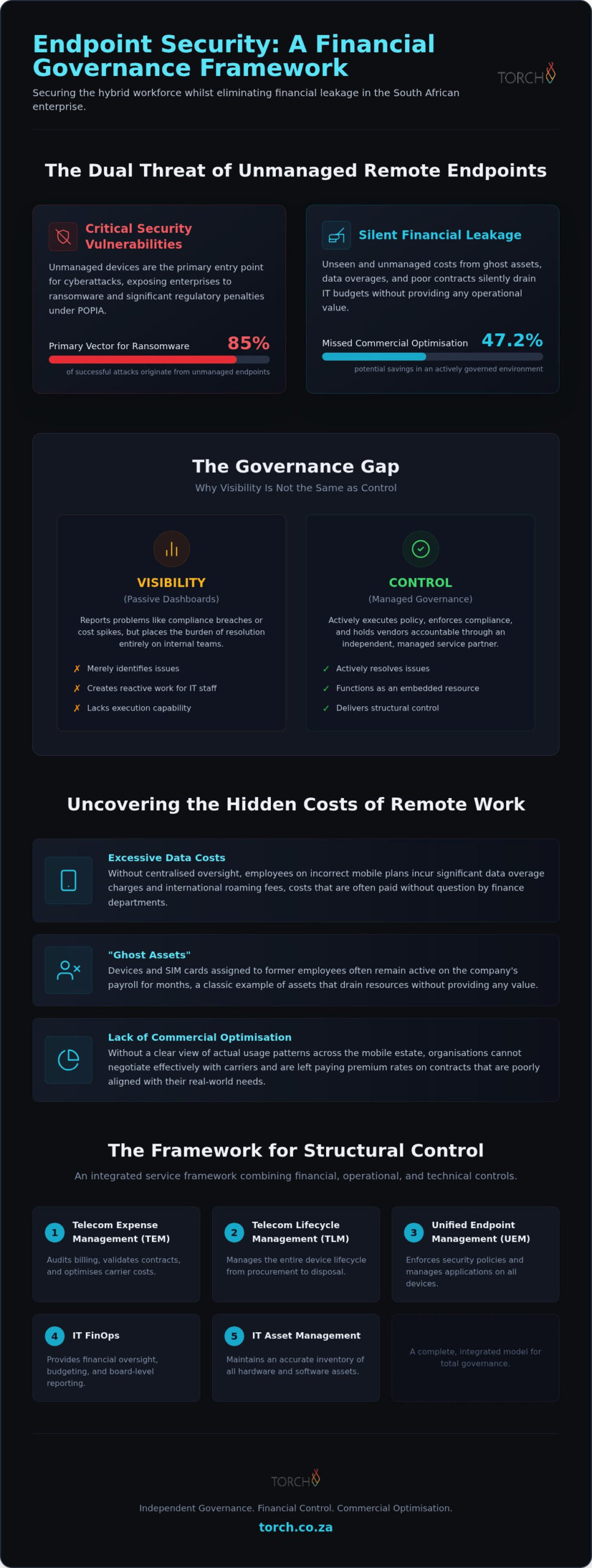
Endpoint security for remote work is no longer a purely technical discipline; it has evolved into a critical financial governance framework. For South African enterprises navigating the complexities of a hybrid workforce, the failure to manage every device connecting to the corporate network represents a dual threat. It is a primary vector for cyberattacks and a significant source of silent financial leakage that drains IT budgets through unmanaged data costs and ghost assets.
Many organisations believe a basic Mobile Device Management (MDM) dashboard provides adequate protection. However, visibility is not the same as control. A dashboard can report a problem, but it cannot enforce policy, renegotiate a contract, or hold a vendor accountable. This distinction is the central governance gap that leaves businesses exposed to both security breaches and uncontrolled expenditure.
This checklist moves beyond generic advice to provide a strategic framework for CFOs, CIOs, and IT leaders. It details how to secure your dispersed workforce whilst eliminating the financial waste associated with unmanaged remote devices, transforming endpoint security from a cost centre into a mechanism for sustained commercial optimisation.
The Financial and Security Stakes of the Hybrid Estate
In 2026, the perimeter of the corporate network is no longer the office wall; it is every laptop, smartphone, and tablet used by your remote workforce. This shift from an office-centric to an endpoint-centric security model exposes significant financial and operational risks. Unmanaged devices are not just a security vulnerability; they are a drain on resources, with enterprises often paying for services that are unused, underutilised, or allocated to employees who have left the organisation. Securing this hybrid estate requires a governance model where basic connectivity is secondary to structural control and financial accountability.
Ransomware and the Cost of Unmanaged Devices
The financial stakes of a security breach are immense, with the average cost of a data breach in South Africa reaching millions of Rands in remediation, fines, and reputational damage. Research consistently shows that unmanaged endpoints are the primary entry point for ransomware, with some studies indicating that as many as 85% of successful attacks originate from these vulnerable devices. An unmanaged device is any endpoint lacking active, centrally enforced security policy and lifecycle management.
For large South African enterprises, a single breach can lead to devastating long-term financial consequences, including regulatory penalties under the Protection of Personal Information Act (POPIA). Without a robust Unified Endpoint Management (UEM) strategy, every employee-owned or corporate-issued device operating outside the traditional office network becomes a potential foothold for malicious actors.
Silent Leakage: The Hidden Costs of Remote Work
Beyond the headline-grabbing threat of ransomware, unmanaged remote devices create a consistent, silent leakage in IT budgets. This financial drain manifests in several ways:
- Excessive Data Costs: Without centralised oversight, employees on incorrect mobile plans can incur significant data overage charges and international roaming fees, costs that are often paid without question by finance departments.
- “Ghost Assets”: Devices and SIM cards assigned to former employees often remain active on the company’s payroll for months, a classic example of “ghost assets” that drain resources without providing any value.
- Lack of Commercial Optimisation: Without a clear view of actual usage patterns across the mobile estate, organisations cannot negotiate effectively with carriers. They are left paying rack rates on contracts that are poorly aligned with their real-world needs, missing out on potential savings of up to 47.2% achievable in an actively governed environment.
–
–
This direct link between security posture and commercial optimisation underscores a modern business reality: you cannot secure what you cannot see, and you cannot control the cost of what you do not manage.
The Governance Gap: Why Visibility Is Not the Same as Control
Many enterprises invest in dashboards and reporting tools under the assumption that visibility equates to control. However, a dashboard that merely reports a problem—such as a device that is out of compliance or a surge in data spending—places the burden of resolution back onto already overburdened internal IT teams. True governance moves beyond passive monitoring to active, structural control, ensuring that policies are not just documented but consistently enforced.
This is particularly true in a multi-vendor environment where relying on carrier-led management tools creates a conflict of interest. A carrier’s primary goal is to sell connectivity, not to identify areas where you can spend less. Independent, carrier-agnostic governance is essential for ensuring vendor accountability and eliminating financial waste.
Dashboards vs. Execution
The difference between visibility and control is the difference between reporting an issue and resolving it. A dashboard might flag a security risk, but it takes a managed service to investigate the alert, enforce the required policy, and confirm remediation. Internal IT teams, often stretched thin by daily operational demands, rarely have the capacity to move beyond basic monitoring into the proactive execution required for enterprise-scale governance.
An effective governance partner embeds resources within the organisation to perform these functions, turning data from a reporting tool into actionable intelligence. This high-touch execution model bridges the gap between knowing there is a problem and having the dedicated resources to fix it, ensuring security policies are consistently applied across every endpoint.
The Six Integrated Service Lines of Structural Control
A holistic security posture cannot be achieved with a single tool. It requires an integrated framework that combines financial, operational, and technical controls. Torch’s model moves beyond a simple three-pillar approach to incorporate Six Integrated Service Lines, creating a comprehensive system for structural control:
- Telecom Expense Management (TEM): Audits billing, validates contracts, and optimises costs.
- Telecom Lifecycle Management (TLM): Manages the entire lifecycle of a device from procurement to disposal.
- Unified Endpoint Management (UEM): Enforces security policies and manages applications on all devices.
- IT FinOps: Provides financial oversight, budgeting, and board-level reporting for all IT assets.
- IT Asset Management (ITAM): Maintains a single source of truth for all hardware and software assets.
- Security Operations (SecOps): Integrates security practices into the entire governance framework to mitigate risk.
This integrated model ensures that optimisation is sustained, not temporary. By combining these six disciplines, organisations can create a resilient security and financial governance framework. For a deeper understanding of the core technical component, explore our strategy for Unified Endpoint Management.
The Enterprise Endpoint Security Checklist for Remote Work
This checklist provides a five-pillar framework for establishing comprehensive governance over your remote and hybrid endpoint estate. It is designed to be actionable for both technical and financial stakeholders, linking security enforcement directly to operational efficiency and cost control.
- Pillar 1: Full Estate Visibility and Asset Discovery. You cannot manage what you do not know exists. The first step is to create a complete, real-time inventory of every device accessing corporate resources, including corporate-issued, BYOD, and CYOD assets.
- Pillar 2: Enforced Policy Compliance and Multi-Factor Authentication. Establish and automate the enforcement of security policies, ensuring every device meets baseline security requirements before being granted access to the network.
- Pillar 3: Automated Patch Management and Application Governance. Ensure all endpoints are consistently updated with the latest security patches to protect against known vulnerabilities. Control which applications can be installed and run on devices.
- Pillar 4: Data Usage Monitoring and Roaming Control. Monitor mobile data consumption in real time to prevent bill shock and enforce policies that control costly international roaming.
- Pillar 5: Cradle-to-Grave Lifecycle Management. Implement a formal process for managing the entire lifecycle of every asset, from procurement and onboarding to decommissioning and secure disposal.
Technical Enforcement and Compliance
A robust security posture relies on consistent technical enforcement. Your checklist for remote work endpoints must include:
- Mandatory Multi-Factor Authentication (MFA): Enforce MFA for access to all corporate applications and data, especially email and cloud services.
- Data Encryption: Ensure all data at rest on endpoint devices is encrypted to protect sensitive information in the event of loss or theft.
- Selective Wiping for BYOD: Implement technology that allows IT to remotely wipe only corporate data from an employee-owned device, protecting personal privacy whilst securing company assets.
- Automated Compliance Reporting: Use a UEM platform to automate the generation of compliance reports, providing auditors with clear evidence that POPIA requirements are being met. Tracking these assets effectively is a core discipline of IT FinOps, which provides the financial lens for your asset register.
–
–
–
Commercial and Operational Governance
Technical controls are only one half of the equation. They must be supported by rigorous commercial and operational governance to eliminate financial leakage and ensure efficiency.
- Audit Mobile Contracts: Regularly audit your mobile carrier contracts against actual remote work usage patterns to identify misalignments and opportunities for negotiation.
- Establish a Single Source of Truth: Create a centralised, accurate IT asset register that integrates with HR and finance systems. This prevents billing for “ghost assets” and provides a foundation for accurate financial forecasting. For more on this, see how to move from a simple asset management reporting dashboard to independent governance.
- Define the Asset Lifecycle: The “cradle-to-grave” asset lifecycle—covering procurement, deployment, management, and retirement—must be the standard for independent governance, ensuring no device is left unmanaged at any stage.
–
–
Implementing Structural Control: Beyond the Checklist
A checklist is a valuable guide, but its true power is only unlocked through consistent, automated, and managed execution. For most enterprises, the path from a manual checklist to a fully governed environment requires a strategic partner capable of implementing structural control. This involves leveraging specialised technology and embedding expert resources to manage the complexities of the endpoint estate on your behalf.
Proprietary technology like Torch’s SpotLight™ platform provides the real-time governance visibility needed to move beyond reactive reporting. It allows for immediate oversight of budgets versus actual spend, cost-centre allocation, and user-level consumption, transforming raw data into a powerful tool for financial control. This active management approach is proven to reduce security exposure whilst capturing up to 19.6% in immediate subscription savings.
Managed Services as a Strategic Imperative
Independent advisors provide superior risk mitigation compared to connectivity vendors, as their incentives are aligned with your goals of cost reduction and security, not with selling more services. An independent partner provides objective oversight, holds vendors accountable, and delivers the board-level IT finance reporting needed to build budget confidence.
This journey from an unmanaged estate to a governed environment does not need to be a multi-year project. As demonstrated in a six-week engagement with the Tsogo Group, a focused, data-backed approach can rapidly define a new mobility model, reduce administrative burden, and deliver a procurement decision that satisfies CFO scrutiny. This is the power of combining deep market expertise with a proven Telecom Expense Management framework.
Next Steps for the CFO and CIO
For financial and technology leaders, the first step towards a governed endpoint estate is to quantify the extent of the current financial leakage. A no-cost telecom billing audit can analyse your last three months of invoices to identify immediate and actionable savings opportunities. This data-driven diagnostic provides a clear business case for transitioning to a managed governance model.
Ultimately, the most effective partnerships operate on a risk-share model, where the provider’s incentives are directly aligned with your cost-reduction outcomes. This ensures a focus on delivering measurable, verified savings. To understand the specific governance gaps in your organisation, consider a confidential, no-obligation diagnostic with an expert.
Book a 30-minute governance review with Derek King to begin building a more secure and financially efficient remote work environment.
Frequently Asked Questions (FAQs)
Why is endpoint security essential for remote work in South Africa?
Endpoint security is essential in South Africa to protect against high rates of cybercrime, particularly ransomware, and to ensure compliance with the Protection of Personal Information Act (POPIA). With a remote workforce, unmanaged devices create significant vulnerabilities and can lead to severe financial and legal penalties if sensitive data is breached.
How does Unified Endpoint Management (UEM) reduce ransomware risk?
UEM reduces ransomware risk by enforcing consistent security policies across all devices, regardless of their location. This includes mandatory patch management to close known vulnerabilities, application controls to prevent malicious software from being installed, and the ability to remotely isolate or wipe a device if it is compromised, preventing an attack from spreading across the network.
Can we manage remote security without infringing on employee privacy on BYOD devices?
Yes. Modern UEM solutions use containerisation to create a separate, encrypted corporate workspace on an employee’s personal device. This allows the company to secure and manage all corporate data and applications within the container—including the ability to selectively wipe it—without accessing or affecting the employee’s personal data, thus respecting their privacy.
What is the difference between MDM and Unified Endpoint Security Management?
Mobile Device Management (MDM) is an older technology focused primarily on managing the settings and security of corporate-owned smartphones. Unified Endpoint Security Management (UESM), a component of UEM, is a modern, holistic approach that manages and secures a much wider range of endpoints—including laptops, tablets, and desktops—across multiple operating systems (iOS, Android, Windows, macOS) and ownership models (corporate and BYOD).
How much can an enterprise save by governing its remote mobile estate?
An actively governed estate can achieve up to 47.2% in total cost reduction compared to an unmanaged environment. These savings come from a combination of optimised carrier contracts, elimination of ghost assets and billing errors, and control over data usage and roaming costs.
What are the POPIA implications for remote work endpoints?
Under POPIA, an organisation is responsible for protecting any personal information it processes, regardless of where that data is stored or accessed. For remote work endpoints, this means the organisation must be able to demonstrate that it has implemented appropriate technical and organisational measures—such as encryption, access controls, and data wipe capabilities—to prevent unauthorised access to or loss of personal data on employee devices.