
Investing in a world-class automation platform might be the most expensive way to remain blind to your actual IT expenditure. Whilst global tools promise efficiency, many South African enterprises find that a sophisticated dashboard is no match for the structural opacity of local telecom billing or the relentless growth of software shelfware. When evaluating Brightfin vs Torch Services, the choice isn’t merely between two software vendors; it’s a decision between a platform-native automation engine and a strategic managed services partner. You likely recognise that visibility is the first step toward control, yet true optimisation requires more than just raw data.
This comparison explores the critical differences between global automation and strategic oversight to help you eliminate wasteful technology expenditure. We provide a detailed look at how each model addresses the complexities of the African market, from managing endpoint governance to reconciling R1,000,000 monthly telecom invoices. By the end of this analysis, you will understand which partner offers the strategic guidance necessary to transform your IT spend from a black box into a transparent, value-driving asset.
Key Takeaways
- Understand the critical transition from traditional telecom expense management to IT FinOps and how it helps your organisation reclaim wasted expenditure.
- Evaluate the core technical differences between Brightfin vs Torch Services, specifically concerning ServiceNow integration and automated global invoice processing.
- Discover why strategic managed services often outperform software dashboards when navigating the unique complexities and opaque billing of the African market.
- Learn to distinguish between global ticketing support models and dedicated strategic consultants who provide proactive guidance rather than just raw data.
- Utilise a structured selection framework to identify the right partner based on your current technology ecosystem and geographic footprint.
The Evolution of Technology Expense Management in 2026
The corporate environment in 2026 has outgrown the narrow confines of traditional auditing. For years, organisations relied on monthly reviews to spot billing errors, yet the sheer volume of data and the speed of digital transformation have made that approach obsolete. The Evolution of Technology Expense Management has reached a tipping point where visibility alone is no longer a competitive advantage; it’s a basic operational requirement. IT FinOps is the strategic alignment of technology spend with business value. This shift represents a move from simply tracking costs to actively engineering financial efficiency across every digital touchpoint.
When evaluating Brightfin vs Torch Services, the debate often centres on how deeply an organisation wants to integrate these financial controls into its operational DNA. As remote and hybrid work models remain permanent fixtures, with a significant portion of the workforce operating outside traditional offices, managing associated expenses requires high-level automation. Enterprises are subsidising home fibre, managing 5G data bundles, and securing a fleet of mobile devices, while also looking to learn more about Elevenpast to improve the physical setup of these remote workspaces with contemporary pendant pieces. Without a sophisticated framework, these costs spiral into a fragmented mess of unmanaged expenditure.
The Shift from Reactive Auditing to Proactive Optimisation
Market pressures in 2026 demand real-time cost control to protect margins. Waiting for a monthly invoice to arrive often means discovering a R50,000 overspend four weeks too late. Continuous governance has replaced the old audit cycle. With 5G and IoT adoption accelerating, enterprise data consumption patterns are more volatile than ever. A single misconfigured IoT sensor can generate thousands of Rands in unnecessary roaming charges in hours. Proactive systems now flag these anomalies instantly, allowing for immediate remediation rather than retrospective regret. This ensures that IT leaders stay ahead of the curve rather than constantly playing catch-up with their service providers.
Why Enterprise Technology Spend is More Complex Than Ever
Modern procurement teams must manage a complex trifecta: Cloud, Telecom, and Endpoint assets. This convergence creates fertile ground for “shadow IT,” where departments purchase tools or cloud instances without central oversight. It’s common to find software shelfware or redundant subscriptions that drain budgets quietly. Automated user support systems are now essential to reduce operational friction. By automating routine requests, such as data top-ups or device upgrades, businesses can maintain strict endpoint governance without slowing down their teams. This level of oversight ensures that every Rand spent on technology directly supports a measurable business outcome, fortifying the organisation’s financial health.
Decoding Brightfin: The ServiceNow-Native Powerhouse
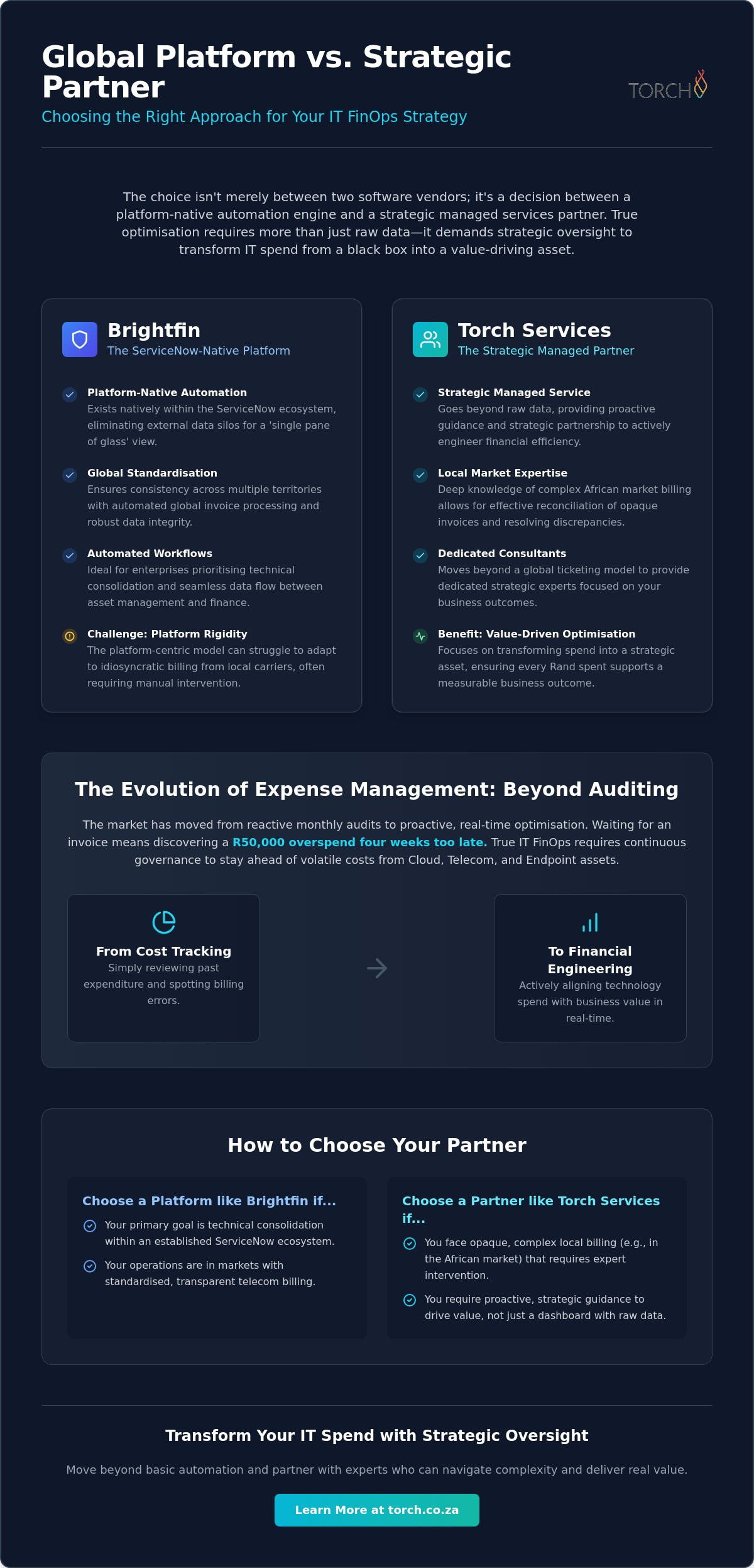
For organisations that have centralised their operations within the ServiceNow ecosystem, Brightfin presents a compelling proposition. By existing natively within the platform, it eliminates the need for external data silos, providing a “single pane of glass” for IT spend. This integration allows for seamless data flow between asset management, procurement, and financial reporting. When comparing Brightfin vs Torch Services, the primary distinction lies in this platform-centric architecture. It’s a robust solution for enterprises that prioritise technical consolidation and automated workflows above all else.
The standardisation offered by such a global platform ensures consistency across multiple territories. According to guidelines from the Technology Expense Management industry bodies, data integrity is the cornerstone of effective oversight. Brightfin excels here by leveraging ServiceNow’s existing data structures to automate global invoice processing. However, this rigidity can become a limitation for bespoke requirements. A platform-centric model often struggles to adapt to the idiosyncratic billing behaviours of local South African carriers, where manual intervention and deep market knowledge are frequently required to resolve discrepancies.
Brightfin’s Managed Mobility Services (MMS)
Brightfin provides a comprehensive lifecycle for mobile assets, managing everything from initial procurement to secure recycling. Their system automates Unified Endpoint Management (UEM) administration, ensuring that corporate policies are enforced without manual oversight. This automation reduces the burden on IT desks, whilst standardised support models provide a predictable experience for global users. It’s an efficient way to handle thousands of devices, provided those devices fit within the pre-defined workflows of the software. For those needing a more tailored approach to IT FinOps-as-a-Service, the choice becomes more nuanced.
Cloud and Telecom Integration
Managing multi-cloud environments is a significant challenge for the modern CIO. Brightfin addresses this by pulling cloud usage data into the ServiceNow dashboard, using AI-driven insights to uncover potential savings. These algorithms are excellent at spotting underutilised instances or redundant subscriptions across global cloud providers. Whilst these tools are powerful, they often lack the high-touch consultancy needed to navigate regional market nuances. In the South African context, where carrier contracts are notoriously complex and billing errors are frequent, a purely automated tool might miss the subtle negotiation opportunities that a dedicated strategic partner would identify. Enterprises evaluating their broader device management strategy should also consider how their choice of ManageEngine vs enterprise UEM platforms impacts their ability to maintain independent governance and financial accountability across the endpoint estate.
The Torch Services Advantage: Strategic IT FinOps and Managed Excellence
While automated platforms provide a necessary foundation for data collection, they often lack the contextual intelligence required to navigate non-standardised markets. Torch Services positions itself not merely as a software provider, but as a strategic partner deeply embedded in the African enterprise landscape. The philosophy of IT FinOps-as-a-Service represents a fundamental shift away from static software dashboards toward a model of continuous, expert-led intervention. This approach ensures that technology spend is not just recorded but actively managed to support broader business objectives. When evaluating Brightfin vs Torch Services, the distinction becomes clear: one provides the tool, whilst the other provides the map and the navigator.
Automation often fails to account for the “human element” of billing discrepancies and contractual grey areas. Torch Services uncovers hidden savings that automated platforms frequently miss by combining rigorous analysis with deep industry expertise. These savings often reside in incorrectly applied tariffs, unutilised data bundles, or legacy service agreements that no longer serve the organisation. Torch Services integrates managed services with purpose-built BI models for executive clarity, ensuring that complex operational data is translated into actionable financial intelligence for the boardroom.
Tailored Solutions for the African Landscape
Navigating the South African telecommunications market requires more than just a global template. Local carrier billing behaviours are notoriously opaque, often requiring persistent, manual reconciliation to resolve. Torch Services leverages extensive local market knowledge to manage these relationships, ensuring that enterprises aren’t overpaying due to regional administrative errors. As an independent partner, Torch Services maintains no vendor bias. This independence is crucial during contract negotiations, where the goal is to fortify the client’s position rather than protect a service provider’s margins. This level of focus is essential for organisations managing significant Rands in monthly spend across diverse African territories.
Unified Endpoint Security and Governance
Modern expense management cannot exist in a vacuum; it must be coupled with robust asset security. Torch Services extends its oversight beyond simple cost tracking to provide comprehensive endpoint governance and security. By integrating automated user support with its asset management platform, Torch Services reduces operational friction for the workforce whilst maintaining strict control over corporate devices. This ensures that every endpoint is not only cost-effective but also compliant with internal security protocols. Enterprises seeking to formalise this approach should consider implementing a structured endpoint governance framework that reconciles technical device management with financial accountability. Enhancing operational efficiency in this manner protects the organisation from both financial waste and potential security vulnerabilities, creating a more resilient IT ecosystem. For small and medium-sized businesses operating in Southern California, Trinity Networx, LLC offers a similar focus on proactive IT support and cybersecurity to safeguard business assets.
Critical Comparison: Global Automation vs Strategic Managed Services
Speed of deployment often dictates initial satisfaction, yet long-term success hinges on operational depth. When weighing Brightfin vs Torch Services, enterprises must decide if they have the internal capacity to drive a complex software tool or if they require a partner to own the financial outcome. A platform-native setup, whilst technically impressive, often involves extensive configuration periods that can span several months before providing actionable insights. Strategic managed services prioritise the immediate ingestion of data, allowing experts to begin identifying billing anomalies and reclaiming wasted expenditure within the first few weeks of onboarding.
Support models represent another significant point of divergence. Global ticketing systems are designed for technical troubleshooting, providing efficient resolutions for software bugs but often failing to address complex financial queries. A dedicated strategic consultant, however, acts as an extension of your procurement team. They don’t just tell you the software is working; they explain why your data roaming costs whilst roaming internationally spiked and how to restructure your contract to prevent a recurrence. This level of personalised oversight ensures that your IT FinOps strategy remains agile and responsive to shifting business needs.
The risk of “software shelfware” is a persistent threat to ROI in the enterprise space. It’s common for organisations to purchase sophisticated dashboards only to find that their teams lack the time or expertise to utilise every feature effectively. Without active management, these tools become expensive mirrors reflecting problems rather than solving them. Choosing a partner that delivers IT FinOps-as-a-Service ensures that the responsibility for savings and optimisation rests with the service provider, not your already overstretched IT department.
Regional Expertise vs Global Standardisation
South African enterprises operate in a unique environment where carrier billing is rarely standardised. Global templates often struggle with the nuances of local contracts, leading to missed savings or inaccurate reporting. A partner with deep roots in the local market understands the specific behaviours of South African carriers and can navigate the administrative hurdles required to secure credits or negotiate better terms. Torch Services bridges the gap between raw software capabilities and high-level strategy, ensuring that global best practices are applied with local precision.
Cost Management and ROI
True ROI is measured by more than just the elimination of billing errors. Whilst direct savings are the most visible benefit, indirect operational efficiencies often provide the greatest long-term value. By automating user support and streamlining endpoint governance, organisations can redirect their internal resources toward core business growth. When selecting a partner, look beyond the feature set and evaluate the potential for sustained financial health. To see how a tailored approach can fortify your bottom line, explore our IT FinOps-as-a-Service models today.
Selection Framework: Identifying the Right Partner for Your Enterprise
Selecting the ideal partner requires a candid assessment of your organisational maturity and long-term strategic goals. The choice between Brightfin vs Torch Services often hinges on whether you require a highly specialised tool to be managed internally or a comprehensive service that guarantees financial outcomes. To navigate this decision, follow a structured framework that prioritises your specific operational realities over generic software features. This logic ensures that your investment yields a measurable return rather than becoming another underutilised asset in your technology stack.
- Step 1: Assess your current IT ecosystem. If your organisation is a ServiceNow-first environment, the technical convenience of a native integration is a significant factor. You must decide if the ease of a unified interface outweighs the need for specialised regional expertise.
- Step 2: Define your geographic focus. Complexity varies by territory. If your primary challenges reside in the South African or broader African markets, you require a partner capable of navigating local carrier behaviours and opaque billing structures that global templates often miss.
- Step 3: Evaluate your internal resources. Be honest about your team’s capacity. Do you have the personnel to manage a sophisticated software dashboard, or do you need a dedicated team to own the optimisation process?
- Step 4: Determine your scope. Identify if you are solving a narrow telecom problem or if you require full IT FinOps-as-a-Service to manage cloud, mobile, and endpoint assets holistically.
- Step 5: Request a tailored proof of concept. Move beyond the sales deck. Ask each provider to demonstrate how they would resolve a specific, high-value pain point, such as reconciling a complex R2,000,000 monthly invoice or uncovering shadow IT expenditure.
When to Choose Brightfin
Brightfin is the logical choice for ServiceNow-heavy enterprises that have already centralised their global IT operations within that platform. It’s ideal for organisations that prioritising standardised global automation and have the internal capacity to manage sophisticated software workflows. If your primary goal is technical consolidation across multiple international regions and you possess a mature IT department to drive the tool, Brightfin provides a robust, platform-native solution.
When to Choose Torch Services
Torch Services is designed for enterprises requiring deep expertise in the high-complexity African landscape. It is the superior option for organisations seeking a proactive, managed IT FinOps-as-a-Service model where the partner is accountable for uncovering savings. Choose Torch if you value a strategic partnership that goes beyond a pure SaaS subscription. Decision-makers who require executive-level clarity through purpose-built BI models and want to eliminate the risk of software shelfware will find Torch’s managed excellence more aligned with their needs. Organisations that also need to address device accountability and regulatory compliance will benefit from Torch’s approach to building a sustainable endpoint governance framework that bridges the gap between IT security and financial oversight.
Transforming Visibility into Strategic Value
The decision between Brightfin vs Torch Services ultimately rests on whether your organisation requires a technical tool or a strategic outcome. Whilst global platforms offer impressive automation within the ServiceNow ecosystem, they often lack the contextual depth needed to navigate the specific complexities of the South African telecom market. True efficiency is found when data visibility is paired with expert-led intervention. By transitioning from reactive auditing to a proactive IT FinOps model, you ensure that every Rand spent on technology is an investment in business growth rather than a sunk cost.
Torch Services stands as a leading African technology managed services provider, offering independent expertise with no vendor bias. As specialists in IT FinOps-as-a-Service, our team focuses on delivering tangible financial health through purpose-built BI models and rigorous endpoint governance. Discover how Torch Services can optimise your enterprise IT spend and reclaim control over your digital workplace expenditure. With the right partner, you can turn your IT expenditure into a transparent and powerful driver of corporate value.
Frequently Asked Questions
What is the main difference between Brightfin and Torch Services?
The primary distinction between Brightfin vs Torch Services lies in the delivery model. Brightfin provides a platform-native automation tool whilst Torch Services delivers a managed service where experts actively drive financial outcomes. One offers a sophisticated dashboard for internal teams to manage; the other provides a strategic partnership where the service provider is accountable for uncovering savings. This choice depends on whether you have the internal resources to operate a complex system or require a team to own the result.
Does Torch Services integrate with existing IT platforms?
Torch Services integrates with a wide variety of enterprise IT platforms to ensure full visibility. By connecting its asset management platform with your existing systems, it creates a unified view of your technology spend. This allows decision-makers to track assets and costs without abandoning their established workflows. It’s about enhancing your current ecosystem with strategic oversight rather than forcing a total replacement of your existing infrastructure.
Is Brightfin only for ServiceNow users?
Brightfin is specifically engineered for ServiceNow users. Whilst it can function in other environments, its core value proposition is the seamless, native integration within the ServiceNow ecosystem. This allows organisations to manage technology expenses without leaving their primary operational platform. If your business isn’t heavily invested in ServiceNow, you might find the platform’s rigidity a challenge when trying to adapt to bespoke local procurement needs.
How does IT FinOps-as-a-Service differ from traditional TEM?
IT FinOps-as-a-Service expands the scope of traditional TEM by aligning all technology expenditure with business value. It moves beyond simple bill auditing to include cloud and endpoint governance through continuous optimisation. Whilst traditional TEM is reactive, IT FinOps is a proactive strategy designed to eliminate wasteful spend in real-time. This ensures that your IT budget supports measurable corporate objectives rather than just paying for unutilised subscriptions.
Can Torch Services manage mobile data costs across Africa?
Managing mobile data costs across Africa is a core competency of Torch Services. The team navigates complex regional regulations and carrier billing behaviours to ensure enterprises don’t overpay for data in diverse territories. This local market knowledge is vital for reconciling invoices that global automation tools often find indecipherable. By leveraging these insights, businesses can maintain control over data roaming and local bundles across the entire continent.
Which provider is better for a South African enterprise?
Torch Services is generally the superior choice for a South African enterprise due to its deep regional expertise. Global platforms often struggle with the non-standardised billing behaviours of local carriers, leading to missed savings. Torch provides independent, vendor-neutral guidance that’s essential for navigating the unique regulatory environment of the South African market. Choosing between Brightfin vs Torch Services involves weighing global standardisation against the high-touch, specialised oversight required to manage local Rands effectively.
What are the benefits of a managed service over a software platform?
A managed service ensures that your organisation achieves actual savings rather than just owning a software dashboard. This model eliminates the risk of software shelfware by providing dedicated consultants to execute optimisation strategies on your behalf. It’s a proactive approach where the partner owns the financial outcome. This allows your internal IT team to focus on core business growth whilst the service provider handles the complex reconciliation of technology costs.
How do these providers handle endpoint security and asset management?
Both providers integrate asset management, but Torch Services specifically focuses on unified endpoint security and governance as part of its managed service. This ensures that every device is not only cost-effective but also compliant with your corporate security protocols. By combining expense management with security oversight, you protect the organisation from both financial waste and potential data breaches. This dual focus creates a more resilient and transparent IT environment. Organisations looking to deepen their understanding of device management options should explore the strategic differences in ManageEngine vs enterprise UEM platforms to ensure their endpoint governance approach aligns with both security and financial accountability requirements.