
The Visibility Gap: Why Enterprise IT Spend Remains Opaque
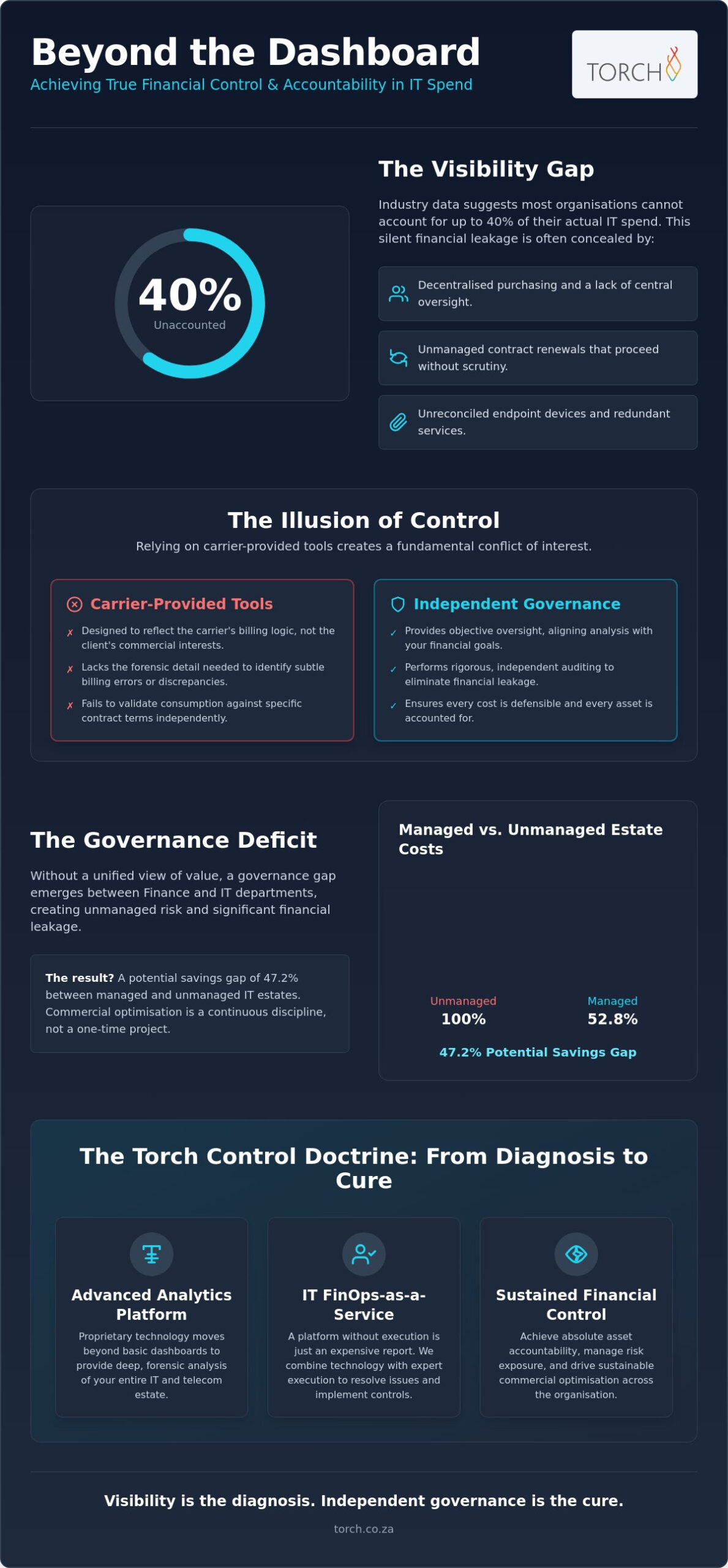
For most large South African enterprises, achieving true IT spend visibility is more than a reporting challenge; it is a structural governance problem. It represents the gap between what a company believes it spends on its technology estate and what it actually pays. This gap is not merely an accounting discrepancy but a source of silent financial leakage, where unmanaged assets, billing errors, and contractual misalignments quietly drain capital from the IT budget. The complexity is compounded by escalating data consumption, projected to reach 24.0 GB per user by 2025, which adds layers of difficulty to tracking and controlling costs across thousands of endpoints.
Internal procurement teams, though skilled in negotiation, often lack the specialist mandate or proprietary tools required for independent auditing of complex telecom and IT invoices. They are tasked with sourcing and procurement, not the continuous, forensic analysis needed to reconcile vendor billing against contractual terms and actual usage. This results in a persistent state of opacity, where financial leaders cannot confidently answer a fundamental question: are we receiving the value we are paying for?
The Structural Failure of Carrier-Provided Tools
A primary reason for this lack of clarity is an over-reliance on carrier-provided spend management tools. Whilst these platforms offer basic dashboards, they present a fundamental conflict of interest: a vendor cannot be expected to rigorously audit its own billing or validate its own revenue streams. These tools often lack the granularity to identify complex billing errors, misapplied tariffs, or discrepancies between contracted rates and invoiced amounts. True financial control requires impartial, independent telecom advisory that operates solely on behalf of the client.
Without this independent oversight, technology estates are susceptible to “operational drift.” This occurs when changes in user behaviour, device allocation, and service consumption are not reflected in procurement or financial controls, leading to a gradual but significant divergence between planned budgets and actual expenditure.
Financial Leakage and the Governance Deficit
The financial impact of this drift is substantial. According to Torch’s 2026 White Paper, Governed vs Unmanaged, this creates a potential savings gap of up to 47.2% between an independently governed estate and a typical unmanaged one. This discrepancy arises from a “governance gap,” a common misalignment where Finance and IT functions operate in silos. Finance approves payments based on invoices, whilst IT manages the operational assets, with neither department having a complete, reconciled view of the entire lifecycle. This gap is where financial leakage thrives, hidden within bulk invoices and complex cost centre allocations. Addressing this requires commercial optimisation, which should be understood as a continuous discipline, not a one-time negotiation event.
Beyond Dashboards: The Torch Strategic Framework for Spend Analytics
Effective IT spend analytics for enterprises moves beyond simple data visualisation. A dashboard can show you what you are spending, but it cannot explain why or execute the changes needed to correct course. The Torch Control Architecture addresses this by combining proprietary technology with embedded execution. This governance-led model ensures that the insights generated by our analytics are translated into tangible financial and operational outcomes, from resolving billing disputes to optimising carrier contracts.
Our IT FinOps-as-a-Service offering institutionalises this discipline within an organisation, restoring confidence in the financial numbers presented to the board. We move beyond platform-only solutions by providing a team of specialists who act as an extension of your own, dedicated to enforcing financial accountability and commercial integrity across your technology supply chain. This approach transforms spend analytics from a passive reporting function into an active control mechanism.
TorchLight and SpotLight: Proprietary Intelligence
At the core of our framework are two proprietary intelligence engines: TorchLight and SpotLight. TorchLight functions as a competitive intelligence tool, using sophisticated scenario modelling to benchmark your existing commercial agreements against the best available market rates. This provides objective, data-driven leverage for negotiations with major carriers like Vodacom and MTN, ensuring your contracts remain commercially optimised. SpotLight delivers the real-time visibility needed for effective oversight, allowing finance managers to track budget versus actual spend with granular detail. Its deep integration with enterprise ERP and HRM systems ensures cost centre allocations are accurate and defensible, eliminating the administrative burden of manual reconciliation.
The Three Control Domains of IT Governance
Our approach is structured around three interconnected domains of control, which together provide a comprehensive framework for governing a complex IT estate:
- Financial Control: This domain focuses on the integrity of the numbers. It involves forensic invoice reconciliation, variance analysis to identify anomalies, and ensuring every charge is validated against a known asset and a contractual term.
- Commercial Control: Here, the focus shifts to contractual optimisation. We conduct carrier-agnostic benchmarking to ensure you are not overpaying for services and actively manage contracts to align with your evolving business needs, preventing costly auto-renewals on unfavourable terms.
- Operational Control: This domain establishes end-to-end asset accountability. Through robust unified endpoint management, we ensure every device is tracked, secured, and allocated correctly, closing the gaps that lead to unmanaged assets and associated security exposures.
Case Study: Resolving Mobility Complexity in the Hospitality Sector
The strategic value of this independent, governance-led approach was demonstrated in our work with the Tsogo Group, which was navigating a complex mobility transition across its Southern Sun and Tsogo Gaming divisions. The central challenge was to define a future-proof mobility policy: should the group standardise on company-owned devices, move to a user allowance model, or implement a hybrid solution?
Each option carried significant financial, operational, and HR-related implications. The decision-making process was stalled by a lack of clear, objective data to model the commercial and practical outcomes of each path. A wrong move could lead to increased costs, administrative chaos, and dissatisfaction amongst employees.
Torch was engaged to provide an independent, data-driven recommendation. In a focused six-week process, our team moved from the initial challenge to a final, board-level decision. The intervention reduced the administrative burden on the group’s internal teams and delivered a set of stress-tested procurement recommendations that provided a clear, defensible path forward.
The Hybrid Mobility Model Calibration
A key outcome of the engagement was the detailed calibration of a hybrid mobility model. Rather than applying a one-size-fits-all policy, Torch mapped specific commercial outcomes and user requirements against the unique operational needs of different properties within the group. This analysis uncovered crucial “hybrid nuances”—subtle but critical factors that would have been missed in a standard procurement exercise. By modelling the total cost of ownership for different user profiles, we could precisely define where an allowance was more efficient and where a company-owned device remained necessary, significantly reducing the manual burden of SIM card management and complex cost allocations.
This principle of forensic asset analysis is equally applicable to physical infrastructure. For enterprises looking to optimise their fiscal position, Engineered Tax Services offers expertise in identifying how different property types can be leveraged for tax benefits through cost segregation studies.
Ensuring a Clean Transition with HR Alignment
Technology transitions are as much about people as they are about platforms. A critical part of our recommendation involved a detailed change management plan, including the development of clear HR documentation to support the new policy rollout. This ensured that the transition would be smooth, well-understood by employees, and legally sound. The client noted that this strategic insight—clarifying the path forward before any procurement began—was “worth more than the RFP itself.” This process of aligning spend analytics with operational reality is also crucial in adjacent domains, forming the foundation for effective cloud cost optimisation in South Africa, where visibility is the first step toward control.
Implementation and the Torch Control Doctrine
Our implementation methodology is guided by the Torch Control Doctrine. This doctrine is built on a simple premise: effective control is the foundation of sustainable optimisation. Optimisation without control is temporary, whilst control without a plan for optimisation is inefficient. Our four-step process is designed to establish robust governance first, creating the stability needed for long-term financial improvement.
- Conduct a No-Cost Telecom Billing Audit: We begin by performing a forensic audit of your last three months of invoices to identify and quantify immediate financial leakage from billing errors.
- Implement SpotLight for Real-Time Visibility: We deploy our SpotLight platform to provide a single, unified view of your entire IT and telecom estate, establishing clear cost centre accountability.
- Embed Governance Execution: Our team of specialists begins the active work of resolving vendor discrepancies, closing contractual gaps, and enforcing financial policies across the supply chain.
- Integrate Security Monitoring: We align asset visibility with security posture, using our platform to identify unmanaged endpoints that represent a primary vector for ransomware and other cyber threats.
Mitigating Silent Security Exposure
The link between unmanaged spend and security risk is direct and undeniable. Industry data consistently shows that a significant majority of ransomware attacks—some reports suggest as high as 85%—originate from unmanaged or poorly secured endpoint devices. When an organisation lacks a complete and accurate asset inventory, it cannot secure what it cannot see. This approach of integrating financial governance with security oversight helps identify these unmanaged devices, which often fly under the radar of traditional cybersecurity tools. Closing these visibility gaps is not just a financial exercise; it is a critical step in reducing the attack surface and mitigating the significant recovery costs associated with a security breach.