
The Governance Gap: Why BYOD Security Risks Are Often Misunderstood
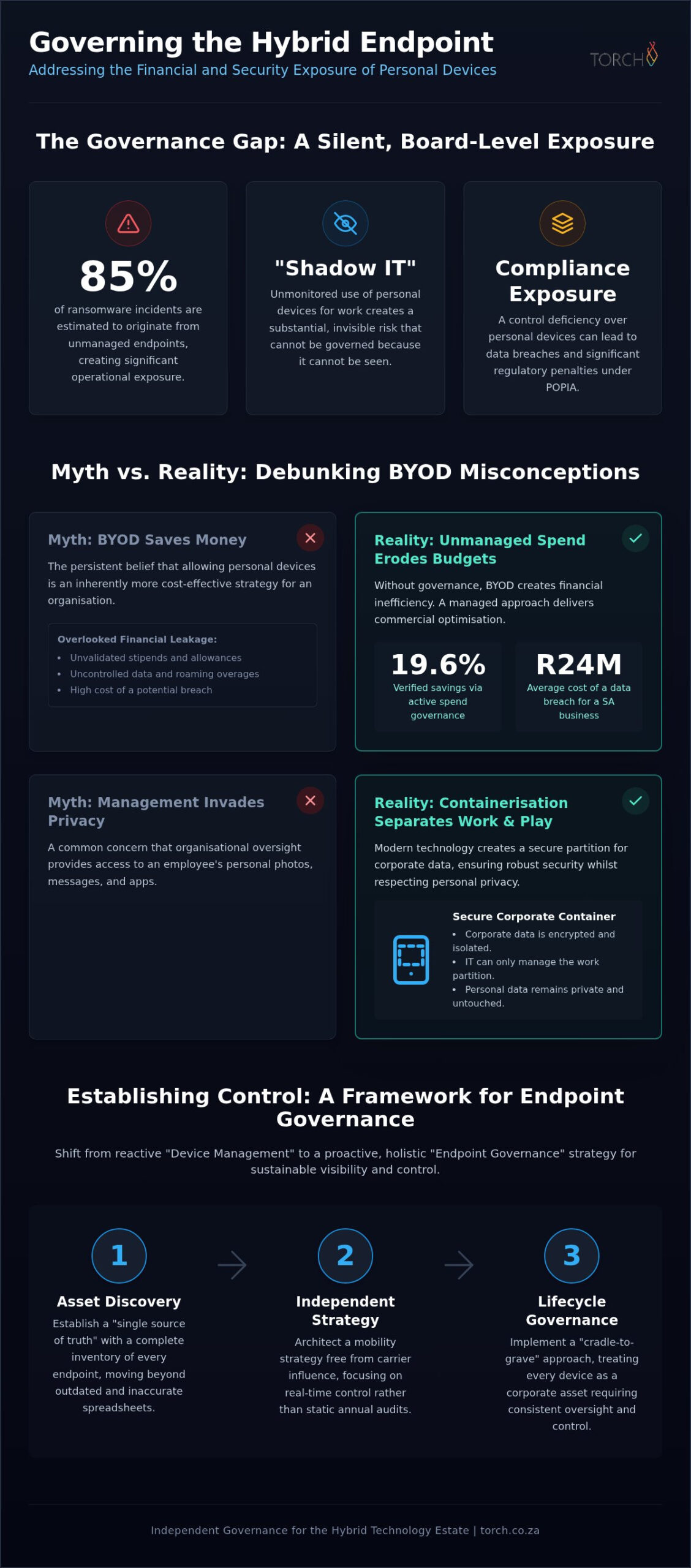
In the context of the 2026 hybrid workforce, Bring your own device (BYOD) is no longer an optional policy but a pervasive reality. Employees increasingly prefer the convenience of using their personal smartphones, tablets, and laptops for work. Whilst this offers flexibility, it simultaneously creates a significant governance gap, where a large number of personal devices accessing sensitive corporate data remain unmanaged and unsecured. This lack of oversight is a primary concern for business leaders, as unmanaged endpoints serve as the principal entry point for an estimated 85% of ransomware incidents.
For South African enterprises, this creates a “silent security exposure”—a board-level risk that extends beyond IT into financial and operational domains. The challenge is not merely technical; it is a fundamental issue of governance, visibility, and control over the entire technology estate.
The Reality of Shadow BYOD
Even in organisations without a formal BYOD policy, employees will inevitably use personal devices for work-related tasks, creating a phenomenon known as “Shadow IT.” This unmonitored activity introduces substantial risk. For example, compromised passwords remain a leading cause of security incidents, and when these credentials are used on personal, unmonitored devices, the organisation has no visibility into the potential breach. This absence of a unified view over every endpoint is arguably the greatest hurdle for modern IT leadership, as you cannot govern what you cannot see.
POPIA and Compliance Exposure
The legal implications of corporate data residing on personal, unsecured hardware are profound, particularly under the Protection of Personal Information Act (POPIA). A “control deficiency” arises when IT teams are unable to enforce security policies or remotely wipe corporate data from a lost, stolen, or offboarded employee’s personal device. This not only exposes the business to data breaches but also to significant regulatory penalties. To ensure compliance and assert necessary control, organisations must implement a robust framework for unified endpoint management (UEM), which provides the tools to manage and secure data regardless of the device it resides on.
Myth vs Reality: The Financial and Security Exposure of Personal Devices
Common misconceptions often obscure the true nature of BYOD security risks and their financial consequences. Many organisations adopt BYOD under the assumption that it reduces costs and that basic security measures are sufficient. However, a closer look reveals a more complex reality where unmanaged personal devices can introduce significant financial leakage and operational vulnerabilities.
- Debunking the myth: The belief that “BYOD is cheaper than company-owned devices” often overlooks unmanaged allowances, data overages, and the high cost of a potential breach.
- Addressing the misconception: The idea that “Antivirus is enough” for mobile security is dangerously outdated. Modern threats require comprehensive endpoint governance that antivirus software alone cannot provide.
- Challenging the idea: The concern that “Employees will not accept device management” can be effectively addressed through modern solutions like containerisation, which separates corporate and personal data.
- Linking security to finance: Ultimately, unmanaged devices lead to unmanaged data spend, creating a direct line between security governance gaps and financial inefficiency.
Myth 1: BYOD Saves Money
The perception that BYOD is inherently more cost-effective is a persistent myth. Hidden costs, often buried in unvalidated stipends and uncontrolled data allowances, can quickly erode any perceived savings and drain IT budgets. In contrast, a managed approach through services like telecom expense management (TEM) can deliver verified savings of up to 19.6% by actively governing spend. Furthermore, the cost of recovering from a single data breach, which can average R24 million for South African businesses, far outweighs the investment in properly securing and managing a device estate.
Myth 2: Privacy and Security Are Mutually Exclusive
A common objection to BYOD management is the fear that it infringes on employee privacy. However, modern UEM platforms resolve this conflict through containerisation. This technology creates a secure, encrypted partition on a personal device where all corporate applications and data are stored. This segregation allows the organisation to manage and protect its assets without accessing the employee’s personal information, such as photos, messages, or favourite apps. It provides a clear boundary, ensuring robust security for the business whilst respecting the privacy of the individual. For a deeper exploration of policy nuances, leaders can consult strategic resources like the Hybrid Endpoint Security: 2026 Strategic Governance Guide.
Establishing Control: A Strategic Framework for Hybrid Endpoint Governance
To effectively manage the complexities of a modern workforce, organisations must shift their mindset from simple “Device Management” to a more holistic “Endpoint Governance.” This strategic approach ensures long-term sustainability by treating every device as a corporate asset that requires oversight throughout its lifecycle. A “cradle-to-grave” approach is essential for all assets, whether company-owned or employee-owned. To achieve this without bias, it is critical to partner with an independent advisor who can help architect a mobility strategy free from carrier influence, focusing instead on real-time monitoring and control rather than outdated static annual audits.
Step 1: Asset Discovery and Visibility
The first step toward effective governance is establishing a “single source of truth” for every device accessing the corporate network. This involves a comprehensive discovery process to create a complete and accurate inventory of all endpoints. Specialised technologies, such as Torch’s TorchLight and SpotLight platforms, play a crucial role here, moving beyond simple spreadsheets to uncover “ghost assets” and wasteful subscriptions that create financial leakage. Ultimately, asset visibility is the absolute foundation of any credible security posture; without it, effective governance is impossible.
Step 2: Policy Enforcement through Automation
Once visibility is established, the next step is to enforce compliance policies consistently and automatically. Enterprise Mobility Management (EMM) and UEM software automates this process, significantly reducing the administrative burden on IT teams. Policies for access control, data encryption, and application usage can be implemented remotely across a dispersed workforce, ensuring a consistent security posture for every user. Aligning these technical controls with financial targets through an IT FinOps framework ensures that security measures also support commercial optimisation and accountability.
From Shadow IT to Managed Estates: The Torch Approach to Unified Endpoint Security
True endpoint security is achieved not through software alone, but through a partnership that provides “embedded execution” rather than just another dashboard. Torch operates as an independent governance partner, bridging the critical gap between Finance, IT, and HR during complex BYOD transitions. Our approach is built on establishing control across three interconnected domains: Financial Control (governing spend), Commercial Control (optimising contracts), and Operational/Security Control (managing endpoints). This carrier-agnostic position is a key differentiator, ensuring that every strategic recommendation is objective and aligned solely with the client’s best interests.
The Torch Control Doctrine
Our guiding principle is that “Control is the only sustainable form of optimisation.” Lasting efficiency and security are not the results of one-off projects but of continuous, real-time governance. Our TorchLight and SpotLight technologies provide this visibility, transforming complex data into clear, actionable intelligence. This approach delivers tangible results; for instance, by implementing our governance framework, a major South African bank was able to identify and realise R8.9 million in verified savings within its mobile technology estate, demonstrating the power of moving from operational complexity to strategic clarity.
Securing Your 2026 Mobility Strategy
Choosing the right mobility model—whether BYOD, Company-Owned, Personally-Enabled (COPE), or a hybrid—should be a decision based on data, not guesswork. Torch helps organisations analyse their unique requirements to determine the optimal model that balances flexibility, security, and cost. A governance-led approach to execution is a fundamental component of mitigating ransomware risks and other threats associated with unmanaged endpoints. By establishing clear lines of control and accountability, businesses can confidently embrace hybrid work without compromising their security or financial stability.
Frequently Asked Questions (FAQs)
What are the most common BYOD security risks for South African businesses in 2026?
The most common risks include data leakage from unsecured personal devices, compliance breaches under POPIA, increased exposure to malware and ransomware via unmanaged endpoints, and lack of visibility over “Shadow IT,” where employees use personal devices without official sanction.
Can an employer legally manage a personal device under POPIA?
Yes, provided it is done correctly. An employer can manage corporate data and applications on a personal device through technologies like containerisation, which separates business assets from personal data. A clear and transparent BYOD policy, consented to by the employee, is essential to ensure compliance with POPIA.
Is BYOD actually more cost-effective than providing company phones?
Not necessarily. While it can eliminate upfront hardware costs, BYOD often introduces hidden expenses like uncontrolled data allowances, administrative overhead, and the significant financial risk of a data breach. A fully managed company-owned model can often provide a lower Total Cost of Ownership (TCO) through centralised governance and optimised carrier contracts.
How does Unified Endpoint Management (UEM) mitigate ransomware risks?
UEM mitigates ransomware risks by ensuring all devices accessing the network adhere to strict security policies. This includes enforcing password complexity, enabling encryption, restricting unauthorised applications, and providing the ability to remotely isolate or wipe a compromised device, thereby containing a potential threat before it can spread.
What happens to corporate data if an employee with a BYOD device leaves the company?
With a proper UEM solution in place, an organisation can selectively wipe only the corporate data and applications from the employee’s personal device during the offboarding process. The employee’s personal data, such as photos and contacts, remains untouched, ensuring a clean and secure separation.
How can I discover how many unmanaged devices are currently accessing my corporate network?
Discovering unmanaged devices requires a combination of network analysis tools and an endpoint discovery process. A specialised partner can conduct a thorough audit of your network to identify all connected endpoints, compare them against a list of managed assets, and create a complete inventory that forms the basis for a comprehensive governance strategy.