
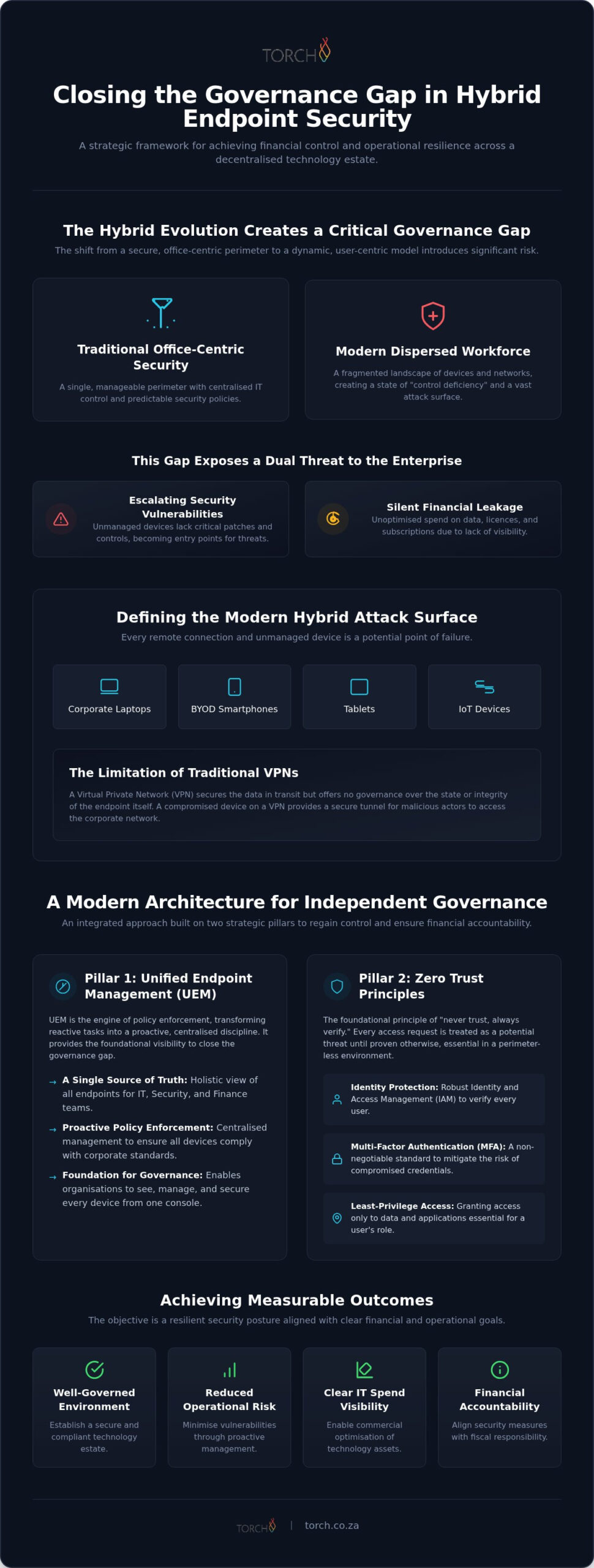
For South African enterprises, the transition to a hybrid work model is no longer a strategic choice but an operational reality. Whilst this evolution offers unprecedented flexibility, it has also created a significant governance gap. Without a unified framework to manage a dispersed fleet of laptops, smartphones, and tablets, organisations face a dual threat: escalating security vulnerabilities and silent financial leakage from unmanaged technology estates. The traditional, office-centric approach to security is now obsolete, leaving a landscape of control deficiency that invites both operational and financial risk.
This guide provides a strategic framework for CFOs, CIOs, and IT Directors to close this gap. It repositions hybrid endpoint security not as a purely technical challenge, but as a core governance discipline. By adopting a unified architecture, enterprises can regain control, ensure financial accountability, and build a resilient security posture fit for the modern, decentralised workforce. The focus is on achieving measurable outcomes: a well-governed and secure environment, reduced operational risk, and clear visibility into IT spend.
The Hybrid Evolution: Closing the Governance Gap in Endpoint Security
Endpoint security in a hybrid context is the comprehensive governance of every device—corporate-owned or personal—that accesses company data, regardless of its location. The challenge for most organisations lies in the emergence of a critical “Governance Gap,” a void where IT and Finance lack a unified mandate, shared data, and a common language to manage these assets effectively. IT teams focus on technical security, whilst Finance departments scrutinise costs, often leading to disconnected strategies and overlooked risks.
This gap is a direct result of the shift from a static, office-based perimeter to a dynamic, user-centric model where the endpoint itself is the new perimeter. Every remote connection and unmanaged device represents a potential point of failure. This state of “control deficiency” has become the primary driver of enterprise risk, creating vulnerabilities that are not just technical but also financial and regulatory.
Defining the Modern Hybrid Attack Surface
The contemporary attack surface is vast and fragmented, extending far beyond the traditional office network. It encompasses a diverse range of endpoints, including corporate-issued laptops, employee-owned smartphones (BYOD), tablets, and even IoT devices. Each of these assets represents a potential entry point for threats, particularly when employees connect from unsecured home networks or public Wi-Fi.
The risks associated with unmanaged devices are substantial. Without centralised oversight, these endpoints often lack critical security patches, updated anti-malware software, and correctly configured access controls. Traditional security tools like Virtual Private Networks (VPNs) are insufficient for modern endpoint governance. A VPN secures the connection—the data in transit—but it does nothing to govern the state or integrity of the device at either end of that connection. If an endpoint is already compromised, a VPN simply provides a secure tunnel for malicious actors to access the corporate network.
The Financial and Operational Stakes of Unmanaged Devices
Beyond the obvious security implications, unmanaged endpoints are a significant source of silent financial leakage. Without a central inventory or active management, organisations often pay for mobile data plans, software licences, and subscriptions that are no longer needed or are improperly allocated. This lack of visibility leads to operational drift, where device configurations deviate from company policy, user support becomes inefficient, and productivity suffers due to poorly maintained assets.
Addressing these challenges requires a single source of truth for every asset. This is where the benefits of a unified endpoint security platform become a strategic imperative. A Unified Endpoint Management (UEM) solution provides the foundational visibility needed to close the governance gap, enabling organisations to see, manage, and secure every device from a single console. It transforms endpoint management from a reactive, fragmented task into a proactive, centralised discipline.
Core Components of a Modern Security Architecture for Hybrid Teams
A robust security architecture for a hybrid workforce is built on three strategic pillars: Unified Endpoint Management (UEM), Zero Trust principles, and comprehensive Lifecycle Governance. This integrated approach moves beyond siloed tools to create a cohesive defence that aligns security policies with financial and operational objectives. Unlike traditional Mobile Device Management (MDM), which often focuses narrowly on mobile devices, a UEM platform offers a holistic view of all endpoints, establishing a single source of truth for IT, security, and finance teams.
This architecture is supported by automated user support systems that maintain security posture without overburdening internal teams and real-time monitoring through proprietary BI models like Torch’s TorchLight and SpotLight, which are designed to identify anomalies in usage, cost, and security compliance. This allows for proactive intervention before minor issues escalate into significant governance failures.
Zero Trust as a Strategic Imperative
The foundational principle of a Zero Trust architecture is “never trust, always verify.” In a hybrid environment where employees connect from countless locations and networks, this model is no longer optional but essential. It assumes that threats can exist both outside and inside the traditional network perimeter. Consequently, every access request must be authenticated, authorised, and encrypted before granting access to corporate resources.
Key components of a Zero Trust strategy for endpoints include:
- Identity Protection: Ensuring that every user is who they claim to be through robust identity and access management (IAM) protocols.
- Multi-factor Authentication (MFA): A non-negotiable standard that requires users to provide two or more verification factors to gain access. This dramatically reduces the impact of compromised passwords, a common attack vector in South Africa.
- Least-Privilege Access: Granting users access only to the data and applications explicitly required for their roles, minimising the potential damage if an account is compromised.
Unified Endpoint Management (UEM) and Policy Enforcement
A UEM platform is the engine of policy enforcement in a hybrid model. It provides the technical capability to deploy, manage, and secure devices remotely, without requiring physical access. This ensures that every endpoint, whether corporate-owned or personal, adheres to the organisation’s security standards. Key benefits include:
- Remote Policy Implementation: IT administrators can push security configurations, application updates, and compliance policies to thousands of devices simultaneously, ensuring consistent protection across the entire estate.
- Containerisation: For Bring Your Own Device (BYOD) scenarios, UEM enables the creation of a secure, encrypted container on a personal device. This segregates corporate data and applications from personal content, protecting sensitive information whilst respecting employee privacy.
- Selective Wipe Capability: If a device is lost or stolen, administrators can remotely wipe only the corporate container, removing all company data without affecting the user’s personal files, photos, or applications. This is a critical capability for protecting corporate data and ensuring compliance with data protection regulations.
Mitigating Ransomware Risks and Compliance Exposure in South Africa
The South African ransomware landscape presents a severe and growing threat to enterprises. With a median ransom demand of R18 million and an average recovery cost exceeding R24 million (excluding the ransom payment itself), the financial consequences of an attack are devastating. Critically, research shows that 85% of ransomware incidents originate from unmanaged or poorly secured endpoints within the hybrid workforce. These devices serve as the primary entry point for attackers to gain a foothold in corporate networks.
Addressing this risk requires a strategic, governance-led approach rather than a purely reactive one. This is where the principles of IT FinOps become invaluable. By framing security investments in the context of financial risk mitigation and operational resilience, IT leaders can more effectively justify the necessary expenditure to the board. A unified endpoint security platform provides the defensible data needed to demonstrate how proactive governance directly reduces the likelihood and financial impact of a ransomware attack.
POPIA Compliance and Data Protection
The Protection of Personal Information Act (POPIA) places a legal obligation on South African organisations to secure any personal information they process. This responsibility extends directly to employee devices used for work purposes, as they frequently store or access sensitive corporate and customer data. A data breach resulting from a lost company phone, a successful phishing attack on a personal laptop, or malware on an unmanaged tablet can lead to significant regulatory fines and reputational damage.
A UEM platform is a cornerstone of a defensible POPIA compliance strategy. It enables organisations to enforce data protection policies, encrypt sensitive information, and remotely secure compromised devices. Regular audits and compliance checks conducted through the UEM system provide tangible proof that the organisation is taking reasonable and appropriate measures to safeguard personal information, thereby reducing regulatory risk exposure.
Addressing the BYOD vs. COPE Governance Debate
Organisations must decide between two primary models for provisioning devices: Bring Your Own Device (BYOD), where employees use their personal hardware for work, and Corporate-Owned, Personally-Enabled (COPE), where the company provides the device but allows for personal use. Each model presents a different set of governance challenges.
- BYOD: Offers flexibility and can reduce initial hardware costs but introduces complexities around security, privacy, and support.
- COPE: Provides greater control and security but requires more significant capital investment and management overhead.
Many executives face the “two-phone problem,” carrying separate devices for work and personal life. A well-implemented UEM solution can eliminate this inefficiency. By using containerisation to create a secure corporate workspace on a single device, organisations can adopt a COPE model that balances robust security with user privacy and convenience. This framework allows for a clear choice that aligns with the organisation’s risk appetite and operational needs. For a deeper analysis, leaders should explore the critical security risks associated with BYOD models and how to mitigate them through effective governance.
The Strategic Advantage of Independent Endpoint Governance
In a complex hybrid environment, control is the only sustainable form of optimisation. Merely deploying software is not governance. True governance requires a continuous cycle of visibility, analysis, policy enforcement, and optimisation, overseen by an independent party free from vendor or carrier bias. An independent advisor is uniquely positioned to audit carrier bills, verify vendor performance, and ensure that technology investments deliver their promised value without creating financial leakage or operational drag.
This approach is built on Three Control Domains: Financial, Commercial, and Operational/Security Control. It ensures that every decision is scrutinised through multiple lenses, aligning technical requirements with financial discipline. Furthermore, leveraging managed services for endpoint governance relieves the pressure on overburdened internal IT and Finance teams, allowing them to focus on core strategic initiatives while experts manage the day-to-day complexities of the endpoint estate.
Financial Control and Accountability
A core benefit of independent governance is the establishment of rigorous financial control. Active management of software licences and mobile subscriptions ensures that provisioned services match actual usage, a process that typically delivers immediate savings of 19.6% or more. This is achieved through meticulous invoice reconciliation, a practice that uncovers hidden costs, billing errors, and other forms of financial leakage that often go unnoticed in complex carrier agreements.
This discipline is the essence of FinOps-as-a-Service: a managed service that bridges the gap between IT operations and financial accuracy, providing the CFO with a verifiable, accurate view of technology spend.
The Path Forward: From Visibility to Control
The journey from unmanaged chaos to a governed, secure endpoint estate is a strategic progression. It begins with establishing complete visibility over every asset, moves toward enforcing consistent policies, and culminates in achieving total control over the environment. This path empowers CFOs and CIOs with the defensible financial data needed to make informed decisions, manage risk effectively, and drive commercial optimisation across the enterprise.
The first step is to understand the current state of your endpoint environment. By engaging in a strategic consultation, you can identify governance gaps and map a clear, actionable path toward a more secure and financially disciplined future.
Book a 30-minute governance review with Derek King — no obligation, no sales pitch.
Frequently Asked Questions (FAQs)
What is endpoint security for a hybrid workforce?
Endpoint security for a hybrid workforce is a comprehensive governance strategy for managing and securing all devices (laptops, smartphones, tablets) that access corporate data, regardless of their location or ownership. It combines technology, policy, and financial oversight to protect against threats while ensuring operational efficiency and cost control in a decentralised work environment.
Why are unmanaged devices the biggest risk for ransomware in South Africa?
Unmanaged devices are the leading entry point for ransomware because they often lack essential security controls, such as up-to-date software patches, correctly configured firewalls, and enterprise-grade anti-malware protection. Attackers exploit these vulnerabilities to gain initial access to a network, making the large number of unsecured remote endpoints in a hybrid workforce a primary target.
How does Unified Endpoint Management (UEM) improve security for remote workers?
A UEM platform provides a single console to enforce security policies across all remote devices. It allows IT teams to remotely deploy security updates, configure access controls, encrypt sensitive data, and respond to threats in real-time. This ensures a consistent and high level of security for every employee, no matter where they are working from.
Can we secure personal devices (BYOD) without invading employee privacy?
Yes. Modern UEM solutions use containerisation to create a separate, encrypted “work profile” on an employee’s personal device. This isolates all corporate applications and data from personal content. IT administrators only have control over the work container, allowing them to secure company data and perform actions like a selective wipe without accessing or affecting the employee’s personal files, photos, or applications.
What are the POPIA implications for hybrid workforce endpoints?
Under the Protection of Personal Information Act (POPIA), South African companies are legally responsible for protecting personal data, regardless of where it is stored or accessed. This means organisations must have adequate security measures on all endpoints—including employee-owned devices—that handle personal information. A failure to secure these devices can result in a data breach, leading to significant regulatory fines and reputational damage.
How much does a ransomware attack typically cost a South African business?
The financial impact is severe. The median ransom demand for a South African business is approximately R18 million. However, the total cost is far greater, with the average recovery cost—which includes downtime, remediation, and lost business—exceeding R24 million, even before the ransom is paid.