
For Chief Financial Officers, building a business case for Telecom Expense Management (TEM) is not merely an exercise in justifying a new software purchase. It is a strategic proposal to establish structural governance over a complex, high-spend area of the business that is often fraught with financial leakage, administrative inefficiency, and unmanaged risk. A compelling business case shifts the conversation from a one-time “cost-saving project” to a sustainable framework for commercial optimisation and financial control.
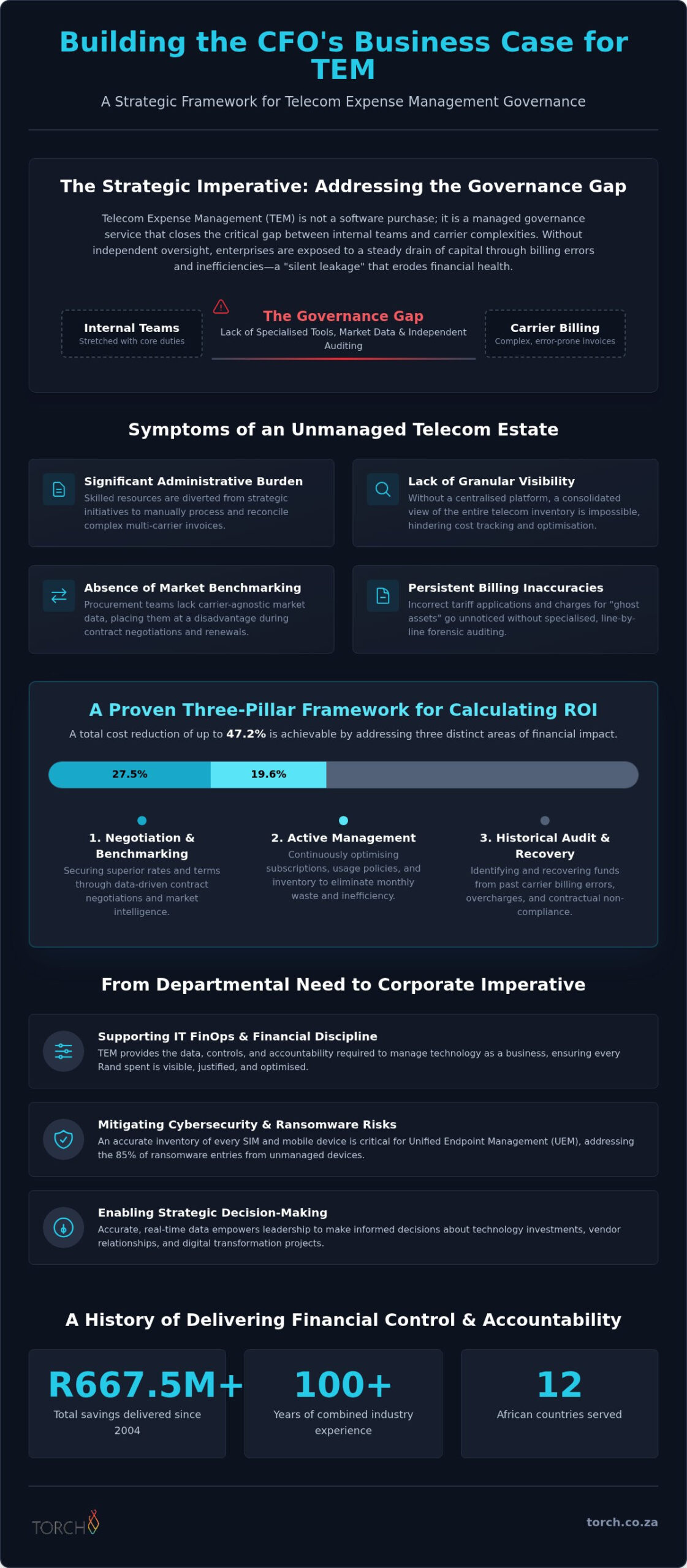
The argument for TEM succeeds not by promising vague savings, but by identifying the critical governance gaps that expose an enterprise to unnecessary expenditure and security vulnerabilities. This is because, without independent oversight, even the most diligent internal teams lack the specialised tools, market data, and dedicated resources to effectively audit carrier billing and align contracts with market reality. With over 100 years of combined industry experience and having delivered over R667.5M in total savings since 2004 across 12 African countries, we have seen first-hand that establishing this governance is the foundation of sustainable financial health in IT.
This guide provides a strategic framework for CFOs to construct a data-backed business case for TEM, one that aligns with core financial objectives and secures executive buy-in.
The Strategic Rationale for TEM Governance
At its core, Telecom Expense Management is a strategic discipline focused on bringing visibility, control, and optimisation to an enterprise’s entire communications lifecycle. It is not simply a dashboard or a reporting tool; it is a managed governance service that addresses the inherent “governance gap” that exists in most organisations. This gap appears when internal finance and IT teams, already stretched with core responsibilities, lack the time and specialised expertise to meticulously audit complex carrier invoices, validate thousands of line items, and benchmark contracts against a dynamic market.
Relying on carrier-provided reports for validation is insufficient for true financial governance. Whilst useful for usage trends, these reports do not provide the independent, forensic analysis required to uncover billing errors, identify “ghost assets” (services billed for but not in use), or confirm that contractual rates are being applied correctly. This lack of independent validation creates an environment ripe for “silent leakage”—a steady drain of capital through small, repeated overcharges and inefficiencies that accumulate into significant financial loss over time.
Identifying the Problem Statement
The first step in building a business case for TEM is to clearly articulate the current state of the unmanaged telecom estate. For most enterprises, this is characterised by several key challenges:
- Significant Administrative Burden: Finance and IT teams spend countless hours manually processing and reconciling complex invoices from multiple carriers. This low-value, repetitive work diverts skilled resources from strategic initiatives.
- Lack of Granular Visibility: Without a centralised platform, it is nearly impossible to get a consolidated view of the entire telecom inventory, including all devices, circuits, and subscriptions. This makes it difficult to track assets, manage costs by department, or identify opportunities for optimisation.
- Absence of Market Benchmarking: When contract renewal dates approach, procurement teams often lack access to current, carrier-agnostic market data. This puts them at a significant disadvantage during negotiations, often leading to renewals that are not aligned with the best available market rates.
- Persistent Billing Inaccuracies: Industry analysis consistently shows that a significant percentage of telecom invoices contain complex billing errors. These can range from incorrect tariff applications to charges for decommissioned services, and they often go unnoticed without a specialised, line-by-line audit.
Aligning with Strategic Corporate Goals
A robust business case must connect the operational benefits of TEM to the organisation’s broader strategic objectives. This elevates the proposal from a departmental need to a corporate imperative. Key alignments include:
- Supporting IT FinOps and Financial Discipline: TEM is a cornerstone of a successful IT FinOps strategy. It provides the data, controls, and accountability required to manage technology as a business, ensuring that every Rand spent on telecommunications is visible, justified, and optimised.
- Mitigating Ransomware and Security Risks: There is a direct link between endpoint management and cybersecurity. With research showing that 85% of ransomware entry points originate from unmanaged or poorly managed devices, TEM’s role in maintaining an accurate inventory of every SIM and mobile device is critical for Unified Endpoint Management (UEM) and risk mitigation.
- Enabling Strategic Decision-Making: By providing accurate, real-time data, TEM empowers leadership to make informed decisions about technology investments, vendor relationships, and digital transformation projects. It is a foundational pillar of modern IT financial management best practices.
How to Calculate Cost Savings from TEM
Whilst governance is the strategic rationale, a credible ROI calculation is essential for securing financial approval. A proven methodology for forecasting savings from TEM is a three-pillar model that focuses on distinct areas of financial impact. Our analysis of actively governed estates shows that a total cost reduction of up to 47.2% is achievable when all three pillars are addressed.
The three pillars of TEM ROI are:
- Negotiation and Benchmarking (27.5%): Securing better rates and terms through data-driven contract negotiations.
- Active Management (19.6%): Continuously optimising subscriptions and usage to eliminate monthly waste.
- Historical Audit and Recovery: Identifying and recovering funds from past billing errors.
To lower the barrier for board approval, many TEM providers offer a “risk-share” or contingency-based pricing model. In this arrangement, the provider’s fees are directly tied to the savings they deliver. This aligns incentives and demonstrates confidence in the value proposition, making it a compelling element to include in the financial section of your business case.
Quantifying Negotiation and Benchmarking Gains
The single largest source of savings typically comes from restructuring carrier contracts to align with current market rates. An unmanaged estate may be paying rates that are 20-30% above what is achievable in the open market. The business case should forecast savings of approximately 27.5% through these strategic procurement activities.
This is achieved through:
- Carrier-Agnostic Benchmarking: Unlike an internal review, which is limited to a company’s own data, a TEM partner leverages aggregated, anonymised data from across the market. This provides true insight into best-in-class pricing and terms.
- Market-Scenario Modelling: The value of market-scenario modelling lies in its ability to simulate the commercial outcomes of various negotiation strategies with different carriers before entering formal procurement, allowing the enterprise to pursue the optimal path with confidence.
- Data-Driven Negotiation: Armed with precise data on usage patterns and market benchmarks, the procurement team can move beyond traditional negotiation tactics and build a case for better pricing based on hard evidence. These telecom contract negotiation strategies are central to unlocking structural savings.
The ROI of Active Management
Beyond contract negotiation, continuous, active management of the telecom estate can deliver savings of around 19.6%. This pillar focuses on eliminating the month-to-month financial leakage caused by inefficient subscription management and a lack of real-time visibility.
Key drivers of these savings include:
- Subscription Optimisation: Continuously adjusting mobile data plans and voice packages to match actual employee usage, preventing overage charges and paying for unused capacity.
- Elimination of “Ghost Assets”: Identifying and decommissioning services, SIM cards, and fixed lines that are being billed for but are no longer in use by the organisation. Without active governance, a considerable portion of a company’s telecom inventory can become idle or underutilised, representing pure financial waste.
- Reduction in Manual Labour: Automating invoice processing, cost centre allocation, and reporting frees up significant man-hours within the IT and Finance departments, allowing them to focus on more strategic activities.
- Real-Time Visibility: Using platforms like SpotLight™, management gains immediate insight into spending trends and potential issues, enabling proactive intervention rather than reactive analysis of month-old bills.
Structural Elements of a Robust TEM Business Case
To be effective, a business case must be structured logically and speak the language of the C-suite. It should be concise, data-driven, and focused on the commercial implications of the proposal. A best-practice structure includes four key sections.
- Executive Summary: A one-page overview that frames the problem, summarises the proposed solution, and highlights the key financial outcomes (ROI, payback period) and strategic benefits. This must be tailored for a CFO audience, emphasising governance, control, and risk mitigation.
- Options Analysis: A clear comparison of the available choices. This should always include a “Do Nothing” or “Status Quo” option to quantify the cost of inaction (COI). Other options typically include purchasing a “SaaS Tool” for internal use versus engaging a “Managed Service” provider.
- Implementation Roadmap: A high-level plan outlining the key phases, from initial data collection and billing audit to contract negotiation and ongoing management. A typical engagement can deliver a decision-ready business case and initial audit findings within a six-to-eight-week timeframe.
- Risk Assessment: An honest evaluation of potential risks associated with the project (e.g., data migration, change management) and, more importantly, the significant financial and security risks of maintaining an unmanaged telecom estate.
Comparing Delivery Models
A critical component of the Options Analysis is explaining the difference between TEM software and a TEM managed service. This is a crucial distinction that often determines the success or failure of the initiative.
- Dashboards Alone Fail: Providing internal teams with a SaaS dashboard can improve visibility, but it does not solve the underlying problem of resource constraints and a lack of specialised expertise. The day-to-day work of auditing, optimising, and disputing charges still falls on the same overburdened teams, leading to a failure to deliver sustained commercial optimisation.
- The “High-Touch, Embedded Execution” Model: A managed service acts as an extension of your team. This model combines a powerful platform with a dedicated team of analysts who perform the heavy lifting—auditing invoices, managing inventory, and executing optimisation strategies on your behalf.
- Evaluating Services: When evaluating potential partners, it is essential to look beyond the software and assess their governance capabilities. The right partner provides not just data, but actionable intelligence and execution support. A review of their full telecom expense management services should focus on their methodology for audit, optimisation, and procurement.
Scenario Modelling with TorchLight™
The “Preferred Solution” section of your business case can be powerfully enhanced with data from competitive scenario modelling. Tools like TorchLight™ leverage deep market intelligence to model the potential financial outcomes of various contract scenarios with different carriers. This allows you to:
- Integrate Market Benchmarks: Build a business case based on what is genuinely achievable in the current market, not just incremental improvements on your existing contracts.
- Ensure Vendor Accountability: Establish clear, data-backed performance metrics and KPIs for your TEM provider, ensuring that they are held accountable for delivering the savings forecasted in the business case.
–Model Competitive Tenders: Simulate the outcome of taking your business to market, providing a powerful leverage point for negotiations with your incumbent suppliers.
Securing Board Approval and Implementation
The final stage of building the business case is anticipating and addressing the questions and objections that will arise during the approval process. A proactive approach, grounded in data and strategic alignment, is key to securing buy-in from all stakeholders, particularly the CFO and CIO.
The most common objection is, “Why can’t we do this ourselves?” The most effective response focuses on three points: specialisation, resources, and independence. Emphasise that TEM is a highly specialised discipline that requires dedicated focus. Crucially, highlight that independent, third-party governance is the most reliable way to ensure your organisation is not simply marking its own homework when it comes to carrier billing.
To secure security buy-in, explicitly connect TEM to the broader Unified Endpoint Management (UEM) strategy. An accurate, real-time inventory of every corporate SIM and device is the foundational layer upon which any effective mobile security policy is built. Without it, the organisation is exposed to significant risk from unmanaged endpoints.
Presenting to the CFO and CIO
When presenting to executive leadership, tailor the message to their specific priorities:
- For the CFO: Focus on the themes of financial control, enhanced visibility, managed risk exposure, and a clear, data-driven ROI. Frame TEM as a mechanism for enforcing fiscal discipline within the IT environment. Use evidence-based arguments supported by core IT FinOps principles to demonstrate strategic value.
- For the CIO: Emphasise how TEM frees up valuable IT staff from tedious administrative tasks, allowing them to focus on strategic initiatives like digital transformation and innovation. Highlight the security benefits of complete endpoint visibility and the operational efficiencies gained through automation.
Next Steps: The Governance Review
Conclude your business case with a clear, low-friction call to action. The most effective next step is to propose a no-cost, no-obligation diagnostic to validate the assumptions made in your business case. This demonstrates confidence and provides tangible value to the organisation before any commitment is made.
Outline the simple data requirements—typically the last three months of carrier invoices and asset registers—needed for an initial billing audit. This audit can quickly provide a high-level assessment of the potential savings and governance gaps within your current estate.
To validate your business case assumptions and uncover the potential for optimisation within your own telecom estate, book a 30-minute governance review with Derek King.
Frequently Asked Questions (FAQs)
Why should we not let our mobile carrier manage our telecom spend?
Allowing a carrier to manage its own billing creates an inherent conflict of interest. Carriers are incentivised to maximise revenue, not to find savings for their clients. Independent, third-party governance is essential to ensure that your organisation’s interests are the top priority and that all billing is scrutinised objectively against contractual and market rates.
How long does it typically take to see ROI from a TEM implementation?
An ROI can often be realised within the first six months. Initial savings are typically generated quickly from a historical bill audit and recovery of past overcharges. Deeper, structural savings from contract renegotiation and active optimisation will then compound over the following 12 to 24 months.
What is the difference between a TEM dashboard and a managed governance service?
A TEM dashboard is a software tool that provides visibility into your telecom data. A managed governance service combines that tool with a team of specialised analysts who actively use the data to audit invoices, manage inventory, execute optimisations, and support procurement. The service delivers outcomes, whereas the dashboard only delivers data.
How much data is required to build an accurate business case for TEM?
An accurate business case can be built using a representative sample of data. Typically, three months of complete, consolidated invoices from all your primary telecom carriers, along with a current asset register, is sufficient to perform an initial analysis and produce a reliable forecast.
Can TEM help with endpoint security and ransomware mitigation?
Yes, absolutely. A core function of TEM is to create and maintain a complete, accurate inventory of every single SIM card and mobile device connected to your network. This real-time asset register is the foundation of any effective Unified Endpoint Management (UEM) and security strategy, as you cannot secure what you cannot see.
Is a business case necessary for mid-sized enterprises with only one carrier?
Yes. Even with a single carrier, the complexities of enterprise billing, the challenge of tracking hundreds or thousands of assets, and the lack of market benchmarking data still exist. The principles of governance, visibility, and optimisation are just as critical for ensuring financial control, regardless of the number of vendors.