
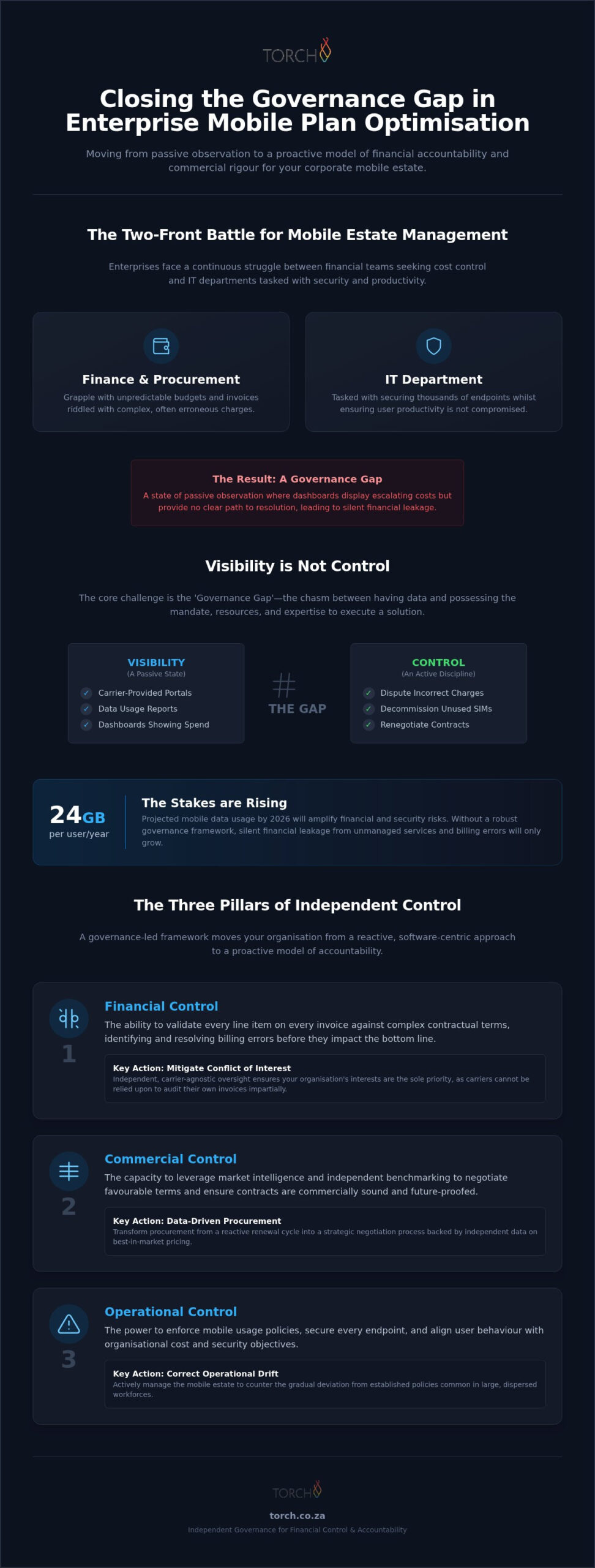
For many South African enterprises, managing a large-scale mobile estate feels like a battle fought on two fronts. On one side, Finance and Procurement teams grapple with unpredictable budgets and invoices riddled with complex, often erroneous charges. On the other, IT departments are tasked with securing thousands of endpoints against ever-present threats, all whilst ensuring user productivity isn’t compromised. The result is often a state of passive observation, where dashboards display escalating costs but provide no clear path to resolution. True enterprise mobile plan optimisation is not achieved through better reporting; it is the outcome of a continuous discipline of independent governance.
By 2026, with projected mobile data usage expected to reach 24GB per user per year, the financial and security stakes will be higher than ever. Without a robust framework for financial, commercial, and operational control, organisations will continue to experience silent financial leakage from unmanaged SIM cards, legacy contracts, and billing inaccuracies. This guide presents a governance-led framework designed to move your organisation from a reactive, software-centric approach to a proactive model of accountability and commercial rigour, giving you defensible control over your mobile spend.
Addressing the Governance Gap in Enterprise Mobile Plan Optimisation
The core challenge in managing corporate mobile spend is not a lack of data, but a ‘Governance Gap’—the chasm between having visibility of a problem and possessing the mandate, resources, and expertise to execute a solution. Most enterprises have access to carrier-provided portals that offer a wealth of information on data usage and costs. Yet, finance teams remain overburdened with manual invoice reconciliations, and IT leaders struggle to enforce policies across a dispersed workforce. This gap exists because visibility alone does not equate to control.
This deficiency is compounded by an inherent conflict of interest when relying on carrier-led management tools for cost validation. To achieve genuine financial accountability, enterprises require a framework built on three pillars of independent control:
- Financial Control: The ability to validate every line item on every invoice against complex contractual terms, identifying and resolving billing errors before they impact the bottom line.
- Commercial Control: The capacity to leverage market intelligence and independent benchmarking to negotiate favourable terms and ensure contracts are commercially sound and future-proofed.
- Operational Control: The power to enforce mobile usage policies, secure every endpoint, and align user behaviour with organisational cost and security objectives.
Failing to address the governance gap leads directly to ‘silent financial leakage’—a persistent drain on resources caused by ghost SIMs, misaligned data pools, and unrecovered billing discrepancies that quietly erode profitability month after month.
The Conflict of Interest in Carrier-Led Auditing
Asking a mobile network operator to validate the accuracy of their own billing is fundamentally compromised. Whilst carriers provide portals as a gesture of transparency, their primary commercial imperative is to protect their revenue, not to identify opportunities for their clients to spend less. This creates a scenario where the entity issuing the invoice is also the one providing the tools to check it, a clear conflict of interest that prevents true financial scrutiny.
In the competitive South African market, which is dominated by a few major players like Vodacom, MTN, and Telkom, this dynamic is particularly pronounced. Independent, carrier-agnostic oversight is essential for unbiased analysis. It introduces a layer of accountability that internal teams, who often lack the specialised tools and market data, cannot replicate. In short, independent governance is the foundation of financial accountability, ensuring that your organisation’s interests are the sole priority during any audit or reconciliation process.
Visibility vs Control: Why Dashboards Are Not Enough
The technology market often presents dashboards as the ultimate solution for managing complex expenses. However, ‘visibility’ is a passive state, whereas ‘control’ is an active discipline. A dashboard can effectively show you that you are overspending, but it cannot dispute an incorrect charge with a carrier, decommission an unused SIM card, or renegotiate an uncompetitive contract. Software-only solutions fail because they report problems without providing the embedded execution required to solve them.
This is particularly true for large enterprises with dispersed workforces, where ‘operational drift’—the gradual deviation from established policies—is common. Without active governance, user behaviour changes, devices become unmanaged, and services are left running long after an employee has left the company. A dashboard will reflect the cost of this drift, but only an active governance framework can correct its course and restore control over the mobile estate.
Commercial Control: Benchmarking and Contractual Rigour
Sustainable enterprise mobile plan optimisation extends far beyond monthly invoice checks; it begins with the commercial structure of your carrier agreements. Many organisations find themselves locked into multi-year contracts based on outdated usage patterns or incomplete market data, leading to significant overspend on legacy services and poorly configured data pools. Establishing commercial control means transforming procurement from a reactive renewal cycle into a strategic, data-driven negotiation process.
This requires a deep understanding of the competitive landscape. By leveraging independent market intelligence, organisations can benchmark their existing rates against current best-in-market pricing, identifying precisely where legacy contracts are over-priced. This data-backed approach removes ambiguity from negotiations with major South African providers and provides the leverage needed to secure terms that align with both current and future needs. It is a critical component of a broader telecoms expense management strategy, ensuring that the contractual foundation of your mobile estate is sound.
Leveraging Competitive Intelligence for Procurement
Internal procurement teams, despite their expertise, typically lack access to the carrier-agnostic benchmarking data required for truly effective negotiations. They can compare offers from different carriers, but they cannot validate whether the ‘best’ offer presented is genuinely competitive against the wider market. Independent governance partners bridge this gap by using aggregated, anonymised data from across the industry.
This intelligence allows for sophisticated scenario modelling based on historical consumption data, predicting future needs and ensuring new contracts are built for flexibility and scale. By entering negotiations armed with irrefutable, data-backed insights, enterprises can dramatically reduce negotiation cycles from months to weeks and avoid signing agreements that fail to meet long-term strategic objectives.
Billing Validation and Risk-Share Models
Once a commercially sound contract is in place, the focus shifts to ensuring its terms are meticulously enforced. This is achieved through automated invoice reconciliation, where sophisticated software validates every charge against the complex rules, rates, and conditions stipulated in the agreement. This process is crucial for identifying ‘hybrid nuances’—the unique billing complexities that arise from managing a diverse workforce with varying mobile needs.
To ensure complete alignment of interests, leading governance advisors often work on risk-share savings models. In this framework, the advisor’s success is directly tied to the financial goals of the enterprise. This commercial structure guarantees that the advisor is motivated to identify every instance of overbilling and pursue every dispute until a credit is secured, transforming the relationship from a vendor-client dynamic into a true financial partnership.
Feeling the pressure of an upcoming contract renewal? An independent review can provide the data you need to negotiate from a position of strength.
Book a 30-minute governance review with Derek King — no obligation, no sales pitch
Operational Best Practices: Policy Enforcement and Endpoint Governance
Financial and commercial rigour can be quickly undermined by poor operational controls. An unmanaged mobile fleet not only creates financial leakage through inefficient data use but also exposes the organisation to significant security vulnerabilities. The critical link between mobile data cost management and endpoint security posture is often overlooked. Every unmanaged smartphone or tablet is a potential entry point for threats like ransomware, making operational governance a matter of both financial prudence and risk mitigation.
Implementing a clear, enforceable mobile phone policy is the first step towards establishing control. This policy should address common challenges like the ‘two-phone problem’—where employees carry both a personal and a corporate device—by outlining secured hybrid mobility models that balance productivity with security. This framework becomes the blueprint for how the organisation manages user behaviour, enforces compliance, and aligns mobile usage with strategic goals. Tools for unified endpoint management (UEM) are instrumental in turning policy into practice, automating enforcement and reducing the burden on IT teams.
Establishing a Robust Mobile Policy Framework
For 2026 and beyond, a well-defined mobile policy is an essential governance tool. It provides clear guidelines for employees on acceptable use, data consumption, and security protocols, creating a culture of accountability. A comprehensive corporate mobile phone policy template should serve as a starting point, tailored to balance the organisation’s need to manage risk and financial leakage with the employee’s need for productivity and flexibility.
Crucially, this policy cannot be a static document. It must be enforced consistently, a task that is nearly impossible to perform manually at scale. This is where UEM software, such as Microsoft Intune, becomes indispensable. By automating policy enforcement—such as restricting access to high-risk applications or enforcing data encryption—UEM platforms ensure compliance without creating excessive administrative work for IT departments, allowing them to focus on strategic initiatives rather than routine device management.
Security Integration: The Financial Cost of Unmanaged Devices
The connection between unmanaged endpoints and financial risk is direct and severe. Industry analysis suggests that a significant percentage of ransomware entry points originate from unmanaged or poorly secured devices, including corporate mobile phones. The financial impact of a single security breach—including remediation costs, regulatory fines, and reputational damage—can dwarf years of potential savings from mobile plan optimisation.
Proactive governance, therefore, is a far more cost-effective strategy than reactive security remediation. Modern UEM platforms provide essential tools for data protection and financial control, such as selective wiping, which allows IT to remove corporate data from a lost or stolen device without affecting personal information. Similarly, containerisation separates corporate apps and data from personal use on a single device, securing sensitive information while enabling cost-effective and flexible hybrid mobility models.
From Dashboards to Execution: Establishing Long-Term Accountability
The ultimate goal of a governance-led framework is to move beyond passive reporting and establish a system of active, long-term accountability. This is where the ‘Embedded Execution’ model fundamentally differs from traditional managed mobility services. Instead of simply flagging a billing error on a dashboard and creating a ticket for an internal team to handle, an embedded governance partner takes ownership of the entire resolution process. This means managing vendor engagement, tracking disputes through to resolution, and ensuring every promised credit appears on a future invoice.
This level of integration extends to financial systems. By feeding accurate, validated mobile spend data directly into ERP and HRM systems, costs can be allocated to the correct cost centres with precision. This provides finance leaders with defensible monthly IT finance packs, perfect for board-level reviews and CFO scrutiny. It elevates the conversation from tactical cost-cutting to strategic financial management, a core principle of the broader IT FinOps discipline.
Restoring Confidence in the Numbers
For a CFO or Procurement Director, confidence in financial data is paramount. A governance-led approach restores this confidence through rigorous variance analysis, which immediately identifies unbudgeted spend and flags operational drift before it becomes a significant financial issue. When billing disputes arise, an embedded partner manages the entire vendor engagement lifecycle, leveraging established relationships and deep commercial knowledge to ensure issues are resolved efficiently.
This provides the CFO with more than just savings; it delivers a ‘Control Architecture’—a reliable and repeatable system for managing technology spend. This architecture underpins strategic procurement decisions, enables accurate forecasting, and ensures that the mobile communications budget is a predictable, well-managed line item rather than a source of financial uncertainty.
The Torch Control Doctrine
In the complex technology landscape of Africa, reactive cost-cutting measures provide only temporary relief. The most sustainable form of enterprise mobile plan optimisation is achieved through proactive, independent financial governance. This philosophy, the Torch Control Doctrine, is about shifting the organisational mindset from passively accepting costs to actively managing them.
It means moving away from a cycle of procurement-led savings projects and towards a continuous discipline of commercial and operational rigour. By establishing a framework of independent governance, your enterprise can achieve lasting financial control, mitigate risk, and ensure its mobile estate is a strategic asset, not a financial liability.
Book a 30-minute governance review with Derek King — no obligation, no sales pitch
Frequently Asked Questions
- How does independent governance differ from a standard telecom dashboard?
A telecom dashboard provides visibility by showing you data on your mobile spend. Independent governance delivers control by taking action on that data. It includes validating invoices against contracts, disputing errors with carriers until they are credited, and providing the commercial intelligence needed for effective contract negotiations—tasks that a software-only dashboard cannot perform.
- Can mobile data cost management really reduce enterprise spend by over 40%?
Yes, for unmanaged estates, savings of this magnitude are achievable. Torch has demonstrated that actively governed estates can deliver up to 47.2% in total savings. These savings come from a combination of sources, including correcting historical billing errors, decommissioning unused services (‘ghost’ SIMs), optimising data plans against actual usage (averaging 19.6% savings), and renegotiating contracts based on independent market benchmarks.
- Why is a carrier-agnostic advisor better than using a carrier-provided portal?
A carrier-provided portal is inherently conflicted, as the carrier’s commercial goal is to maintain its revenue. A carrier-agnostic advisor works exclusively for you, with the sole objective of ensuring your billing is accurate and your contracts are commercially optimal. This independence guarantees unbiased analysis and ensures that your financial interests are the top priority.
- What are the risks of leaving mobile endpoints unmanaged in 2026?
Unmanaged mobile endpoints pose a dual threat. Financially, they lead to wasteful spending on unused data and services. From a security perspective, they are significant vulnerabilities. With ransomware attacks increasingly targeting mobile devices, an unmanaged endpoint can become a gateway into your corporate network, leading to data breaches with severe financial and reputational consequences.
- How long does it take to implement a new mobile data governance framework?
The initial implementation, including data ingestion and the first round of invoice validation, can typically be completed within 30 to 60 days. The framework is designed to run in the background with minimal disruption to your internal teams. The goal is to offload the administrative burden of reconciliation and dispute management, not create more work for your IT and finance departments.
- Is a hybrid mobility model more cost-effective than a company-owned device model?
A hybrid model (e.g., Bring Your Own Device, or BYOD) can be more cost-effective, as it reduces capital expenditure on hardware. However, its success depends entirely on having a strong governance framework. Without robust policies and UEM tools to enforce security and manage data usage, a hybrid model can introduce significant security risks and lead to uncontrolled costs, negating the initial savings.