
Understanding FinOps for Cloud Cost Reporting in the Enterprise
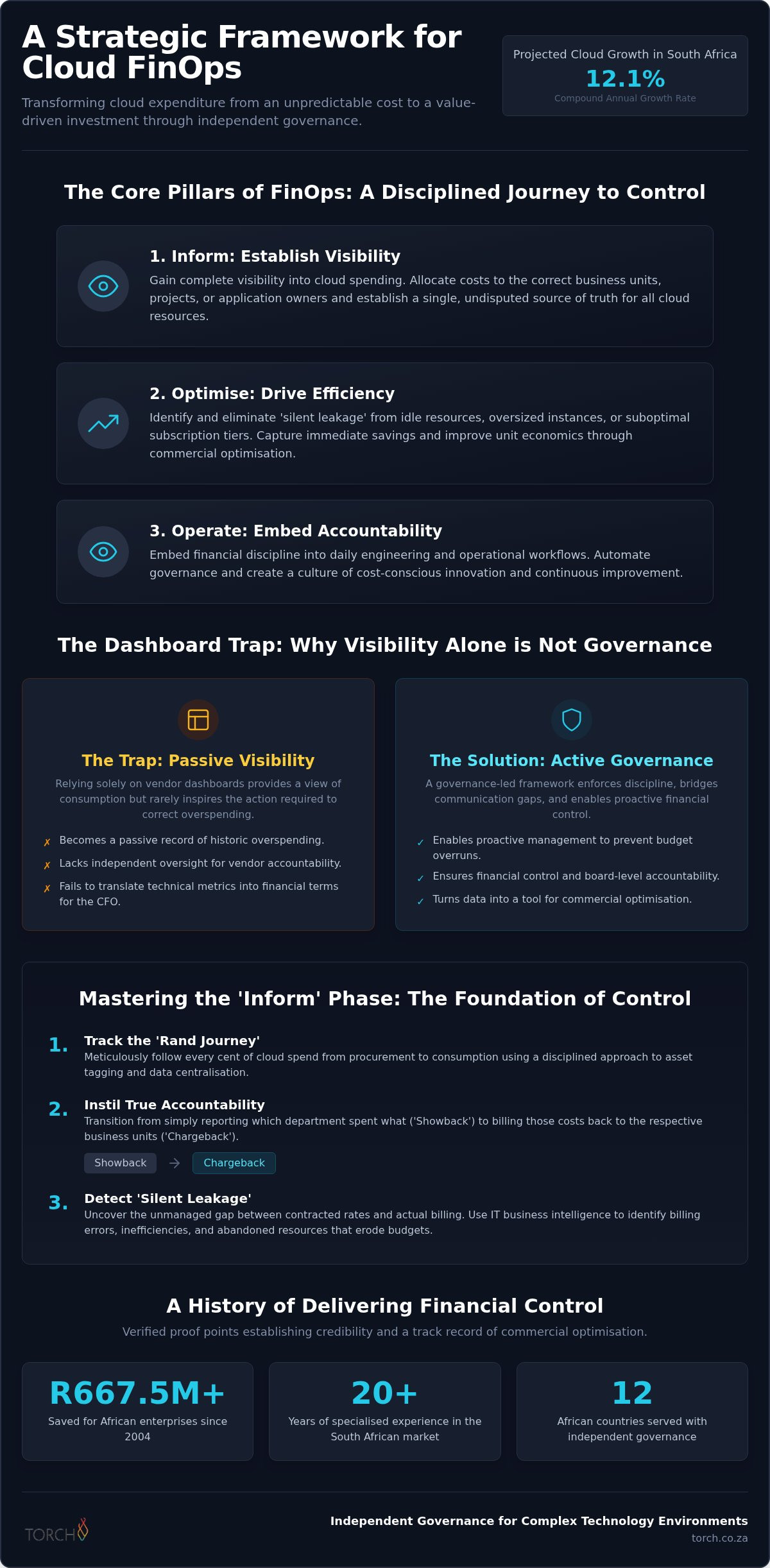
For South African enterprises, the migration to the cloud promised agility and scalability. Yet, for many Chief Financial Officers, it has introduced a new era of financial unpredictability. Unlike the fixed, capital-intensive nature of on-premise IT, cloud expenditure is variable, complex, and notoriously difficult to attribute to business value. With cloud services in South Africa projected to grow at a compound annual rate of 12.1%, establishing financial control is no longer a technical challenge but a strategic imperative.
This is the discipline of FinOps. More than a set of tools or a new name for cost management, FinOps is a cultural and operational shift that brings financial accountability to the variable spend model of the cloud. It is the practice of aligning technology teams with finance and procurement, creating a shared language and responsibility for cloud consumption. As a Sage advisor with over two decades of experience in the South African market, Torch has seen firsthand that true control comes not from dashboards, but from discipline. The foundation of effective FinOps for cloud cost reporting is independent governance—a rigorous framework for visibility, accountability, and commercial optimisation.
The Core Pillars: Inform, Optimise, and Operate
The FinOps Foundation organises the practice into three iterative phases. This framework provides a structured approach to move from financial ambiguity to strategic control, turning raw data into measurable Rand savings.
- Inform: This is the foundational pillar, focused on gaining complete visibility into cloud spending. It involves allocating costs to the correct business units, projects, or application owners through granular tagging and establishing a single, undisputed source of truth for all cloud resources.
- Optimise: Once visibility is established, the focus shifts to efficiency. This phase involves identifying and eliminating “silent leakage”—wasteful spend on idle resources, oversized instances, or suboptimal subscription tiers—to capture immediate savings and improve unit economics.
- Operate: The final pillar embeds FinOps into the fabric of the organisation. It is about continuous improvement, automating governance, and ensuring that financial discipline becomes an integral part of daily engineering and operational workflows, creating a culture of cost-conscious innovation.
Why Visibility Alone is Not Governance
Many enterprises fall into the ‘Dashboard Trap,’ believing that the reporting tools provided by their cloud vendors are sufficient for cost management. Whilst these dashboards provide a view of consumption, they rarely inspire the action required to correct overspending. Seeing a problem does not mean it gets resolved.
This is where visibility diverges from governance. True governance requires independent oversight to ensure vendor accountability and bridge the communication gap between engineering activity and board-level financial reporting. It translates technical usage metrics into the language of the CFO: budget variance, cost-centre allocation, and return on investment. Without an independent partner to enforce this discipline, dashboards become passive records of historic overspending rather than active tools for commercial control.
The Inform Phase: Establishing Visibility and Accountability
The first step in any credible FinOps practice is to meticulously track the ‘Rand journey’—following every cent of cloud spend from the initial procurement decision to its final consumption by a specific team or product. This requires moving beyond high-level invoices to a granular understanding of usage, which is only possible through a disciplined approach to asset tagging and data centralisation.
By establishing a single source of truth for all IT assets and cloud resources, an organisation can transition from ‘showback,’ which simply reports on which department spent what, to ‘chargeback,’ which instils true financial accountability by billing those costs back to the respective business units. This process transforms IT from a perceived cost centre into a strategic enabler whose value can be accurately measured.
Mapping Costs to Business Value
The ultimate goal of the Inform phase is to connect every Rand of cloud spend to a tangible business outcome. This requires a robust system for categorising spend by cost centre, project, application owner, or even by individual feature. This level of detail allows leadership to make informed decisions about resource allocation and investment.
Achieving this requires more than a monthly spreadsheet reconciliation. Real-time governance platforms, such as SpotLight™, provide immediate visibility into how consumption is tracking against budget. This allows finance and IT teams to move beyond reacting to the monthly invoice and instead proactively manage daily consumption, preventing budget overruns before they occur.
Detecting Silent Leakage in IT Spend
Silent leakage is the unmanaged gap between contracted rates and actual billing. It represents the hidden costs, inefficiencies, and billing errors that internal teams often overlook due to a lack of time, specialised tools, or independent perspective. A significant portion of cloud spend is often wasted on unmanaged resources, from forgotten virtual machines to storage that is no longer in use.
Uncovering this variance requires sophisticated IT business intelligence models that can analyse vast datasets to flag anomalies and deviations from contractual terms. By identifying these discrepancies, organisations can reclaim budget that was otherwise being lost to billing inaccuracies and inefficient resource management, directly improving the bottom line.
Beyond Dashboards: Building a Governance-Led Reporting Framework
Effective FinOps for cloud cost reporting is built on a framework that prioritises governance over simple data visualisation. It requires a structured, multi-step process that integrates financial rigour into the heart of IT operations. Since 2004, Torch has helped African enterprises save over R667.5M by implementing such frameworks, proving that sustained optimisation is a result of discipline, not just technology.
- Define Clear KPIs: Establish key performance indicators that align with CFO scrutiny and board-level objectives. These should move beyond technical metrics to focus on business outcomes like cost per transaction, cloud spend as a percentage of revenue, and budget vs. actual variance.
- Implement Rigorous Reconciliation: Institute a formal process for monthly invoice reconciliation and variance analysis. This ensures that every line item is validated against contracts and actual usage, catching billing errors before they become sunk costs.
- Establish a Cross-Functional Team: Create a dedicated FinOps team comprising representatives from Finance, IT/Engineering, and Procurement. This collaborative body is responsible for setting budgets, reviewing spend, and driving optimisation initiatives.
- Automate the Reporting Workflow: Leverage automation to handle the administrative burden of data collection and report generation. This frees up valuable IT and Finance personnel to focus on strategic analysis and decision-making rather than manual data entry.
- Conduct Regular Benchmarking: Perform regular, carrier-agnostic benchmarking to ensure all cloud services are contracted at fair market rates. This provides crucial leverage for commercial renegotiations and prevents vendor lock-in.
The Strategic IT Asset Management Reporting Dashboard
A truly strategic reporting dashboard is more than a collection of charts; it is a tool for governance. It must provide a clear, consolidated view of the entire IT estate, enabling leadership to make data-backed decisions with confidence. The goal is to evolve from passive visibility to proactive, independent governance.
This is the principle behind The Strategic IT Asset Management Reporting Dashboard. By integrating data from multiple cloud providers, on-premise systems, and financial platforms, it restores board-level confidence that IT spend is being managed with the same rigour as any other area of the business.
Vendor Accountability and Commercial Optimisation
An essential truth of financial governance is that a vendor cannot effectively audit its own revenue. Relying solely on a cloud provider’s invoices and dashboards creates an inherent conflict of interest. Independent validation is non-negotiable for achieving commercial optimisation.
By using proprietary benchmarking data and market intelligence, an independent partner can enter negotiations with significant leverage, securing gains of up to 27.5% on behalf of clients. Furthermore, this independence allows for the establishment of robust Service Level Agreements (SLAs) that are focused not just on technical uptime, but on financial performance and billing accuracy, holding vendors accountable for their commercial commitments.
Managed FinOps: Transitioning from Data to Commercial Optimisation
For organisations whose internal teams are already stretched thin, implementing a FinOps practice can seem daunting. This is where a managed service model provides a clear path forward. FinOps-as-a-Service offers embedded execution, not just reporting software. It provides the specialised skills, processes, and accountability needed to turn insights into action.
An independent partner like Torch resolves issues rather than just reporting them. This high-touch, embedded model is proven to deliver an average of 19.6% in savings through continuous subscription adjustment alone. Moreover, by integrating FinOps with disciplines like Unified Endpoint Management (UEM), this governance extends to the entire IT estate, reducing ransomware risk exposure from unmanaged cloud endpoints and securing the organisation’s financial and operational integrity.
The Torch FinOps Readiness Assessment
Understanding the current state of your financial governance is the first step toward improvement. To facilitate this, Torch offers a FinOps Readiness Assessment, a 20-minute diagnostic designed specifically for CFOs and Finance Directors. This consultative review is a low-friction, high-value engagement that requires no technical preparation from your team.
The assessment rapidly identifies governance gaps, control deficiencies, and areas of silent leakage within your current cloud and IT estate. It provides a clear, actionable roadmap for establishing the financial discipline needed to control costs and maximise the return on your technology investments.
Request the Torch FinOps Readiness Assessment
Sustaining Optimisation through Structural Control
One-off cost-saving programmes inevitably fail because they address symptoms, not the root cause. Without a permanent, governance-led framework, spending habits revert, and savings evaporate. Sustained optimisation is only possible when financial discipline is embedded into the organisation’s structure and culture.
A high-touch, embedded execution model provides the continuous oversight needed to resolve billing errors, rightsize resources, and hold vendors accountable month after month. This structural control ensures that the benefits of FinOps are not a temporary windfall but a permanent improvement in the organisation’s financial health. To understand how this framework can be applied to your enterprise, consider a confidential, no-obligation discussion about your current challenges.
Book a 30-minute governance review with Derek King
Frequently Asked Questions (FAQs)
What is the difference between cloud cost management and FinOps?
Cloud cost management is typically a reactive, tool-focused activity centred on tracking spend and identifying anomalies. FinOps is a proactive, cultural practice that unites technology, finance, and business teams around the shared goal of maximising business value from the cloud. It is a strategic discipline focused on accountability, not just reporting.
How can FinOps reporting help reduce our monthly cloud spend in Rands?
FinOps reporting drives Rand-based savings in three key ways. First, it provides the granular visibility needed to allocate costs accurately (chargeback), making teams accountable for their consumption. Second, it systematically identifies waste, such as idle or oversized resources, that can be eliminated. Finally, it provides the data-driven insights required to negotiate better rates with cloud providers.
Why should we use an independent partner instead of our cloud provider’s dashboard?
Cloud providers cannot independently audit their own revenue. Their dashboards show you what you have spent, but they lack the commercial impartiality to validate whether that spend is accurate, efficient, or aligned with market rates. An independent partner provides objective validation, vendor accountability, and expert negotiation leverage that a provider’s tools cannot offer.
What are the common billing errors found in enterprise cloud cost reporting?
Common errors include being billed for decommissioned services, incorrect application of committed-use discounts, rates that do not align with the master service agreement, and miscalculations in data transfer or storage fees. Without rigorous, independent reconciliation, these errors can accumulate into significant financial leakage over time.
How does FinOps integrate with Unified Endpoint Management (UEM)?
A comprehensive FinOps practice governs the total cost and risk of the entire IT estate. Because unmanaged endpoints are a primary source of both security breaches and uncontrolled data costs, integrating UEM is critical. FinOps provides the financial oversight, whilst UEM provides the operational control to ensure every device accessing cloud resources is secure, compliant, and cost-efficient.
What metrics should be included in a board-level cloud cost report?
A board-level report should focus on business outcomes, not just technical metrics. Key metrics include: total cloud spend vs. budget and forecast; cost per business unit, product, or customer; unit economics (e.g., infrastructure cost per transaction); savings realised from optimisation initiatives; and a summary of financial risks and governance posture.