
Challenging the Myth of SaaS Cost-Cutting
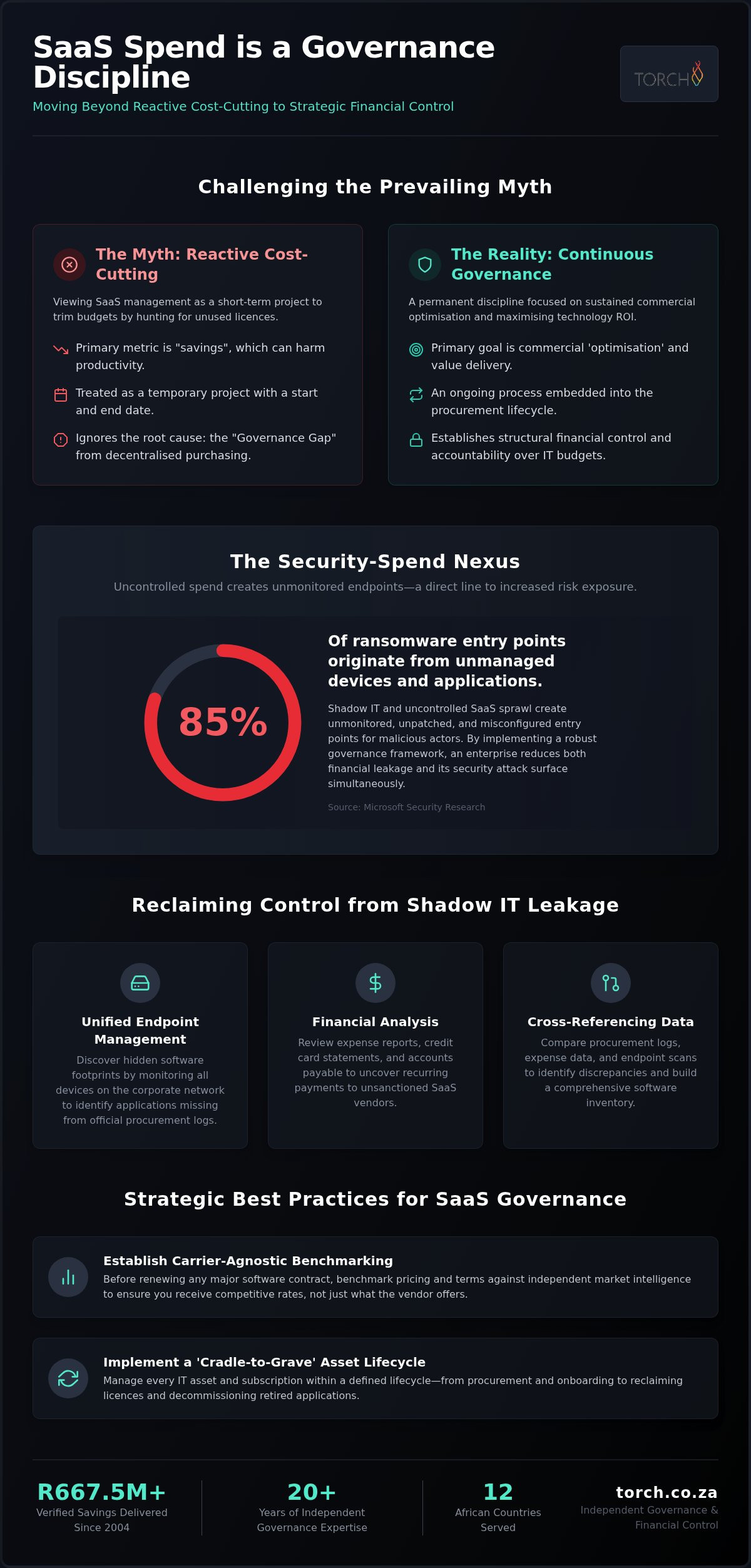
For many CFOs and CIOs in South Africa, the term ‘SaaS spend management’ has become synonymous with a reactive, often frustrating, cost-cutting exercise. It is typically viewed as a project with a start and an end date, designed to trim budgets by hunting down unused licences. This perspective, however, is a dangerous myth. True SaaS spend management is not a project; it is a continuous governance discipline focused on sustained commercial optimisation and maximising the return on every Rand invested in technology.
The myth that the primary goal is cost-cutting ignores a more critical reality: the real objective is to establish financial control and accountability. When decentralised teams can procure software with a company credit card, a ‘Governance Gap’ emerges. This gap is where unmanaged subscriptions, redundant applications, and auto-renewing contracts create silent financial leakage, undermining budgets and exposing the enterprise to significant risk. Traditional, centralised IT procurement workflows were simply not designed for this new era of decentralised, on-demand software acquisition.
Why ‘Savings’ is the Wrong Metric
Chasing ‘savings’ as a primary metric can be misleading. An aggressive push to slash software costs without understanding its operational impact can lead to productivity bottlenecks, frustrated teams, and cancelled tools that were, in fact, delivering significant value. The more effective approach is commercial ‘optimisation’, which ensures that every subscription is not only used but is also delivering measurable ROI. This shift requires a move towards establishing structural control over IT budgets, where financial governance is embedded into the procurement lifecycle.
In essence, SaaS spend management is the specialised discipline within the broader IT FinOps framework that applies financial accountability to the way an enterprise buys and manages its software-as-a-service portfolio.
The True Cost of Unmanaged Subscriptions
For South African enterprises, the financial risks are magnified. The volatility of the Rand (ZAR) against the US Dollar means that international SaaS pricing can fluctuate dramatically, making budget forecasting a significant challenge. Without a firm grip on the entire software estate, these costs can spiral out of control. Our analysis shows that actively governed estates can achieve significant total cost reductions—not by blindly cutting, but by eliminating waste and negotiating from a position of strength.
A primary source of this waste comes from ‘auto-renewal traps’. Many SaaS contracts are designed to renew automatically, often with price increases, bypassing the necessary CFO or procurement oversight. This automated leakage ensures that even if a tool is no longer needed or a better alternative exists, the organisation continues to pay for it, year after year.
Reclaiming Control from Shadow IT Leakage
This uncontrolled SaaS sprawl is directly linked to increased ransomware risk exposure. Every unsanctioned application exists outside the organisation’s security perimeter, creating new entry points for malicious actors. Furthermore, it introduces significant financial risk through duplicate functionality. It is common to find multiple departments independently paying for project management, file sharing, or design tools that perform the same function, leading to redundant expenditure that is invisible to central finance.
Identifying the Silent Leakage Points
Discovering unsanctioned SaaS usage does not require becoming ‘the department of No’. A more effective strategy is to build a complete picture of the technology estate through objective analysis. This involves a multi-pronged approach:
- Unified Endpoint Management (UEM): The role of Unified Endpoint Management is critical in discovering hidden software footprints. By monitoring all devices connected to the corporate network, UEM platforms can identify installed applications that do not appear on official procurement logs.
- Financial Analysis: A thorough review of expense reports, credit card statements, and accounts payable records often reveals recurring payments to SaaS vendors that are not part of the sanctioned IT portfolio.
- Cross-Referencing Data: Comparing data from procurement logs, expense reports, and endpoint scans allows an organisation to identify discrepancies and build a comprehensive inventory of all software in use, both sanctioned and unsanctioned.
The Security-Spend Nexus
The link between uncontrolled spend and security risk cannot be overstated. According to Microsoft Security research, 85% of ransomware entry points originate from unmanaged devices and applications. When an application is not vetted by IT, it is not patched, monitored, or configured according to corporate security policies, making it a prime target for exploitation. By implementing a robust governance framework, an enterprise reduces both financial leakage and its security attack surface simultaneously.
For hybrid workforces in South Africa, where employees connect from a variety of locations and devices, policy enforcement is paramount. A clear governance model ensures that every endpoint, regardless of its location, adheres to the same security standards, protecting both the user and the organisation’s data.
Strategic Best Practices for SaaS Governance
Establishing control over the SaaS estate requires a strategic, repeatable framework, not a series of ad-hoc audits. The following best practices form the foundation of a mature SaaS spend management discipline:
- Establish Carrier-Agnostic Benchmarking: Before renewing any major software contract, benchmark the pricing and terms against the current market. This requires independent market intelligence to ensure you are receiving competitive rates, not just what the vendor offers.
- Implement a ‘Cradle-to-Grave’ Lifecycle: Every IT asset and subscription, from procurement to decommissioning, must be managed within a defined lifecycle. This includes processes for onboarding new users, reclaiming licences from departing employees, and retiring applications that no longer serve a business need. A clear software asset management framework is essential for this.
- Centralise Vendor Accountability: Consolidate vendor management to create a single point of accountability. Track performance against Service Level Agreements (SLAs) and conduct regular business reviews to ensure vendors are delivering on their promises.
- Move from ‘Chargeback’ to ‘Showback’: Instead of simply charging IT costs back to departments, a ‘showback’ model provides visibility into consumption, encouraging departmental leaders to take ownership of their technology spend and make more informed decisions about the tools they use.
Benchmarking and Negotiation Tactics
Effective negotiation begins long before you speak with a vendor. By using market intelligence and procurement modelling tools, you can simulate various contract scenarios to understand the potential financial impact of different terms. This data-driven approach removes emotion from the negotiation and focuses the conversation on commercial value.
Engaging an independent advisor is critical for maintaining vendor accountability. An advisor without ties to any specific carrier or software vendor can provide objective analysis and advocate solely on your behalf. This approach avoids an ‘anti-vendor’ sentiment whilst ensuring rigorous financial discipline is applied to every agreement.
Automating the Governance Workflow
As the governance framework matures, automation can drive significant efficiency gains. Automated user support, for example, can manage licence requests and provisioning, freeing up internal IT teams for more strategic work. Integrating SaaS spend data with existing Enterprise Resource Planning (ERP) and Human Resource Management (HRM) systems is also crucial. This integration creates a ‘Single Source of Truth’ for all technology spend, linking costs directly to employees, departments, and projects for unparalleled financial clarity. For organisations looking to scale these efforts, specialist integrators like Apollonix Tecnologia can provide the expertise needed to automate and optimise complex software ecosystems for maximum value.
Moving from Dashboard Insights to Managed Execution
Perhaps the most persistent myth in SaaS spend management is that a dashboard alone can solve the problem. Dashboards are excellent at surfacing problems—they can show you where you are overspending or which licences are inactive. But a dashboard cannot renegotiate a contract, reclaim a licence, or enforce a security policy. Dashboards provide insights; people and processes solve problems.
For CFOs and CIOs looking to move beyond surface-level insights, the logical next step is to assess their organisation’s governance maturity. The Torch FinOps Readiness Assessment provides a 20-minute diagnostic designed to uncover these hidden governance gaps.
The Role of the Independent Advisor
Carriers and software vendors cannot be expected to effectively audit their own revenue streams. Objective, independent analysis is the most reliable way to uncover deep-seated structural waste. With a track record built on over 100 years of combined industry expertise, Torch operates as a carrier-agnostic advisor dedicated to bringing visibility and control to complex technology estates across Africa.
This independence, backed by a history of saving clients more than R667.5M since 2004, allows us to challenge assumptions, benchmark contracts against proprietary market data, and drive negotiations that deliver sustained commercial value for our clients.
Sustaining Optimisation through Structural Control
The ultimate goal of SaaS spend management is to ensure that cost reductions are not one-off events but are sustained through permanent structural control. This means embedding financial discipline and commercial rigour into the DNA of your procurement and IT operations. When IT financial performance is reported at the board level with the same seriousness as any other business unit, the entire organisation’s behaviour begins to shift.
By moving from reactive cost-cutting to proactive governance, you transform IT from a cost centre into a strategic enabler of business value. To begin uncovering your own organisation’s financial leakage points, we invite you to book a 30-minute governance review with Derek King and discover what an independent, execution-led approach can achieve.