
As a CFO or Finance Director in a South African enterprise, you operate on a foundation of rigorous financial governance. When your internal audit team reports that IT and telecom expenditures are under control, you expect that to be the final word. Yet, a persistent doubt often remains—a sense that despite clean audits, significant financial leakage is occurring within your complex carrier invoices.
This is not a failure of your team, but a reflection of a critical governance gap. Internal audits are designed to catch clerical errors and ensure procedural compliance; they are not equipped to uncover the structural overspending and commercial inefficiencies buried within modern telecom estates. The result is a cycle of hidden costs that erode budgets, even when everything appears correct on the surface.
Discover why traditional internal audits often fail to secure your telecom budget and learn the seven critical questions you must ask any potential Telecom Expense Management (TEM) provider. This framework will empower you to move beyond surface-level checks and establish the independent governance required to achieve sustainable cost optimisation of up to 47.2%.
Why Internal Audits Often Miss Structural Telecom Leakage
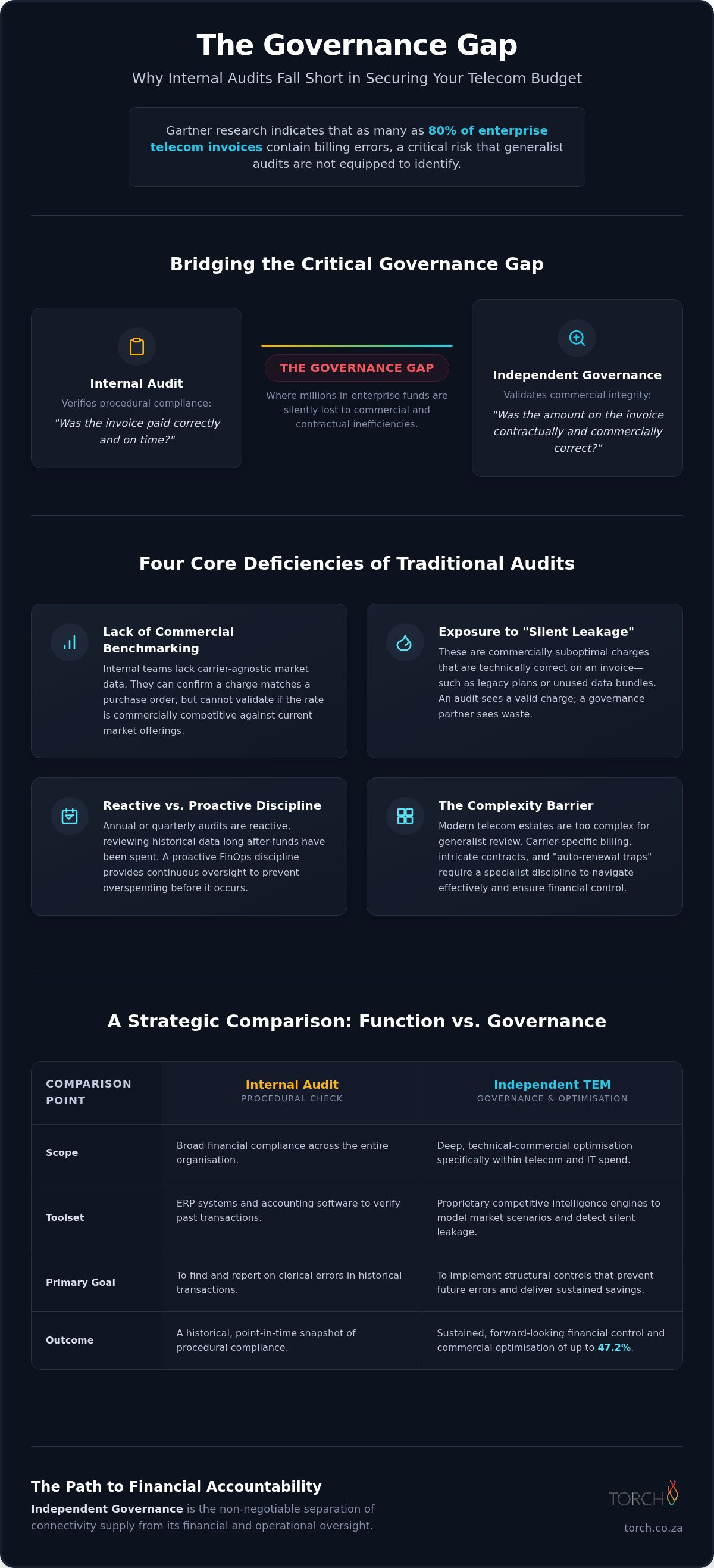
The core challenge lies in the distinction between financial auditing and specialised telecom governance. An internal audit confirms that an invoice was paid and allocated to the correct cost centre. Independent Telecom Expense Management, however, validates whether the amount on that invoice was commercially and contractually correct in the first place. This is the “Governance Gap” where millions in enterprise funds are silently lost.
According to global research firm Gartner, as many as 80% of enterprise telecom invoices contain billing errors. Generalist auditors, unfamiliar with carrier billing intricacies and lacking market benchmarks, are ill-equipped to identify these discrepancies. They can confirm a number matches a purchase order, but they cannot confirm if that number represents true market value or contains hidden penalties.
- The Governance Gap: This is the space between what a generalist auditor can verify (e.g., “Was the invoice paid on time?”) and what a specialist TEM partner investigates (e.g., “Was this the contractually agreed-upon rate, and is it still commercially competitive?”).
- Lack of Benchmarking Data: Internal teams rarely have access to carrier-agnostic, real-time market data. Without it, they cannot know if they are paying R200 for a service that the market now offers for R120. This prevents true validation and leaves significant negotiation leverage on the table.
- “Silent Leakage”: These are the most dangerous costs—charges that are technically correct on an invoice but are commercially suboptimal. Examples include employees on legacy plans, paying for unused data bundles, or failing to benefit from newly available promotions. An audit sees a valid charge; a governance partner sees waste.
- Reactive vs. Proactive Discipline: Annual or quarterly audits are reactive, reviewing historical data long after the money has been spent. A proactive FinOps discipline, embedded within TEM, provides continuous oversight to prevent overspending before it occurs.
The Complexity Barrier in Modern Telecom
The sheer complexity of a modern enterprise telecom estate creates a barrier that standard auditing practices cannot penetrate. Managing hundreds or thousands of mobile endpoints across multiple carriers, each with its own unique billing cycle, contract terms, and service catalogue, is a specialist discipline. As Gartner’s research indicates, the vast majority of these accounts contain errors that a generalist will miss.
This complexity is compounded by commercial tactics that bypass standard procurement checks. “Auto-renewal traps,” for instance, can lock an organisation into uncompetitive rates for years without ever triggering a formal review. An internal auditor sees a recurring, approved expense; a TEM expert sees a multi-year financial liability that needs immediate renegotiation.
Independence vs Internal Bias
A fundamental principle of effective auditing is independence, yet many organisations unknowingly rely on biased sources for their telecom validation. Carrier-provided “self-service” portals are not objective auditing tools; they are sales platforms designed to display data in a way that benefits the provider. Relying on them for financial oversight is like asking a vendor to audit their own invoices.
Furthermore, internal IT and finance staff often lack the specific expertise and negotiating leverage to effectively dispute complex carrier variances. They are overburdened with other critical tasks and may not have the capacity for the time-consuming process of logging, tracking, and resolving intricate billing disputes. This is where independent governance becomes essential. Independent Governance is the non-negotiable separation of connectivity supply from its financial and operational oversight. An impartial expert, working exclusively for you, ensures that every Rand spent is validated, justified, and optimised.
Telecom Expense Management vs Internal Audit: A Strategic Comparison
Choosing between relying on an internal audit and engaging a TEM partner is a fundamental decision about financial governance. It is not about replacing your auditors but augmenting their financial compliance function with a specialist commercial and technical discipline. The two functions serve different purposes, use different tools, and deliver vastly different outcomes.
An internal audit provides a snapshot in time, focused on historical accuracy and compliance. A managed TEM service delivers sustained, forward-looking control over one of the most complex and dynamic expense categories in the enterprise.
- Scope: Internal audit focuses on broad financial compliance across the entire organisation. TEM provides deep, technical-commercial optimisation specifically within the telecom and IT spend category.
- Toolset: Auditors rely on ERP systems and accounting software to verify transactions. TEM providers use proprietary competitive intelligence engines, like Torch’s TorchLight™, to model market scenarios and detect silent leakage that ERPs cannot see.
- Outcome: The goal of an audit is to find and report on errors in past transactions. The goal of TEM is to implement structural controls that prevent future errors and deliver sustained, measurable savings.
- Staff Impact: An audit often creates additional workload for IT and finance teams who must supply data and answer queries. A high-touch TEM service reduces their administrative burden by taking ownership of invoice reconciliation, carrier disputes, and user support.
Depth of Data and Benchmarking
The most significant difference lies in the data used to validate spending. An internal audit team works with historical, internal data—what your company has paid in the past. This approach cannot identify if you are overspending relative to the market.
A TEM provider leverages real-time, carrier-agnostic market data. At Torch, our proprietary business intelligence models and TorchLight™ engine allow us to benchmark your rates against current, best-in-market pricing. This data-driven approach is how we achieve an average of 27.5% in negotiation gains for our clients. We can model future consumption patterns for hybrid workforces and ensure your contracts are structured for where your business is going, not just where it has been. For more on this, see our guide on building a business case for TEM.
The “Risk-Share” Advantage
Perhaps the most compelling argument for a CFO is the financial model. An internal audit is a fixed, operational cost—a necessary expense for compliance. In contrast, many of Torch’s TEM services operate on a risk-share basis, where our remuneration is a percentage of the verified savings we deliver.
This transforms TEM from an additional cost into a self-funding governance discipline. The incentive is perfectly aligned: we are motivated to find and recover every Rand of overspend because our success is directly tied to yours. This model removes the financial risk of engagement and ensures that the programme delivers a clear and immediate return on investment. It is a cornerstone of a modern IT FinOps strategy, focusing on value creation rather than simple cost-cutting.
7 Critical Questions to Ask a TEM Provider Before Appointing Them
Appointing a TEM partner is a strategic decision that extends beyond software features and dashboards. To ensure you are engaging a true governance partner and not just a reporting tool, your evaluation must focus on independence, execution, and accountability. Here are seven critical questions to ask any potential provider.
- Are you truly carrier-agnostic, or do you receive commissions from vendors?
A provider who receives financial incentives from carriers has an inherent conflict of interest. True governance requires 100% independence. You need an advisor whose only objective is to secure the best commercial and technical outcome for your enterprise. - Do you merely report errors, or do you handle the full remediation and recovery process?
Many software-led solutions simply provide a dashboard of potential issues, leaving your already-strained IT and finance teams to handle the time-consuming work of disputing and recovering funds from carriers. A true managed service takes ownership of the entire lifecycle, from detection to resolution. - How do you integrate with our existing ERP and HRM systems for cost-centre allocation?
Effective governance requires seamless integration with your core financial systems. The provider should be able to automate the allocation of costs to the correct business units, projects, and employees, providing granular visibility and eliminating manual journal entries. - What is your verified track record in the South African enterprise market?
The South African telecom landscape has unique complexities. Ask for specific, local case studies and references. A provider’s longevity and experience are critical. Torch, for example, brings over 100 years of combined telecom expertise and has saved clients over R667.5M since 2004. - Can you demonstrate how your service mitigates ransomware risk through endpoint governance?
Modern TEM is intrinsically linked to security. With most ransomware attacks originating from unmanaged devices, the provider must demonstrate a clear strategy for enforcing security policies on all mobile endpoints as part of a unified governance framework.
Focusing on Execution and Accountability
The right partner moves beyond reporting and into execution. Their value is measured not by the number of dashboards they provide, but by their ability to effect change within your organisation and with your vendors.
- Does your service include embedded staff to resolve issues internally?
A high-touch model where the provider’s staff work as an extension of your team is a powerful differentiator. This ensures accountability and speeds up resolution, as they can engage directly with internal stakeholders and carriers to solve problems. - How do you handle “cradle-to-grave” asset management for mobile devices?
Expense management is tied to asset management. The provider should have a robust process for managing the entire lifecycle of a device, from procurement and deployment to support, repair, and eventual retirement, ensuring you are not paying for devices that are no longer in use.
The answers to these questions will reveal the provider’s true capability. The best way to test these answers is to invite them to a 30-minute governance review to discuss your specific challenges.
Evaluating Technical Prowess
Whilst the service model is paramount, the underlying technology is what enables efficient and scalable governance. Inquire about the provider’s proprietary platforms, such as Torch’s SpotLight™, which offers real-time visibility into spend and consumption against budgets. Ask how they use automation, such as user support bots, to reduce the pressure on your internal IT helpdesk. A mature provider will offer a suite of integrated managed telecom services, not just a single piece of software.
Beyond the Audit: Restoring Board-Level Confidence in IT Spend
The ultimate goal of engaging a TEM partner is to shift from a reactive cycle of “finding savings” to a proactive state of “governing the estate.” This transition provides the long-term stability and predictability that boards and executive committees demand. When you can present IT financial data backed by independent, verifiable business intelligence models, you change the conversation from cost to value.
This journey culminates in achieving a fully optimised and governed environment, where cost reductions of up to 47.2% are not a one-time project but a sustained business-as-usual state. Rigorous governance is the most reliable path to lasting budget security, and it positions IT and Finance as strategic partners to the business.
Sustainable Optimisation Through Structural Control
One-off audits produce temporary savings, but the underlying issues that caused the overspending often remain. Sustainable optimisation is only achieved by implementing structural controls. This means moving away from periodic audits and embracing a continuous FinOps-as-a-Service model.
In a hybrid work environment, this includes rigorous endpoint policy enforcement to control data usage and secure devices. By establishing this framework of continuous oversight, organisations can join the ranks of South African enterprises that have contributed to the R667.5M+ in savings Torch has identified and recovered for its clients since 2004. The scale of this figure is a benchmark for what is possible when structural control replaces periodic review. For a deeper dive, explore our analysis of the risks of unmanaged telecom spend.
Next Steps for the CFO
If you suspect that your telecom spend contains hidden leakage despite clean internal audits, the next step is to seek independent validation. This does not require a lengthy or costly commitment. A logical first step is to initiate a no-cost, no-obligation telecom billing audit against your most recent invoices. This will provide a quick, data-driven assessment of your immediate savings opportunities.
For a more strategic evaluation, a 20-minute FinOps Readiness Assessment can help you benchmark your current governance maturity and identify the specific areas where you are most exposed. Both paths lead to a clear, evidence-based understanding of your position, empowering you to make an informed decision.
To gain clarity on your telecom estate and explore a path to sustained financial control, book a confidential, 30-minute governance review with our Managing Director, Derek King.
Frequently Asked Questions (FAQs)
- Can our internal audit team perform telecom expense management effectively?
-
Whilst internal audit teams are vital for general financial compliance, they typically lack the specialised tools, carrier-agnostic benchmarking data, and deep telecom-specific expertise to perform effective TEM. They can verify that bills are paid but cannot easily validate if the charges are commercially optimal or contractually accurate. TEM is a specialist discipline that complements, rather than replaces, their function.
- How does a TEM provider differ from a standard financial auditor?
-
A financial auditor is a generalist who reviews historical financial records for accuracy and compliance with accounting standards. A TEM provider is a specialist who combines financial, technical, and commercial expertise to analyse, manage, and optimise telecom spend in real-time. The key difference is the focus: auditors look backward at compliance, whilst TEM providers look forward to create sustained optimisation and control.
- Is it worth hiring a TEM provider if our carrier already provides a dashboard?
-
Yes. A carrier-provided dashboard is not an independent auditing tool; it is a reporting interface that presents data from the carrier’s perspective. It cannot identify if you are on an uncompetitive plan or if a billing error benefits the carrier. An independent TEM provider acts as your advocate, using objective data to hold carriers accountable and ensure your interests are protected.
- What are the most common billing errors caught by TEM but missed by internal audits?
-
Common errors include charges for services on decommissioned lines, incorrect tariff plan applications, failure to apply volume discounts, taxes and surcharges being miscalculated, and charges for features that were never activated. The most significant area, however, is “silent leakage”—paying for services that are commercially suboptimal, such as individual data bundles when a shared pool would be far more cost-effective.
- How much does a professional telecom expense management service cost in South Africa?
-
Pricing models vary, but leading providers like Torch often operate on a risk-share basis. This means the fee is a percentage of the actual, verified savings delivered to your business. This makes the service self-funding. For other services like ongoing management or platform access, costs can be structured on a per-user or per-site basis. The goal is always to ensure the service delivers a significant positive return on investment.
- What is the typical ROI for an enterprise investing in TEM governance?
-
The return on investment is typically substantial and immediate. Actively governed telecom estates can achieve total cost reductions of up to 47.2% compared to unmanaged environments. Because many TEM engagements are structured on a savings-based model, the ROI is contractually guaranteed from the outset. The long-term value also includes reduced administrative overhead, improved budget predictability, and enhanced security.