
For Chief Financial Officers and CIOs in South Africa’s leading enterprises, the promise of technology is often undermined by a persistent, uncontrolled reality: silent financial leakage. Despite significant investment in vendors, platforms, and connectivity, many organisations lack the independent governance required to ensure they receive the value they were promised. The result is a technology estate where accountability is eroded, budgets are unpredictable, and commercial leverage is lost.
This guide moves beyond generic advice and software-only solutions. It provides a strategic framework for implementing rigorous, independent telecom vendor management services. We will explore how a governance-led approach not only stops financial leakage but also restores the financial and operational control necessary to drive sustainable business performance into 2026 and beyond.
The Governance Gap: Why Telecom Vendor Management Services Often Fail
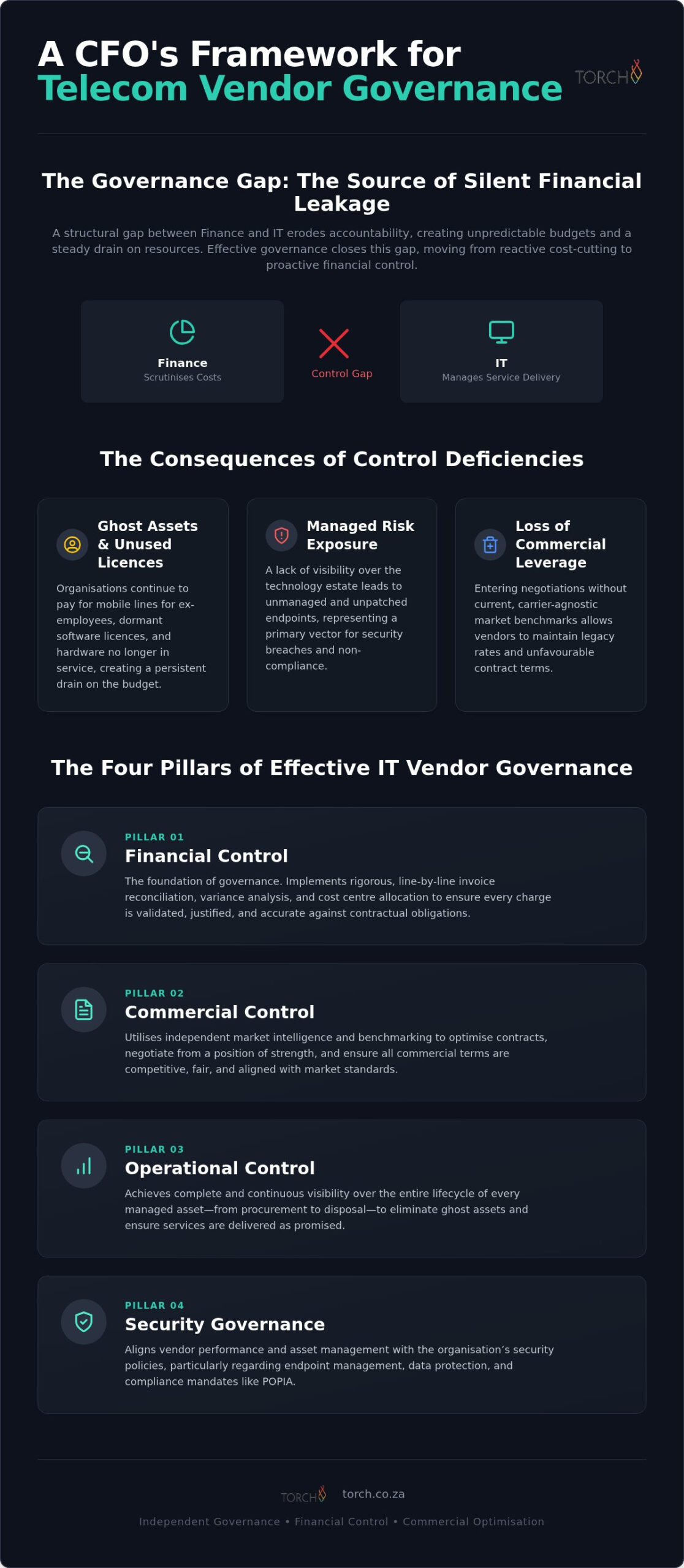
Effective telecom vendor management is not a one-time negotiation or a software dashboard; it is a continuous discipline of enforcing financial and operational accountability. It ensures that every rand spent on technology is visible, justified, and aligned with contractual obligations. However, in most large organisations, a structural gap exists between Finance, which scrutinises costs, and IT, which manages service delivery. This gap creates the ideal conditions for silent financial leakage—a steady drain on resources caused by billing errors, ghost assets, unused licences, and non-compliant vendor performance.
Many enterprises attempt to close this gap with short-term cost-cutting programmes. Whilst these may yield initial savings, they fail to address the underlying lack of governance. Without a permanent, embedded function dedicated to independent oversight, old habits return, contracts drift, and financial leakage resumes. Sustainable optimisation is only possible through a governance-led framework that embeds control directly into the organisation’s financial and operational workflows.
The Illusion of Vendor Self-Reporting
A fundamental principle of good governance is that an entity should never audit itself. Yet, many organisations rely on performance dashboards and billing reports provided by their telecom carriers and technology vendors. This practice introduces a significant conflict of interest. Carriers have a commercial incentive to protect their revenue streams, not to highlight billing inaccuracies or underperformance against Service Level Agreements (SLAs).
Vendor-provided dashboards are often designed to present a favourable view of performance, masking underlying issues such as:
- Contractual Deficiencies: Reports may not reflect the specific terms, rates, and conditions negotiated in your master services agreement, leading to systematic overcharging.
- Billing Errors: Complex invoices from major carriers frequently contain errors that automated systems, especially those managed by the vendor, are not designed to detect.
- Operational Drift: Without independent verification, service performance can slowly degrade over time, falling out of alignment with contractual promises without triggering any alarms on a vendor’s “green-light” dashboard.
True accountability requires an objective, third-party validation of all vendor invoices and performance data against the negotiated contract.
The Cost of Control Deficiencies
The absence of rigorous vendor governance extends beyond simple overspending. It creates systemic weaknesses that impact budget stability, commercial leverage, and security posture. Procurement and finance teams, already stretched thin, often lack the specialist expertise and market intelligence to effectively challenge major telecom carriers.
Key financial and operational impacts include:
- Ghost Assets and Unused Licences: In a dynamic enterprise environment, employees join and leave, and projects start and end. Without a robust asset lifecycle management process, organisations continue to pay for mobile lines for ex-employees, software licences for completed projects, and hardware that is no longer in service.
- Increased Security Risk Exposure: Poor vendor management often correlates with a lack of visibility over the technology estate. Unmanaged and unpatched endpoints, whether corporate or personally owned, represent a primary vector for security breaches, including ransomware attacks. Effective governance ensures every asset is known, managed, and secured.
- Loss of Negotiation Leverage: When procurement teams enter contract negotiations without current, carrier-agnostic market benchmarks, they are negotiating from a position of weakness. Incumbent vendors can leverage information asymmetry to maintain legacy rates and unfavourable terms, costing the organisation millions over the life of a contract.
The Four Pillars of Effective IT Vendor Governance
Moving from a reactive, cost-focused approach to a proactive, governance-led model requires a framework built on four interconnected pillars. This structure ensures that vendor management is not just a procurement function but a strategic discipline that aligns financial, commercial, operational, and security objectives.
- Financial Control: The foundation of governance. This involves implementing rigorous, line-by-line invoice reconciliation, variance analysis, and cost centre allocation to ensure every charge is validated and accurate.
- Commercial Control: The use of independent market intelligence and benchmarking to optimise contracts, negotiate from a position of strength, and ensure all commercial terms are competitive and fair.
- Operational Control: Achieving complete and continuous visibility over the entire lifecycle of every managed asset, from procurement to disposal, to eliminate ghost assets and ensure services are delivered as promised.
- Security Governance: Aligning vendor performance with the organisation’s security policies, particularly in relation to endpoint management, data protection, and compliance mandates like POPIA.
Financial Accountability and IT FinOps
For a CFO, confidence in financial data is non-negotiable. Yet, IT and telecom billing is notoriously opaque, making accurate forecasting and budgeting a significant challenge. The first step in restoring control is implementing systematic invoice validation, where every line item on a vendor bill is audited against contracts, asset inventories, and usage records. This process moves beyond simple bill payment to active financial management.
This discipline is a core component of IT FinOps (Financial Operations), which brings financial accountability to the variable spend model of technology. By transitioning from a basic “chargeback” model to a more transparent “showback” model, departments can see their consumption in detail, fostering a culture of cost awareness. FinOps-as-a-Service provides the expert-led execution required to manage complex IT spend, improve budget accuracy, and deliver defensible financial data for board-level reporting.
Benchmarking and Contractual Optimisation
True commercial control is impossible without objective market intelligence. Relying on a vendor’s own assessment of “market-related” pricing is a flawed strategy. An independent partner uses proprietary data and competitive intelligence engines, like TorchLight, to model procurement scenarios and benchmark existing contracts against current market rates.
For South African businesses, this carrier-agnostic data is critical for negotiating effectively with the handful of major providers that dominate the market. By presenting evidence-based analysis of prevailing rates and terms, internal teams gain the leverage needed to secure more favourable agreements. This process of capturing the “negotiation gain”—the difference between the incumbent’s proposed rates and what the market is truly offering—averages 27.5% through independent market benchmarking, delivering substantial and sustainable financial benefits.
Selection Criteria: Choosing an Independent Vendor Management Partner
Selecting the right partner is critical to the success of a governance-led strategy. The market is filled with software platforms and consultants, but not all are created equal. The primary objective is to find a partner that provides genuine independence and reduces the administrative burden on your internal teams, rather than simply adding another tool to manage.
Key evaluation criteria should include:
- Independence: Is the provider truly carrier-agnostic? A partner that also sells connectivity, hardware, or software has an inherent conflict of interest. True independence ensures their advice is driven solely by your organisation’s best interests.
- Managed Services Over Software: A dashboard can identify a billing error, but it cannot dispute it with the carrier, track it to resolution, and ensure credits are applied. Look for a managed service that includes embedded execution, where the partner’s team handles the day-to-day administrative workload.
- Integration Capabilities: The partner’s platform must integrate seamlessly with your existing Enterprise Resource Planning (ERP) and Human Resource Management (HRM) systems. This provides a single source of truth for asset allocation and cost centre management.
- Proven Local Expertise: Prioritise partners with a demonstrable track record of delivering results for South African enterprises, particularly within complex sectors like financial services, insurance, and hospitality.
Platform vs. Governance-Led Execution
A common misconception is that a software platform is a complete solution for telecom vendor management. Whilst visibility tools are important, they are only one part of the equation. A dashboard shows you a problem; it does not solve it. Without a team of specialists to analyse the data, engage with vendors, and manage disputes, the platform becomes little more than a reporting tool.
Governance-led execution bridges this gap. It combines a powerful technology platform with a dedicated team of experts who act as an extension of your organisation. This embedded execution model means the partner takes responsibility for resolving billing disputes directly with vendors, managing the mobile device lifecycle, and providing the analytical insights needed for strategic decision-making. This frees up your internal finance and procurement teams to focus on their core strategic functions, confident that the underlying administrative and analytical work is being handled by specialists.
The Importance of Carrier Independence
A vendor management partner must be carrier-agnostic, meaning they have no financial or strategic ties to any network operator or technology vendor. This independence is the bedrock of objective financial oversight and vendor accountability. It ensures that all recommendations—from contract negotiations to technology choices—are based on impartial, data-driven analysis.
An independent advisor provides the commercial leverage that internal teams often lack. They can engage with major carriers on a peer-to-peer basis, armed with comprehensive market data that challenges assumptions and drives more competitive outcomes. This objectivity is essential for building a transparent and accountable technology supply chain. For a deeper understanding of how this works in practice, you can learn more about our independent Telecoms Expense Management services.
The Torch Control Architecture: A New Standard for 2026
To meet the demands of an increasingly complex technology landscape, a new standard for governance is required. The Torch Control Architecture is a proprietary framework designed to establish and maintain control across three critical domains: Financial, Commercial, and Operational/Security. This integrated approach moves beyond isolated cost-cutting measures to create a sustainable system of enterprise-wide governance.
Using platforms like SpotLight for real-time visibility, this architecture provides a unified view of the entire technology estate, enabling budget-versus-actual oversight and proactive management. It facilitates the transition from an unmanaged, high-risk environment to a fully secured and governed estate where every asset and every rand is accounted for. The results are tangible and independently verified, such as the R38.4 million in savings verified for a major South African insurer by PwC through active management and governance.
FinOps-as-a-Service for Complex Estates
For organisations with complex, multi-vendor technology estates, establishing defensible financial data is a strategic imperative. The Torch FinOps-as-a-Service model is designed to restore confidence in board-level reporting by ensuring that every figure related to IT and telecom spend is audited, validated, and transparent. Our dedicated staff integrate with your internal teams, acting as an extension of your finance and procurement functions to manage the entire financial lifecycle of your technology assets.
This embedded approach ensures that governance is not a periodic project but a continuous, managed discipline. It delivers the rigour required for accurate financial planning and the accountability needed to build trust with all stakeholders. You can explore our IT FinOps solutions to see how this model provides sustained financial control.
Securing the Future: UEM and Lifecycle Governance
In the modern hybrid workplace, the line between personal and corporate devices has blurred, expanding the organisation’s security perimeter. Mitigating risks like ransomware requires governing all endpoints that access corporate data, regardless of ownership. Unified Endpoint Management (UEM) is a critical component of the Torch Control Architecture, providing the tools to enforce security policies, manage applications, and secure data on every device.
This is combined with a cradle-to-grave asset management discipline that tracks every device from procurement to retirement. This process eliminates ghost spending on unused assets and prevents inventory drift, ensuring the asset register is always accurate and up-to-date. By integrating UEM with financial and commercial governance, organisations can build a resilient and secure technology estate prepared for the challenges of 2026. For more on this, read our Hybrid Endpoint Security: 2026 Strategic Governance Guide.
Frequently Asked Questions (FAQs)
- What is the difference between IT vendor management and IT governance?
-
IT vendor management is the process of managing suppliers of IT products and services, focusing on contract negotiation, performance, and relationship management. IT governance is a broader framework that encompasses vendor management but also includes policies, risk management, and strategic alignment to ensure the entire IT function supports the organisation’s business goals. Effective vendor management is a critical component of a strong IT governance strategy.
- How can I reduce my corporate mobile phone bill without switching carriers?
-
Significant financial optimisation can be achieved with your current carrier through rigorous governance. This includes performing a detailed audit to eliminate unused lines (ghost assets), optimising rate plans to match actual usage patterns, and negotiating better terms based on independent market benchmarks. An independent partner can manage this process to ensure you are on the most commercially advantageous plan available from your provider.
- Why is independence important in a telecom vendor management services partner?
-
Independence is crucial because it eliminates conflicts of interest. A partner who is not affiliated with any carrier or hardware vendor provides objective, unbiased advice focused solely on your best interests. This ensures that all recommendations, from contract negotiations to technology selection, are driven by data and what is best for your organisation, not by sales commissions or partner incentives.
- Can IT vendor performance management help with POPIA compliance?
-
Yes. A key part of POPIA (Protection of Personal Information Act) compliance involves ensuring that third-party vendors who handle personal data have adequate security measures in place. Rigorous vendor performance management includes auditing your vendors’ security controls and ensuring their practices align with your compliance requirements, particularly for mobile devices and cloud services that store or access sensitive information.
- How much can a business save through active telecom expense management?
-
The amount varies depending on the size and complexity of the technology estate and its current level of management. However, it is common for organisations to achieve double-digit percentage savings. Our managed estates deliver independently audited outcomes, including negotiation gains averaging 27.5% and total savings that can reach over 40% through a combination of invoice auditing, asset recovery, and commercial optimisation.
- What are the common pitfalls in IT procurement for South African enterprises?
-
Common pitfalls include renewing contracts without first benchmarking them against the current market, accepting vendor-provided data at face value, lacking a centralised and accurate asset inventory, and having procurement teams that are overburdened and lack the specialist knowledge to effectively negotiate with major telecom carriers. An independent governance partner helps mitigate these risks.
Control is the only sustainable form of optimisation. Whilst dashboards can show you problems, independent governance provides the framework, expertise, and execution to solve them. By implementing a rigorous, control-based approach to telecom vendor management, your organisation can eliminate financial leakage, enhance operational stability, and restore complete accountability across your technology estate.
To understand the specific governance gaps in your organisation, we invite you to book a 30-minute governance review with Derek King. This is a no-obligation, no-sales-pitch consultation designed to provide immediate strategic insight.