
For Chief Financial Officers and procurement leaders in South Africa, the pressure to deliver financial accountability in IT has never been greater. Yet, many enterprises remain exposed to a significant and often invisible source of financial leakage: stale telecom contracts. A structured telecom contract benchmarking framework is a critical component for moving from reactive cost-cutting to proactive financial control, correcting the information asymmetry that has long favoured carriers.
This guide provides a governance-led checklist for 2026, designed to help enterprises achieve market parity, eliminate hidden costs, and establish a repeatable framework for commercial optimisation. It is not about finding a cheaper deal; it is about enforcing the commercial and operational control your organisation deserves.
Beyond the Bottom Line: Why Telecom Contract Benchmarking is a Governance Imperative
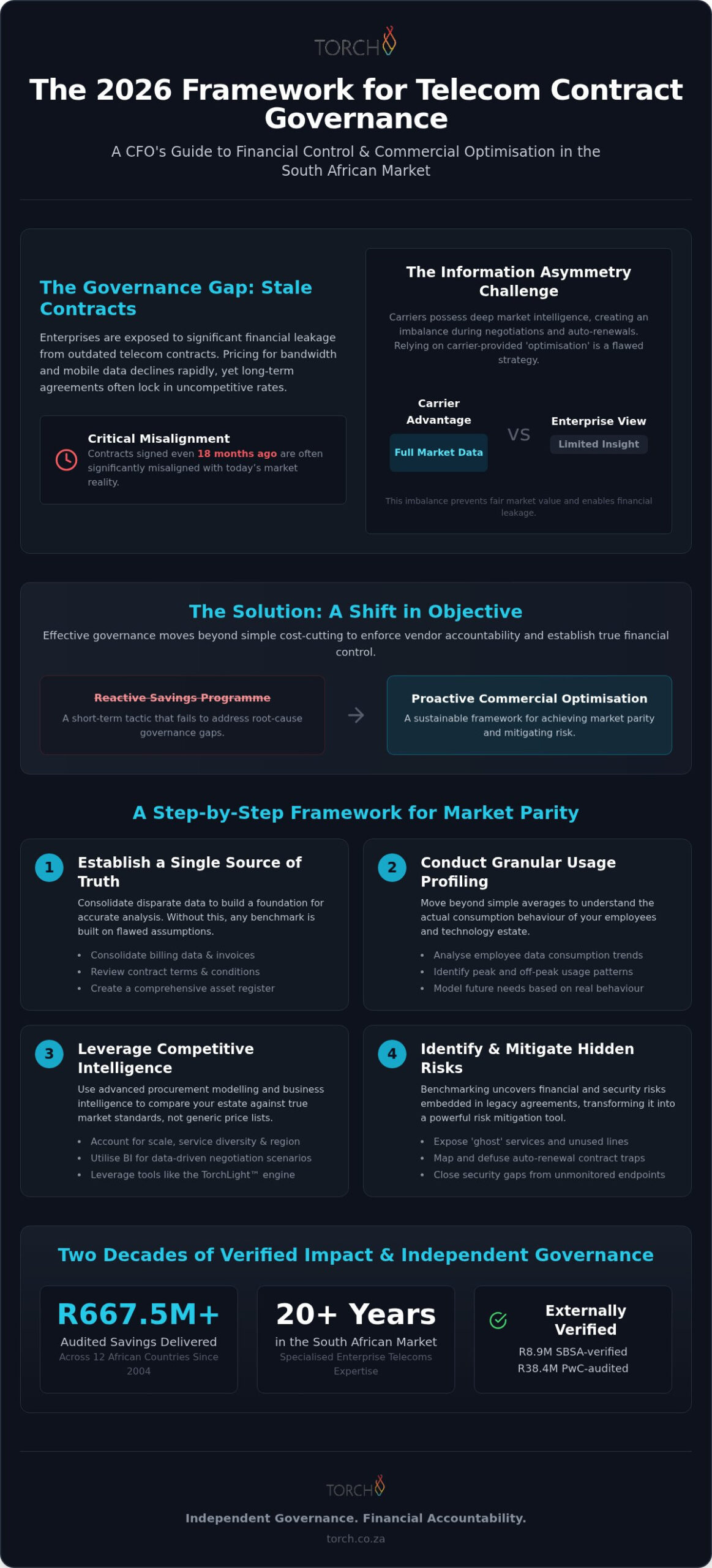
Telecom contract benchmarking is the rigorous, evidence-based process of comparing your organisation’s existing rates, commercial terms, and service configurations against current market standards for equivalent enterprise clients. Given the rapid decline in pricing for bandwidth and mobile data, contracts signed even 18 months ago are often significantly misaligned with today’s market reality. This creates ‘stale contracts’ that quietly drain IT budgets.
The core issue is a governance gap. Internal procurement teams, despite their expertise, often lack the granular, cross-carrier intelligence needed to effectively challenge incumbent vendors. This is where benchmarking shifts from a simple savings programme to a tool for commercial optimisation and financial accountability, ensuring your agreements reflect true market value.
- Define telecom contract benchmarking: A rigorous comparison of rates, terms, and service configurations against current market standards.
- Address ‘stale contracts’: Pricing for bandwidth and mobile data shifts faster than typical three-year contract cycles, leading to overspending.
- Close the governance gap: Internal teams often lack the cross-carrier intelligence to challenge incumbent vendors effectively.
- Frame the objective: Benchmarking is a tool for ‘commercial optimisation’ and ‘financial accountability’, not just a ‘savings programme’.
The Information Asymmetry Challenge
In any negotiation, the party with better information holds the advantage. Carriers invest heavily in market intelligence, allowing them to understand precisely what comparable organisations are paying. During ‘silent’ or auto-renewals, this information asymmetry works against you, as they have little incentive to offer proactive adjustments to bring your rates in line with the market. Relying on carrier-provided ‘optimisation’ reports is a flawed strategy, as their goal is to preserve revenue, not deliver independent governance. Independent governance, in this context, is the practice of using objective, third-party market intelligence to enforce vendor accountability and ensure commercial fairness.
Benchmarking as a Risk Mitigation Tool
Beyond achieving market parity, a robust benchmarking process is a powerful risk mitigation tool. It uncovers hidden costs and ‘silent leakage’—such as billing for unused lines or services—that accumulate in legacy agreements. More critically, these unmanaged ‘ghost’ services are not just a financial drain; they represent unmonitored endpoints that can serve as entry points for security threats, including ransomware. This dual challenge of waste and vulnerability is why Expense To Profit advocates for a strategy where cybersecurity investments are leveraged to generate a measurable ROI through improved operational efficiency.
Furthermore, the process ensures that Service Level Agreements (SLAs) are fit for purpose, matching the demands of a modern, hybrid workforce. By aligning contractual terms with operational reality, you fortify your overall IT FinOps health and build a more resilient and financially sound technology estate.
The Mechanics of Market Parity: How to Organise Your Benchmarking Data
Effective telecom contract benchmarking begins with data integrity. Before you can compare your estate to the market, you must establish a ‘Single Source of Truth’ by consolidating billing data, contract terms and conditions, and asset registers. Without this foundation, any subsequent analysis will be built on flawed assumptions.
The next step is usage profiling. Moving beyond simple averages is essential to understand the actual behaviour of your employees and their data consumption trends. This granular insight, when combined with competitive intelligence from a procurement-modelling engine like TorchLight™, allows you to build data-driven scenarios for negotiation. This process provides the visibility needed to transform raw data into a strategic asset.
- Establish a Single Source of Truth: Consolidate billing data, contract T&Cs, and asset registers before starting.
- Conduct Usage Profiling: Move beyond ‘averages’ to understand actual employee behaviour and data consumption trends.
- Leverage Competitive Intelligence: Use advanced tools like the TorchLight™ engine for accurate scenario modelling.
- Build Visibility: Explore our IT FinOps solutions to gain comprehensive spend visibility.
Data Requirements for a Robust Benchmark
A credible benchmark requires a detailed and accurate data set. This includes a thorough invoice reconciliation process covering the last three to six months to identify billing variances and trends. It is also crucial to map all contractual auto-renewal traps, including notice periods and termination clauses that lock you into unfavourable terms. Finally, a comprehensive asset discovery exercise ensures you are not benchmarking ‘ghost’ services or unused lines, a common source of financial leakage.
Competitive Intelligence vs. Generic Price Lists
‘Average’ market rates sourced from generic price lists are insufficient for large enterprise negotiations. True competitive intelligence accounts for scale, service diversity, and specific regional nuances, such as connectivity challenges and infrastructure reliability across the African continent. By using business intelligence (BI) models, you can leverage current benchmarking data not only to negotiate better terms today but also to forecast future spend and model the financial impact of different commercial structures.
The 2026 Telecom Benchmarking Checklist: A Step-by-Step Framework
A successful benchmarking initiative follows a structured, phased approach that moves from internal discovery to market engagement and final governance. This framework ensures that every decision is backed by data and aligned with your organisation’s strategic financial goals.
- Phase 1: Internal Audit (Inventory validation, usage analysis, contract term mapping).
- Phase 2: Market Comparison (Applying independent intelligence, identifying the ‘governance gap’).
- Phase 3: Strategy & Modelling (Scenario building, ROI forecasting, risk-share evaluation).
- Phase 4: Negotiation & Execution (Vendor engagement, commercial renegotiation, contract finalisation).
Audit & Inventory Validation
The foundation of any successful benchmark is a forensically accurate inventory. This first step involves confirming every active SIM and fixed line against both HR and asset records to identify discrepancies. A key objective is to flag zero-usage devices that have been billed for more than 90 days, as these represent immediate and recoverable costs. At the same time, you must document all ‘out-of-bundle’ spend to understand its primary drivers, whether they are related to policy, user behaviour, or poorly structured mobile plans.
Market Intelligence & RFP Preparation
With a validated inventory, you can now benchmark your current ZAR rates against equivalent enterprise-scale contracts in the South African market. This intelligence forms the basis of a Request for Proposal (RFP) that prioritises ‘structural control’ and ‘vendor accountability’ over simple price comparisons. Based on Torch’s historical performance, including a 27.5% negotiation savings target in your business case provides a realistic goal rooted in proven market outcomes.
Contract Finalisation & Governance Setup
The final phase focuses on embedding long-term control. This requires a meticulous review of the contract ‘fine print’ to identify hidden annual escalations or restrictive termination fees that could erode future value. Once the contract is signed, the work of governance begins. Establish a monthly ‘variance analysis’ schedule to monitor billing against the new contract, preventing future leakage before it occurs. This disciplined process is a core component of a mature Telecom Expense Management programme.
Bridging the Execution Gap: Transitioning from Insights to Independent Governance
Dashboards and reports are valuable for visibility, but they are insufficient on their own. Insights do not resolve billing errors or renegotiate contracts; people do. The execution gap is the space between knowing there is a problem and having the dedicated resources to fix it. This is why a ‘high-touch, embedded execution’ model is essential for achieving and sustaining savings.
Transitioning from a one-off benchmark to a continuous ‘FinOps-as-a-Service’ model ensures that optimisation is not a project, but a permanent business discipline. As a carrier-agnostic advisor that does not sell connectivity, Torch’s role is to act as your independent governance partner. This model is how our clients sustain the 47.2% total cost reduction achieved through actively governed estates.
The Role of Managed Services in Sustained Optimisation
An embedded managed services team moves beyond reporting to take ownership of remediation. Instead of just flagging billing errors on a dashboard, our analysts engage directly with carriers to resolve them. This active management includes continuous subscription adjustment—right-sizing plans based on actual usage—which consistently captures a 19.6% savings opportunity. When integrated with a Unified Endpoint Management (UEM) platform, this approach provides a powerful framework for total mobile spend governance.
Establishing a Governance-Led Culture
Ultimately, the goal is to empower the CFO and other business leaders with board-level IT finance reporting that is clear, credible, and actionable. This elevates the conversation from reactive, operational firefighting to proactive commercial optimisation. By embedding independent governance into your procurement and finance workflows, you create a culture of accountability where every Rand of IT spend is visible, controlled, and justified. This is the difference between simply having data and using it to maintain structural control. To learn more about this transition, explore The Strategic IT Asset Management Reporting Dashboard.
Frequently Asked Questions (FAQs)
What is the difference between a telecom audit and contract benchmarking?
A telecom audit primarily focuses on historical accuracy—validating past invoices against existing contracts to find billing errors. Contract benchmarking is forward-looking; it assesses whether the rates and terms in your current contract are competitive against today’s market standards. A comprehensive governance strategy requires both.
How often should a large enterprise benchmark its telecom contracts?
Given the pace of change in the telecom market, we generally recommend a comprehensive benchmark every 18 to 24 months, or ahead of any significant contract renewal. This cadence ensures your organisation does not fall behind market rates and can proactively manage vendor relationships.
Can benchmarking help us avoid auto-renewal traps in our mobile contracts?
Absolutely. A key component of the benchmarking process is mapping contract end-dates, notice periods, and auto-renewal clauses. This proactive analysis provides the visibility needed to make strategic decisions well in advance, preventing you from being locked into another term at uncompetitive, stale rates.
Why shouldn’t we let our current carrier manage our spend optimisation?
Carriers have an inherent conflict of interest, as their primary objective is to protect and grow their revenue. They cannot independently audit their own billing or proactively offer you the best possible market rates. An independent, carrier-agnostic advisor works exclusively for you, ensuring your interests are the sole priority during negotiations.
What are the typical savings associated with independent telecom benchmarking in South Africa?
Whilst every estate is different, our experience over 20 years in the South African market shows that independent benchmarking and renegotiation consistently yield negotiation savings of around 27.5%. When combined with ongoing active management, total cost reduction can be as high as 47.2%.
How long does a professional telecom benchmarking process usually take?
A professional telecom benchmarking process, from data collection to final negotiation strategy, typically takes between four and eight weeks for a large enterprise. The timeline depends on the complexity of the estate, the number of vendors, and the quality of available data.