
For many enterprises, hardware is treated as a capital expense to be procured and a technical tool to be managed. This perspective, however, overlooks a critical reality: every laptop, server, and mobile device is a financial asset with a complex lifecycle. Without a strategic governance framework, this lifecycle becomes a significant source of financial leakage, security vulnerabilities, and operational inefficiency. The absence of a disciplined hardware asset management lifecycle strategy leaves CFOs and CIOs exposed to unpredictable refresh costs, audit failures, and unmanaged risk.
Effective hardware asset management is not a mere inventory task; it is a financial governance discipline. It requires a “cradle-to-grave” approach that aligns procurement, deployment, active management, and retirement with the organisation’s commercial objectives. This checklist provides a CFO-aligned framework for transforming your hardware estate from a cost centre into a commercially optimised and secure portfolio. By embedding financial accountability and risk mitigation at every stage, you can establish a sustainable system for managing your technology assets with precision and control.
This guide will walk you through the four critical stages of the hardware asset management lifecycle, providing a strategic checklist to fortify your governance posture and drive sustainable commercial optimisation.
Strategic Planning and Commercial Optimisation in Procurement
The hardware asset management lifecycle begins long before a device is switched on. The procurement phase sets the foundation for total cost of ownership (TCO), vendor relationships, and operational efficiency. A reactive or purely price-driven approach at this stage inevitably leads to downstream financial leakage and governance gaps. A strategic framework, by contrast, establishes commercial control from day one.
An effective procurement strategy is built on principles of independence and financial foresight. It moves beyond simple unit costs to model the entire financial journey of an asset. This involves creating a resilient framework that prevents vendor lock-in, ensures competitive pricing through market intelligence, and aligns every acquisition with long-term IT FinOps goals.
- Establish a carrier-agnostic procurement framework to avoid vendor lock-in and maintain negotiation leverage.
- Utilise market benchmarking to ensure competitive intelligence is embedded in all contract modelling and negotiations.
- Define standard hardware personas (e.g., “Remote Executive,” “Field Technician,” “Contact Centre Agent”) to streamline procurement, simplify support, and standardise security baselines.
- Align hardware acquisition with long-term IT FinOps-as-a-Service goals to ensure spend is predictable, transparent, and accountable.
Market Benchmarking and Vendor Accountability
True commercial optimisation requires an objective, data-driven view of the market. Without independent benchmarking, enterprises often negotiate from a position of weakness, unaware of prevailing market rates or more favourable contract terms available elsewhere. This information asymmetry is a primary source of overspending.
Vendor accountability must be defined before any contract is signed. This means establishing clear, measurable performance metrics for hardware delivery, support, and end-of-life services. By conducting silent-leakage detection during the RFP phase—verifying proposed contract scenarios against independent market data—you can identify and eliminate hidden costs before they enter your ecosystem.
- Conduct silent-leakage detection during the initial RFP phase by auditing proposed costs against current market realities.
- Verify all contract scenarios against independent market data to confirm pricing is competitive and terms are favourable.
- Define and agree upon key performance metrics for hardware vendors before signing, covering everything from deployment logistics to warranty support.
Budgeting for Total Cost of Ownership (TCO)
The sticker price of a device is merely the entry point of its financial journey. A comprehensive TCO model calculates the full Rand cost from acquisition to retirement, providing the finance team with a predictable and accurate view of the hardware estate’s financial impact. This model must account for direct costs as well as the often-overlooked “hidden” expenses that accumulate over an asset’s life.
These hidden costs include managed service fees, security licensing, logistics for a hybrid workforce, deployment labour, and eventual data destruction and recycling fees. By building a robust TCO model, you transform hardware budgeting from a reactive capital expense exercise into a strategic financial planning function, enabling more accurate forecasting and eliminating budgetary surprises.
- Calculate the full Rand journey of each asset type, from initial acquisition to secure, certified retirement.
- Include all associated costs, such as managed service fees, security licensing, and support, in your TCO models.
- Account for “hidden” operational costs like logistics, warehousing, and the administrative overhead of remote-work deployment.
Unified Endpoint Deployment and Active Lifecycle Management
Once procured, hardware must be deployed, secured, and managed efficiently throughout its active life. A fragmented or manual approach to deployment creates security gaps and places a significant administrative burden on IT teams. A unified, automated framework ensures that every device is compliant, secure, and productive from its first boot.
The goal of this stage is to establish and maintain a “single source of truth” for the entire hardware estate. This central inventory, governed by real-time data, provides the visibility needed to monitor asset health, track usage patterns, and enforce security policies consistently. Modern tools like Unified Endpoint Management (UEM) are central to achieving this level of control, especially in complex hybrid-work environments. For more insight into this, explore our strategic guide to automated IT asset tracking.
- Implement zero-touch deployment to provision and secure devices automatically, reducing the administrative burden on IT teams and ensuring a consistent user experience.
- Enforce endpoint security policies at the point of first boot, ensuring every device is compliant with corporate standards before it accesses the network.
- Maintain a “single source of truth” for all active assets via a central platform like SpotLight™, providing real-time visibility into device status, location, and health.
- Monitor real-time consumption and usage patterns to identify underutilised assets that can be redeployed or retired, optimising the existing hardware pool.
Automated Deployment and Enrolment
Manual device configuration is not scalable, consistent, or secure enough for the modern enterprise. Automated deployment protocols, such as those for Apple and Android enterprise management, allow IT teams to standardise device setup remotely. This process ensures that critical security controls, such as application management and remote-wipe capabilities, are configured immediately upon enrolment.
Integrating these deployment workflows with existing HR and ERP systems further enhances efficiency. When a new employee joins, their hardware can be automatically provisioned and shipped; when they leave, access can be revoked and the device recovery process initiated without manual intervention.
- Standardise Apple Business Manager and Android Zero-Touch Enrolment protocols for consistent and secure out-of-the-box configuration.
- Configure application control, data encryption, and remote-wipe capabilities as a mandatory part of the enrolment process.
- Integrate deployment workflows with existing HR and ERP systems to automate the asset lifecycle from onboarding to offboarding.
Active Governance and Maintenance
An asset’s journey does not end after deployment. Active governance is the ongoing process of monitoring, maintaining, and securing the hardware estate. This includes scheduling regular compliance audits for every managed device to ensure security policies have not been compromised and that software is up to date.
Furthermore, active governance involves leveraging technology to improve the user experience and predict future costs. Automated user support can resolve common hardware issues in real-time without tying up helpdesk resources, whilst tracking asset health metrics (like battery life and performance) allows you to predict and budget for upcoming hardware refreshes with greater accuracy.
- Schedule regular, automated compliance auditing for every managed device to ensure continuous adherence to security policies.
- Utilise automated user support systems to resolve common hardware issues in real-time, improving productivity and reducing IT overhead.
- Track key asset health indicators to proactively predict and budget for upcoming hardware refreshes, avoiding unexpected capital expenditure.
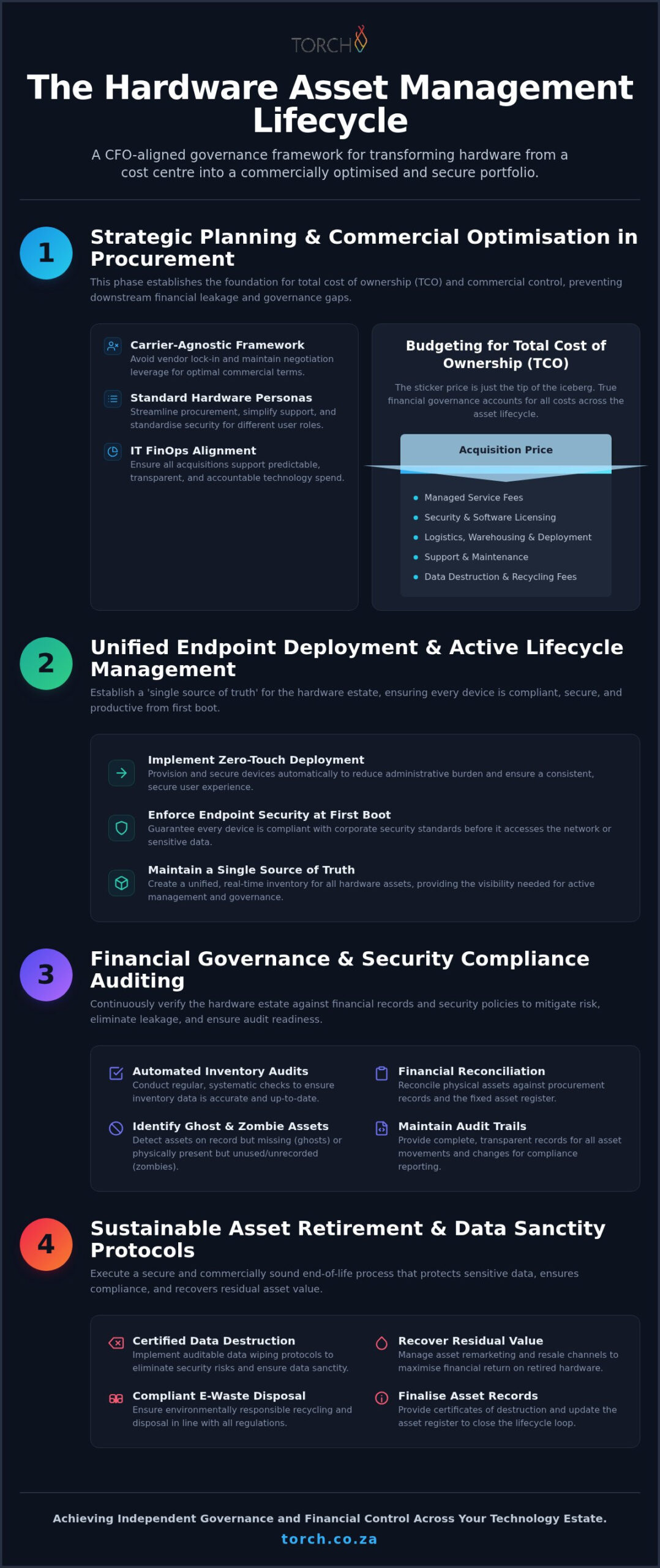
Financial Governance and Security Compliance Auditing
As hardware assets are actively used, they generate a continuous stream of financial and security-related data. This stage of the hardware asset management lifecycle focuses on auditing this data to ensure financial accountability, mitigate risk, and enforce compliance. Without rigorous auditing, billing errors go unnoticed, security vulnerabilities persist, and accountability for asset usage remains weak.
This phase directly addresses the CFO’s primary concerns: eliminating financial waste and managing risk exposure. It involves methodical processes like monthly invoice reconciliation to catch billing errors and applying IT chargeback models to make departments accountable for their technology consumption. Critically, it also involves closing the governance gap created by BYOD (Bring Your Own Device) and other unmanaged endpoints that can expose corporate data to significant threats.
- Perform monthly invoice reconciliation against the active asset register to identify and eliminate billing errors for hardware and associated services.
- Mitigate ransomware risk by identifying and securing unmanaged endpoints that provide easy entry points for cyberattacks.
- Apply IT chargeback or showback models to increase departmental accountability for hardware costs and drive more responsible usage.
- Audit the BYOD governance gap to ensure corporate data remains protected on personal devices, in line with company policy and data protection regulations.
Financial Accountability and Leakage Detection
One of the most significant sources of financial leakage in any large enterprise is the presence of “ghost assets”—devices or services that are no longer in use but continue to incur costs. These often include mobile lines for former employees or subscriptions tied to retired hardware. Identifying them requires a meticulous reconciliation of billing data against a verified, real-time asset inventory.
For example, in a PwC-audited engagement with a major South African bank, our independent governance framework identified 340 inactive SIMs that were still being billed monthly. Deactivating these ghost assets in the first month alone contributed to an R8.9M verified saving. This is a clear demonstration of how linking financial data to asset data uncovers substantial, recoverable waste. A deeper dive into this disciplined approach can be found in our overview of IT FinOps services.
- Identify ghost assets by systematically comparing monthly invoices against the “single source of truth” in your asset register.
- Validate all hardware-related software subscriptions (e.g., security licences, productivity tools) against the active inventory to stop paying for unused licences.
- Establish a clear process for challenging and rectifying billing discrepancies with vendors to recover funds and prevent future errors.
Security Governance for the Hybrid Estate
In a hybrid work model, the corporate security perimeter has dissolved. Every endpoint, whether corporate-owned or personal, is a potential entry point for a cyberattack. In fact, analysis shows that as many as 85% of ransomware entry points originate from unmanaged devices. Strong security governance is therefore non-negotiable.
This requires enforcing data protection regulations like POPIA across all employee devices that access corporate information. It also means automating compliance reporting to provide clear, audit-ready documentation for both internal stakeholders and external regulators. A robust hardware asset management program is a cornerstone of a modern cybersecurity strategy, as it ensures there are no unknown or unmanaged devices operating in the shadows.
- Enforce POPIA compliance controls for all employee devices, ensuring sensitive corporate and customer data is protected regardless of location.
- Automate compliance reporting to provide auditable proof that security policies are being consistently applied across the entire hardware estate.
- Implement policies and technology to identify, isolate, and secure any unmanaged devices attempting to access the corporate network.
Sustainable Asset Retirement and Data Sanctity Protocols
The final stage of the hardware asset management lifecycle—retirement—is also one of the most critical for mitigating risk and finalising an asset’s commercial journey. An informal or poorly executed retirement process can lead to severe data breaches, non-compliance with environmental regulations, and ongoing costs for devices that are no longer providing value. A formalised process ensures data sanctity, regulatory compliance, and commercial closure.
The objective is to ensure that when a device reaches the “grave” phase of its lifecycle, it is handled in a secure, compliant, and financially responsible manner. This involves certified data destruction to prevent data leakage, optimising any residual value through structured buy-back schemes, and, crucially, updating the master asset register to reflect the device’s retired status, thereby stopping all associated costs.
- Formalise an IT asset retirement process to prevent data leakage and ensure every device is accounted for until its final disposal.
- Ensure certified data destruction for all decommissioned storage media, obtaining certificates as proof for compliance and governance records.
- Optimise the residual value of hardware through structured, pre-negotiated buy-back or trade-in schemes with vendors.
- Update the master asset register immediately to reflect the “grave” status, triggering the cessation of all related billing and support contracts.
Secure Decommissioning and Data Wiping
Before a device is physically disposed of, all corporate data must be permanently and verifiably erased. For lost, stolen, or remote-retired mobile devices, remote-wipe protocols must be executed immediately to protect sensitive information. For assets being physically decommissioned, data destruction should follow industry-standard protocols, with certificates of destruction obtained for every single device.
This is not merely a technical task but a crucial governance function. These certificates provide an auditable trail that proves the organisation has met its data protection obligations. A comprehensive Unified Endpoint Management (UEM) solution provides the central control needed to execute these remote actions securely and track the decommissioning status of every asset in the lifecycle.
- Execute remote-wipe protocols for any lost, stolen, or retired mobile devices as a standard offboarding procedure.
- Obtain and archive certificates of data destruction for all decommissioned assets to maintain a complete compliance and governance record.
- Integrate decommissioning triggers with the UEM platform to automate security actions the moment an asset is marked for retirement.
Commercial Recovery and Environmental Responsibility
The retirement phase also offers a final opportunity for commercial optimisation. This includes auditing vendor performance regarding hardware recycling and disposal to ensure they are meeting contractual and environmental obligations. Any structured buy-back schemes should be executed to recover residual value, which can then be used to offset the cost of new hardware.
Most importantly, the final billing cycle must be reconciled to ensure that costs are stopped the moment an asset is officially retired. This final check prevents retired devices from turning into ghost assets. Evaluating your current retirement protocols against best practices can reveal significant opportunities for improving both security and financial control.
- Audit vendor performance regarding hardware recycling and disposal to ensure compliance with environmental standards and corporate policy.
- Reconcile the final billing cycle for every retired asset to confirm that all associated costs have been terminated.
- To evaluate and strengthen your current retirement protocols, book a 30-minute governance review to identify potential gaps in your process.
Frequently Asked Questions (FAQs)
What is the hardware asset management lifecycle?
The hardware asset management (HAM) lifecycle is the complete end-to-end journey of an organisation’s hardware assets, from initial planning and procurement through deployment, active use, maintenance, and eventual secure retirement. A strategic approach manages each stage to optimise cost, mitigate risk, and ensure operational efficiency.
How does hardware asset management improve financial governance?
HAM improves financial governance by providing a “single source of truth” for all hardware assets. This allows for accurate budgeting based on Total Cost of Ownership (TCO), systematic identification of “ghost assets” that cause financial leakage, precise invoice reconciliation, and the application of chargeback models to drive departmental accountability for technology spend.
Why is a “single source of truth” important for IT assets?
A “single source of truth” is a centralised, real-time inventory of all hardware assets. It is critical because it eliminates guesswork and provides the accurate data needed for effective decision-making. It enables IT, finance, and security teams to work from the same information, ensuring consistent policy enforcement, accurate financial reporting, and a complete view of the technology estate.
Can hardware asset management reduce ransomware risk?
Yes. A significant portion of ransomware attacks originate from unmanaged or unknown devices on a network. A robust HAM programme identifies every endpoint, ensuring it is visible, managed, and secured according to corporate policy. By eliminating these blind spots, you significantly reduce the available attack surface for threat actors.
How do I identify ghost assets in my IT inventory?
Ghost assets are identified by systematically reconciling your financial data (e.g., monthly carrier or vendor invoices) with your active IT asset inventory. Any device or service being paid for that does not correspond to an active, assigned asset in your register is a ghost asset. This process requires a highly accurate, real-time asset inventory to be effective.
What are the risks of poor hardware retirement processes?
Poor retirement processes create severe risks, including data breaches from improperly wiped devices, financial leakage from paying for assets no longer in use, and non-compliance with data protection (e.g., POPIA) and environmental regulations. It can also lead to reputational damage if sensitive corporate data is compromised from a discarded device.
A disciplined, governance-led approach to the hardware asset management lifecycle is fundamental to achieving financial control and security resilience in the modern enterprise. By treating hardware as a portfolio of financial assets, you can move beyond reactive management and establish a predictable, optimised, and defensible system.
Torch provides the independent governance layer that enables African enterprises to master this lifecycle. Our framework is designed to give CFOs and CIOs the visibility and control needed to eliminate waste, secure their estate, and drive sustainable commercial value.
To assess the maturity of your current hardware governance framework, book a 30-minute governance review with Derek King.
- Actively governed estates achieve up to 47.2% total cost reduction.
- Independent, carrier-agnostic governance advisor.
- 100+ years of combined industry experience and R667.5M+ saved since 2004 across 12 African countries.