
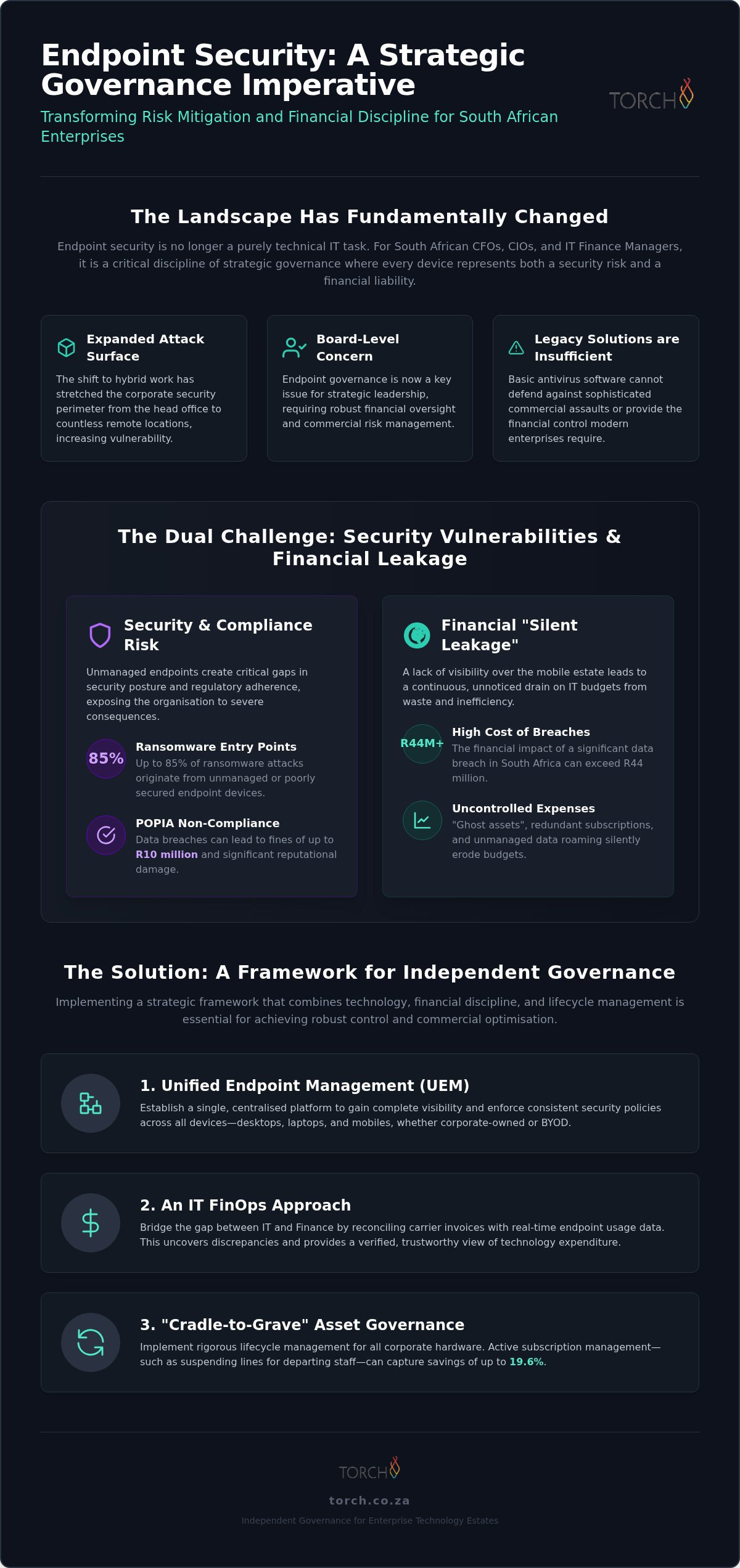
In the South African enterprise landscape, the conversation around endpoint security has fundamentally changed. It is no longer a purely technical discussion confined to IT departments. For CFOs, CIOs, and IT Finance Managers, it has become a critical discipline of strategic governance, where every unmanaged device represents not only a potential entry point for ransomware but also a significant source of silent budgetary leakage. The rapid shift to hybrid work has expanded the corporate attack surface, stretching from head office to remote home offices across the country, making robust governance more crucial than ever.
Navigating this complex environment requires a dual focus: fortifying security to mitigate risk while simultaneously imposing financial discipline to control costs. How can an organisation secure its dispersed endpoints against sophisticated threats, ensure compliance with the Protection of Personal Information Act (POPIA), and eliminate the hidden expenses of an unmanaged mobile estate? The answer lies in treating endpoint security as a function of financial and operational governance, not just a technological fix.
This guide provides a strategic framework for South African enterprises to address these challenges. We will explore the evolving threat landscape, uncover the financial impact of poor endpoint management, and outline a clear, actionable plan to implement a secure, cost-optimised, and compliant device policy.
The Landscape: Why Endpoint Security in South Africa is a Strategic Imperative
Endpoint security is the practice of securing the connection points of an enterprise network—such as desktops, laptops, smartphones, and tablets—against unauthorised access and malicious threats. In today’s context, however, this definition is incomplete. True endpoint security also involves maintaining complete financial and operational visibility over every device, ensuring that IT assets are both protected and commercially optimised throughout their lifecycle.
The widespread adoption of hybrid work models in South Africa has exponentially increased the number of endpoints connecting to corporate networks, many of which are outside the traditional security perimeter. This expanded attack surface, combined with increasing regulatory pressure from POPIA, has elevated endpoint governance from an IT task to a board-level concern. Legacy solutions like basic antivirus software are no longer sufficient to defend against modern, sophisticated attacks or provide the financial oversight required by today’s business leaders. Engaging with a specialist like OC Cubed – Your trusted MSP allows organisations to implement proactive IT solutions that address these security and financial challenges simultaneously.
The Evolving Threat Profile in 2026
Threat actors are increasingly targeting South African enterprises, with sophisticated ransomware attacks aimed at the financial, logistics, and manufacturing sectors. These are not random attacks; they are calculated commercial assaults designed to cripple operations and extort significant payments. From a strategic standpoint, security is not merely an IT problem but a commercial risk management discipline. The board needs assurance that the organisation is protected, and that requires a level of oversight that goes beyond internal checklists. An independent, objective perspective is essential for validating security controls and financial processes, a principle that applies as much to cybersecurity as it does to telecom expense management vs internal audit frameworks.
Regulatory Pressures and POPIA Compliance
The Protection of Personal Information Act (POPIA) imposes strict obligations on how organisations handle personal data. An unmanaged or poorly secured endpoint—whether corporate-owned or a personal device used for work (BYOD)—can lead to a data breach, resulting in severe legal and financial consequences, including fines of up to R10 million. Achieving POPIA compliance requires a delicate balance between protecting corporate data and respecting employee privacy. This is where the concept of “independent governance” becomes a powerful trust-builder. By implementing a clear, consistently enforced policy through a centralised management platform, organisations can demonstrate due diligence to the board, regulators, and employees alike, proving that they are taking responsible steps to protect sensitive information across their entire device estate.
Uncovering the “Silent Leakage” of Unmanaged Mobile Estates
Beyond the headline-grabbing risk of a data breach, unmanaged endpoints introduce a more insidious threat: “Silent Leakage.” This term describes the continuous, often unnoticed, drain of Rands from IT budgets due to a lack of visibility and control over the mobile estate. It manifests as paying for redundant carrier subscriptions for former employees, uncontrolled data roaming charges, and the cost of “ghost assets”—devices that are lost, stolen, or retired but remain active on billing systems.
The financial stakes are enormous. With the cost of a significant data breach in South Africa now capable of exceeding R44 million, the security risk is clear. Yet, the cumulative financial loss from silent leakage can be just as damaging over time. Each unmanaged device is a potential source of both a security incident and unnecessary expenditure. True governance provides the rigorous accountability needed to rescue budgets from this silent drain and transform IT from a cost centre into a strategically optimised function.
The Cost of Visibility Gaps
Research shows that up to 85% of ransomware entry points originate from unmanaged or poorly secured devices. These visibility gaps are not just security risks; they are financial liabilities. Without a central inventory, an organisation cannot know if it is paying for a device that is sitting unused in a desk drawer or if an employee is incurring excessive data roaming charges on a business trip. An IT FinOps approach bridges this gap by reconciling carrier invoices with actual, real-time endpoint usage data. This process uncovers discrepancies, identifies opportunities for optimisation, and provides the finance team with a verified, trustworthy view of technology spend.
Asset Governance and Financial Control
Effective financial control starts with robust asset governance. This means managing the “cradle-to-grave” lifecycle for every piece of corporate hardware, from procurement and deployment to maintenance, retirement, and disposal. By implementing active subscription management—for example, immediately suspending lines for departing employees or optimising plans based on actual usage—organisations can capture savings of up to 19.6%. A Unified Endpoint Management (UEM) platform is the cornerstone of this strategy. It provides a single source of truth for both IT and Finance, linking every device to a user, a cost centre, and a policy, thereby eliminating the guesswork and manual reconciliation that allow silent leakage to thrive.
How to Implement and Enforce a Mobile Device Security Policy
Creating a robust endpoint security framework requires more than just drafting a policy document; it demands a structured, systematic approach to implementation and enforcement. For South African enterprises with multi-vendor environments and hybrid teams, this process must be both rigorous and adaptable. The following steps provide a clear path to establishing durable governance.
- Conduct a Comprehensive Audit: Begin by auditing the entire existing endpoint estate. This initial discovery phase aims to reconcile what you think you own with what you are actually paying for. The goal is to identify and eliminate ghost assets and redundant subscriptions, establishing a clean, accurate baseline.
- Define Clear Security Tiers: Not all users and devices carry the same level of risk. Develop security tiers based on employee roles, access rights, and the sensitivity of the data they handle. A senior executive with access to board-level information requires a different security posture than a field technician.
- Deploy a Carrier-Agnostic UEM Platform: A centralised Unified Endpoint Management (UEM) platform is essential for consistent policy enforcement. Crucially, this platform should be carrier-agnostic, allowing you to manage all devices—regardless of network provider—from a single pane of glass.
- Automate User Support: Reduce the administrative burden on your internal IT team by automating common user requests like SIM swaps, device suspensions, or data top-ups. This frees up skilled technicians to focus on high-value strategic initiatives rather than repetitive, low-level tasks.
- Establish a Continuous Review Cycle: Governance is not a one-time project. Implement a continuous review cycle to monitor both security compliance and financial variance. Regular reports should track key metrics, flag anomalies, and inform ongoing optimisation efforts.
Standardising Policy Across Hybrid Teams
Effective policy is not just about documentation; it is about enforcing accountability through automated checks and consistent application. For hybrid teams, this means ensuring that a user working from home in Cape Town is subject to the same security controls as an employee at the Johannesburg head office. This is particularly critical when managing a Bring Your Own Device (BYOD) program. A UEM solution can create a secure container on a personal device, isolating corporate data from personal applications and allowing for selective wiping if the device is lost or the employee leaves the company. Leveraging tools like IT helpdesk automation further reinforces policy by providing a structured, auditable channel for all device-related requests and support.
Automating the Governance Journey
Automation is the key to scaling governance effectively. Tools such as SMS-based self-service bots (like Boost™) can handle real-time user requests 24/7, from activating roaming to reporting a lost device, all within predefined policy and budget constraints. For remote workforces spread across South Africa, “zero-touch” deployment enables new devices to be configured and secured automatically out of the box, without requiring physical intervention from IT. This level of automation not only improves efficiency but also provides the consistent, verifiable data needed for automated reporting, giving the board confidence that risk is being actively managed.
Fortifying the Enterprise with Unified Endpoint Management (UEM)
Ultimately, addressing the endpoint security challenges in South Africa requires a move beyond siloed solutions. Unified Endpoint Management (UEM) provides an integrated framework that combines technical security with commercial optimisation. It is a strategic approach that acknowledges that a secure endpoint is also a financially governed one. By bringing device management, security policy, and expense control into a single, cohesive system, enterprises can achieve significant and sustainable results. Our analysis shows that actively governed estates can achieve a total cost reduction of up to 47.2% compared to their unmanaged equivalents.
This transformation requires a strategic partner with deep local market expertise and a proven track record. With over 100 years of combined industry experience and having saved South African enterprises more than R667.5M since 2004, Torch provides the independent, carrier-agnostic advisory needed to navigate this complex environment. We offer high-touch, embedded execution to ensure that governance strategies are not just planned, but fully implemented.
Sustainable Optimisation Through Structural Control
Many organisations are sold dashboards that promise visibility but ultimately fail to deliver results. A dashboard can report a problem, but it cannot fix it. Sustainable optimisation is achieved through structural control, where governance processes are embedded directly into your organisation’s operations. This is why our teams operate within client organisations—to resolve issues, not just highlight them. Using proprietary tools like TorchLight™, we provide market benchmarking and contract audits that internal teams cannot access, uncovering hidden savings and ensuring you never overpay. This integrated approach is the most effective way to build a resilient, long-term defensive posture against both cyber threats and financial waste.
Next Steps: Securing Your Governance Framework
The dual threats of ransomware and financial leakage are active and growing. Waiting for a major security incident or a budget crisis is a reactive strategy that puts your organisation at a significant disadvantage. The time to act is now. By establishing a robust governance framework, you can protect your enterprise, enhance operational efficiency, and deliver clear, demonstrable value to the board.
For CFOs and CIOs looking to take the next step, we offer a professional, low-friction path forward. We invite you to a complimentary, no-obligation 30-minute governance review with Derek King to assess your current endpoint security and financial governance posture.
Frequently Asked Questions (FAQs)
- What are the most common endpoint security challenges for South African businesses?
- The primary challenges include securing a dispersed hybrid workforce, ensuring compliance with the POPIA, defending against a rising tide of sophisticated ransomware, and controlling the “silent leakage” of IT funds from unmanaged devices, ghost assets, and redundant mobile subscriptions.
- How much does a data breach typically cost a company in South Africa?
- While costs vary, a significant data breach in South Africa can cost an enterprise over R44 million, factoring in regulatory fines, remediation expenses, reputational damage, and business interruption.
- Can unmanaged mobile devices lead to hidden IT costs?
- Absolutely. Unmanaged devices are a major source of hidden costs, or “silent leakage.” This includes paying for services for ex-employees (“ghost assets”), uncontrolled data usage and roaming charges, and redundant software licences, all of which drain the IT budget.
- What is the difference between MDM and Unified Endpoint Management (UEM)?
- Mobile Device Management (MDM) is a tactical tool focused primarily on controlling smartphones and tablets. Unified Endpoint Management (UEM) is a strategic platform that provides a single point of control for all endpoints, including laptops, desktops, and IoT devices. UEM integrates security, application management, and lifecycle governance into one cohesive framework. For a deeper comparison, see our guide on Unified Endpoint Management vs MDM.
- How does POPIA affect my mobile device security policy?
- POPIA mandates that organisations protect personal information, regardless of where it is stored or accessed. This means your security policy must extend to all endpoints that handle personal data, including employee-owned devices (BYOD). A failure to secure these devices can result in a data breach and significant non-compliance penalties.
- Is it possible to reduce telecom spend whilst increasing endpoint security?
- Yes, this is the core principle of a governance-led approach. By using a UEM platform to gain visibility and control over your entire device estate, you can enforce security policies while simultaneously identifying and eliminating financial waste. This integration turns two distinct cost centres into a single, optimised strategic function.