
For many South African CFOs and CIOs, the distinction between software and hardware asset management feels academic. In practice, both represent significant line items on a budget that is increasingly difficult to control. When software subscriptions auto-renew without scrutiny and hardware assets disappear from the network but not the balance sheet, the result is the same: silent financial leakage that erodes profitability and increases risk.
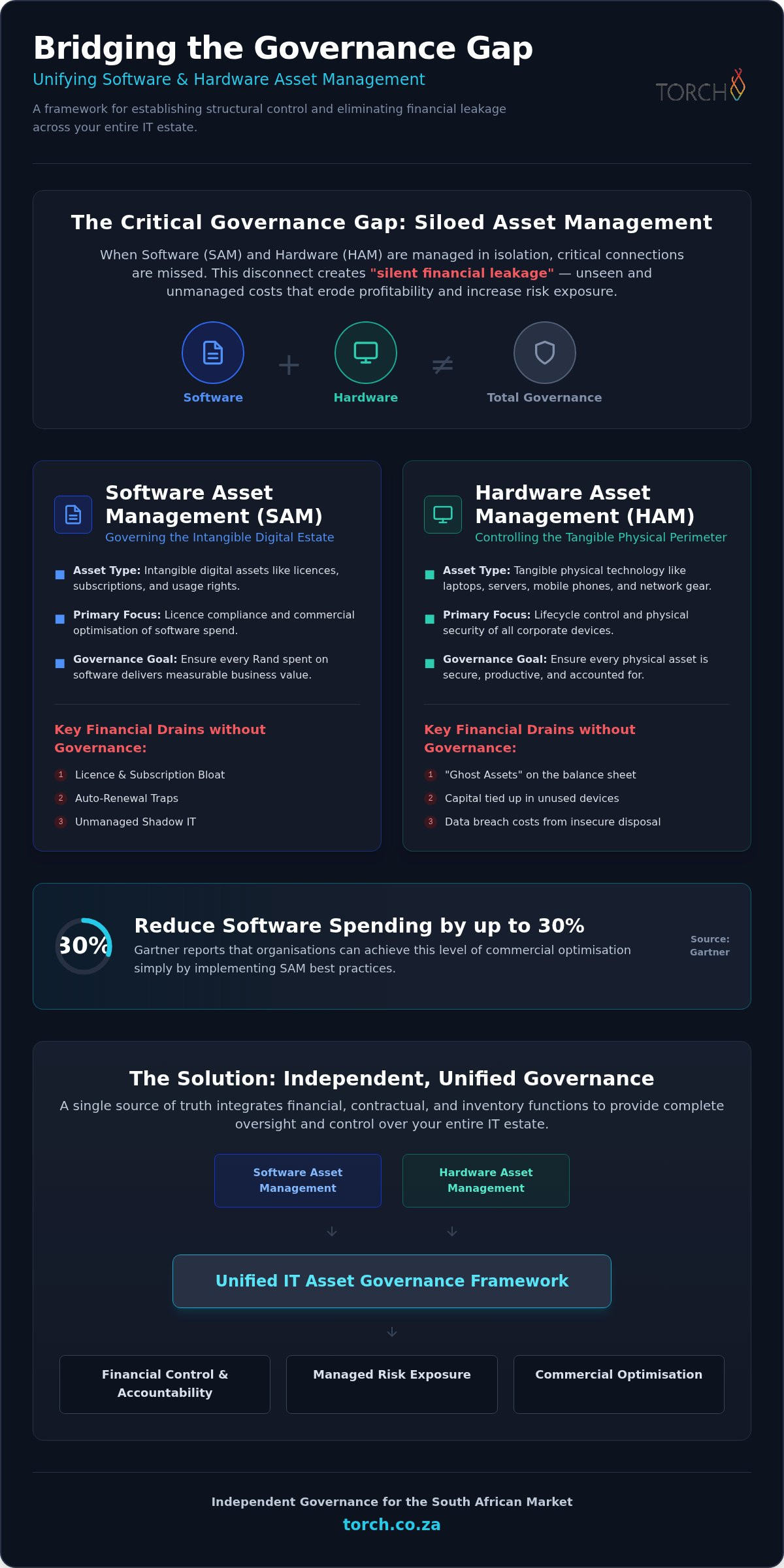
Treating these two critical domains as separate silos is a foundational governance gap. Software Asset Management (SAM) governs the intangible—digital rights, licence agreements, and subscriptions. Hardware Asset Management (HAM) governs the tangible—the physical devices that form your corporate perimeter. Without a unified governance framework overseeing both, enterprises are left exposed to budget overruns, compliance penalties, and security vulnerabilities.
This guide provides a financially literate framework for distinguishing between software and hardware asset management, not as an academic exercise, but as a strategic imperative for establishing structural control over your entire IT estate.
The Governance Gap: Distinguishing Software vs Hardware Asset Management
At its core, IT Asset Management (ITAM) is a business practice that joins financial, contractual, and inventory functions to support lifecycle management and strategic decision-making for the IT environment. However, its effectiveness is often compromised when its two primary components, SAM and HAM, are managed in isolation.
- Software Asset Management (SAM) is the governance of intangible digital assets. Its focus is on managing software licences, ensuring compliance with usage rights, and optimising subscription spend across a complex portfolio of applications.
- Hardware Asset Management (HAM) is the lifecycle control of tangible physical technology. This includes everything from laptops and mobile phones to network switches and data centre servers, tracking them from procurement through to secure disposal.
When these disciplines operate independently, critical connections are missed. A software licence is useless without a corresponding hardware device, and a device is a security risk without properly managed software. This disconnect creates “silent leakage”—unseen and unmanaged costs that accumulate over time. The solution is independent governance: a layer of oversight that unifies both SAM and HAM under a single, commercially focused discipline.
| Aspect | Software Asset Management (SAM) | Hardware Asset Management (HAM) |
|---|---|---|
| Asset Type | Intangible (Licences, Subscriptions, Digital Rights) | Tangible (Laptops, Servers, Mobiles, Network Gear) |
| Primary Focus | Licence Compliance & Commercial Optimisation | Lifecycle Control & Physical Security |
| Key Financial Risk | Overspending on unused licences, non-compliance penalties, and auto-renewal traps. | “Ghost assets” on the books, capital tied up in unused devices, and data breach costs. |
| Core Challenge | Tracking usage, managing complex contracts, and controlling SaaS/subscription bloat. | Physical tracking, secure disposal, and managing depreciation across a dispersed estate. |
| Governance Goal | Ensure every Rand spent on software delivers measurable business value. | Ensure every physical asset is secure, productive, and accounted for throughout its lifecycle. |
SAM: Managing the Invisible Estate
The complexity of SAM has escalated with the shift to cloud computing and Software-as-a-Service (SaaS). The challenge is no longer just about counting desktop installations; it is about managing a fluid portfolio of subscriptions, usage rights, and renewal dates. Without active governance, organisations fall victim to three primary financial drains:
- Licence Compliance and Subscription Bloat: According to Gartner, organisations can reduce software spending by as much as 30% by implementing SAM best practices. Unused or underutilised licences represent a direct and immediate opportunity for cost savings.
- Auto-Renewal Traps: Many software contracts are designed to auto-renew, often with built-in price increases. Without a proactive renewal management calendar, enterprises lose the opportunity to renegotiate terms or terminate unnecessary services, locking them into another year of wasteful spend.
- Shadow IT: When individual departments or employees procure software without central oversight, it creates significant financial and security risks. These unmanaged applications often have overlapping functionality with existing tools, leading to redundant spending and introducing unvetted software into the corporate environment.
HAM: Governing the Physical Perimeter
Hardware assets are the physical gateways to your corporate network and data. Governing them extends beyond a simple inventory list; it requires rigorous control over their entire lifecycle, from procurement to disposal. A failure in HAM governance introduces tangible risks that can have severe financial consequences.
- End-User and Network Assets: The modern enterprise estate includes a vast array of devices, from employee laptops and corporate-issued mobiles to routers, servers, and IoT sensors. Each one is a potential point of failure or security breach if not properly managed.
- The Security Risk of “Ghost Assets”: A “ghost asset” is a device that is still listed in your asset register but is physically lost, stolen, or retired without being properly decommissioned. These devices pose a significant security threat, as they may still contain sensitive corporate data and provide a backdoor for unauthorised access.
- Lifecycle Accountability: Effective governance requires a structured hardware asset management lifecycle. This process ensures that assets are procured at competitive prices, deployed securely, maintained effectively, and disposed of in a way that guarantees data destruction and regulatory compliance.
Operational Nuances: Navigating the Lifecycle of Digital and Physical Assets
The operational cadence for managing software and hardware differs significantly. Hardware assets typically depreciate over a fixed period, representing a capital expenditure that is written down over time. Software, particularly SaaS, has shifted to an operational expenditure model, with recurring subscription costs that demand continuous monitoring and justification.
Managed service models are also transforming other physical asset categories, allowing organisations to shift from capital-intensive equipment to performance-based agreements. For instance, you can learn more about how Eco Light Services provides fully managed, zero-emission lighting towers that simplify site compliance and operational oversight.
This distinction is crucial for financial planning and risk management. Unmanaged hardware contributes directly to security vulnerabilities—research indicates that up to 85% of ransomware entry points originate from unmanaged devices. Meanwhile, unmanaged software leads to rampant budget bloat. A mature ITAM framework must integrate these disparate lifecycles to provide a holistic view of financial and security risk. This unified approach, often found in a comprehensive Unified Endpoint Management (UEM) strategy, closes the gaps that siloed management creates.
The Hardware Lifecycle: Cradle-to-Grave Control
For physical assets like mobile endpoints in the South African context, lifecycle control is about more than just tracking. It is a series of financially critical events that require independent, expert oversight.
- Procurement: The lifecycle begins with procurement, but making the right decision requires market intelligence. Using a competitive-intelligence engine like TorchLight™ allows organisations to perform carrier-agnostic benchmarking and contract-scenario modelling, ensuring they secure the best possible terms without vendor bias.
- Deployment: For a dispersed national workforce, zero-touch deployment is essential. This capability allows IT teams to provision and configure devices remotely, ensuring they are secure and compliant with corporate policy from the moment an employee turns them on.
- Maintenance and Security: Once deployed, every device must be actively managed. This means enforcing policy compliance on every user, every day. UEM platforms provide the tools to monitor device health, push security updates, and remotely lock or wipe a device if it is lost or stolen.
The Software Lifecycle: Continuous Optimisation
Unlike the linear “cradle-to-grave” hardware lifecycle, the software lifecycle is cyclical and requires continuous optimisation to prevent financial leakage.
- Usage Monitoring: The first step in optimisation is visibility. By actively monitoring software usage, organisations can identify redundant applications and unused licences, capturing immediate Rand savings by reallocating or terminating them.
- Renewal Management: Effective SAM moves contract renewals from a reactive administrative task to a proactive commercial negotiation. With sufficient lead time and data on actual usage, you can challenge auto-renewals and renegotiate contracts from a position of strength.
- Accruals and Forecasting: For the Office of the CFO, accurate financial reporting is non-negotiable. A governed SAM process provides reliable data for IT finance accruals and forecasting, ensuring that budgets are precise and that board-level reporting satisfies executive scrutiny.
How to Create a Single Source of Truth for IT Assets
The persistent challenge in ITAM is data integrity. Information is often fragmented across multiple systems—ERP for finance, HRM for employee data, carrier portals for billing, and MDM/UEM tools for device status. Without a unified and verified dataset, any attempt at management is based on incomplete or inaccurate information. Achieving a single source of truth is the most effective way to eliminate silent financial leakage and manage risk exposure. This is not about buying another tool; it is a disciplined, three-step governance process.
Step 1: Data Consolidation and Reconciliation
The initial phase involves identifying and integrating all relevant data sources to build a complete picture of the IT estate. A single source of truth is a unified, verified dataset for all IT spend that serves as the undisputed record for financial and operational decision-making.
- Link mobile billing data directly to cost centres and employee records from your HRM and ERP systems. This immediately clarifies who is using what and which department is responsible for the cost.
- Identify discrepancies between what is being paid for and what is actually being used. This reconciliation process uncovers billing errors, unused services, and ghost assets that are draining the budget.
Step 2: Independent Auditing and Benchmarking
Once data is consolidated, it must be validated against market realities and contractual obligations. Internal audits often fail to capture significant savings because they lack independence or up-to-date market intelligence.
- Internal teams can be influenced by long-standing carrier relationships, whilst carriers themselves cannot be expected to audit their own revenue streams objectively. An independent advisor provides the necessary impartiality.
- A no-cost telecom billing audit against the last three months of invoices is a powerful diagnostic tool. It leverages deep industry expertise to identify hidden billing errors, misapplied tariffs, and other anomalies that internal teams typically miss, backed by independently verified results, such as our R38.4M in PwC-audited savings for a single client.
- Leveraging over 100 years of combined team experience and a track record of R667.5M+ in savings delivered since 2004, an independent partner can benchmark your contracts against the market to ensure your rates are truly competitive.
Step 3: Establishing Structural Control
With clean data and a clear baseline, the final step is to implement the policies and automated controls that ensure governance is sustained over the long term.
- Define and enforce clear policies for Bring-Your-Own-Device (BYOD) and company-owned device programmes, ensuring security and cost parameters are consistently applied.
- Reduce the administrative burden on IT and finance teams by automating routine user requests. Tools like Boost™, an SMS-based self-service bot, can handle tasks like SIM swaps and data top-ups 24/7, freeing up skilled staff for strategic work.
- Implement a real-time monitoring platform like SpotLight™ to maintain visibility. This ensures that every asset remains governed, visible, and secure, moving the organisation from a reactive, once-a-year audit to a cadence of continuous governance.
Sustainable Optimisation: Integrating Asset Management into FinOps
Establishing a single source of truth is a critical achievement, but maintaining it requires a cultural shift. This is where the principles of IT FinOps provide the necessary financial discipline. IT FinOps integrates SAM and HAM into a broader framework of financial accountability, ensuring that every technology investment is tracked, justified, and optimised on an ongoing basis.
This approach transforms IT from a cost centre into a value-driven business partner. By providing clear, board-level IT finance reporting, CIOs can restore confidence in their budget and demonstrate the commercial value of technology investments. Organisations with actively governed estates consistently achieve superior results, with total cost reductions of up to 47.2% compared to unmanaged environments. Torch serves as the strategic partner to implement this framework, delivering the sustained structural control needed for long-term optimisation.
From Dashboards to Execution
Many organisations invest in dashboards that provide a view of their IT assets, but visibility alone does not solve governance gaps. A dashboard can show you a problem, but it cannot fix it. The difference between insight and impact lies in execution.
- Effective governance requires an embedded execution and remediation capability. It is not enough to report on discrepancies; you need a dedicated resource to investigate, resolve, and correct them.
- Torch staff operate within client organisations as an extension of their team, taking on the manual work of invoice validation, vendor engagement, and issue resolution. This high-touch model ensures that governance gaps are closed, not just identified.
- This agile, hands-on approach accelerates results, moving an organisation from identifying a challenge to making a final, data-backed procurement decision in as little as six weeks.
The ROI of Managed IT Governance
The financial return on a managed governance programme is tangible, measurable, and multifaceted. It is delivered through a combination of continuous optimisation, expert negotiation, and proactive risk mitigation.
- The 19.6% savings available through continuous subscription adjustment and licence optimisation.
- The 27.5% in negotiation gains found through independent, carrier-agnostic benchmarking and commercial renegotiation.
- The significant reduction in ransomware exposure achieved by enforcing endpoint security and policy compliance across the entire hybrid estate.
Ultimately, the true value of integrating software and hardware asset management under a single governance framework is the restoration of control. It provides CFOs and CIOs with the confidence that every Rand invested in technology is secure, efficient, and aligned with strategic business objectives. For many, this includes securing the physical layer of the estate with commercial technology solutions from Terapixels Systems.
Frequently Asked Questions
- Is software asset management more important than hardware asset management?
Neither is more important; they are two sides of the same coin. Effective IT governance requires an integrated approach that manages both. Software cannot run without hardware, and hardware is useless without software. A failure in one domain creates financial and security risks across the entire IT estate. - How does a single source of truth reduce IT costs in Rands?
A single source of truth provides a unified, accurate view of all IT assets and their associated costs. This allows you to identify and eliminate “silent leakage” such as paying for software licences for employees who have left the company, supporting “ghost” hardware that no longer exists, and renewing subscriptions for redundant applications. This visibility directly translates into Rand savings. - Can our mobile carrier manage our asset governance effectively?
A mobile carrier’s primary objective is to sell connectivity and related services. They lack the independence to audit their own billing or recommend solutions that might reduce their revenue. True governance requires an independent, carrier-agnostic partner whose only incentive is to optimise your spend and strengthen your control. - What are the main security risks of unmanaged hardware assets?
Unmanaged hardware assets, or “ghost assets,” pose a significant threat. A lost or stolen laptop that hasn’t been remotely wiped can lead to a major data breach. A decommissioned server that wasn’t properly sanitised could leak sensitive corporate information. These devices create backdoors into your network, making them prime targets for cyberattacks. - How often should an enterprise perform a software vs hardware audit?
Whilst an annual audit was once standard practice, the pace of modern business demands a more dynamic approach. Best practice is to move to a model of continuous governance, where data is reconciled and monitored in near real-time. This allows you to identify and remediate issues as they arise, rather than waiting for a yearly review. - What is the difference between ITAM and IT FinOps?
IT Asset Management (ITAM) is the set of business practices for managing the lifecycle of IT assets. IT FinOps is a broader cultural and financial management framework that brings financial accountability to all IT and cloud spending. ITAM is a critical data source for a successful IT FinOps practice, providing the detailed asset information needed for accurate forecasting, budgeting, and value-based decision-making.