
Beyond the Template: Why IT Vendor SLAs Require Independent Governance
For many South African enterprises, an IT vendor Service Level Agreement (SLA) is seen as a legal formality—a document signed during procurement and filed away. Yet, a well-structured SLA should be one of the most powerful tools in your arsenal for financial control and vendor accountability. It is not merely a template to be filled in; it is the constitutional document that governs the commercial and operational health of your technology estate.
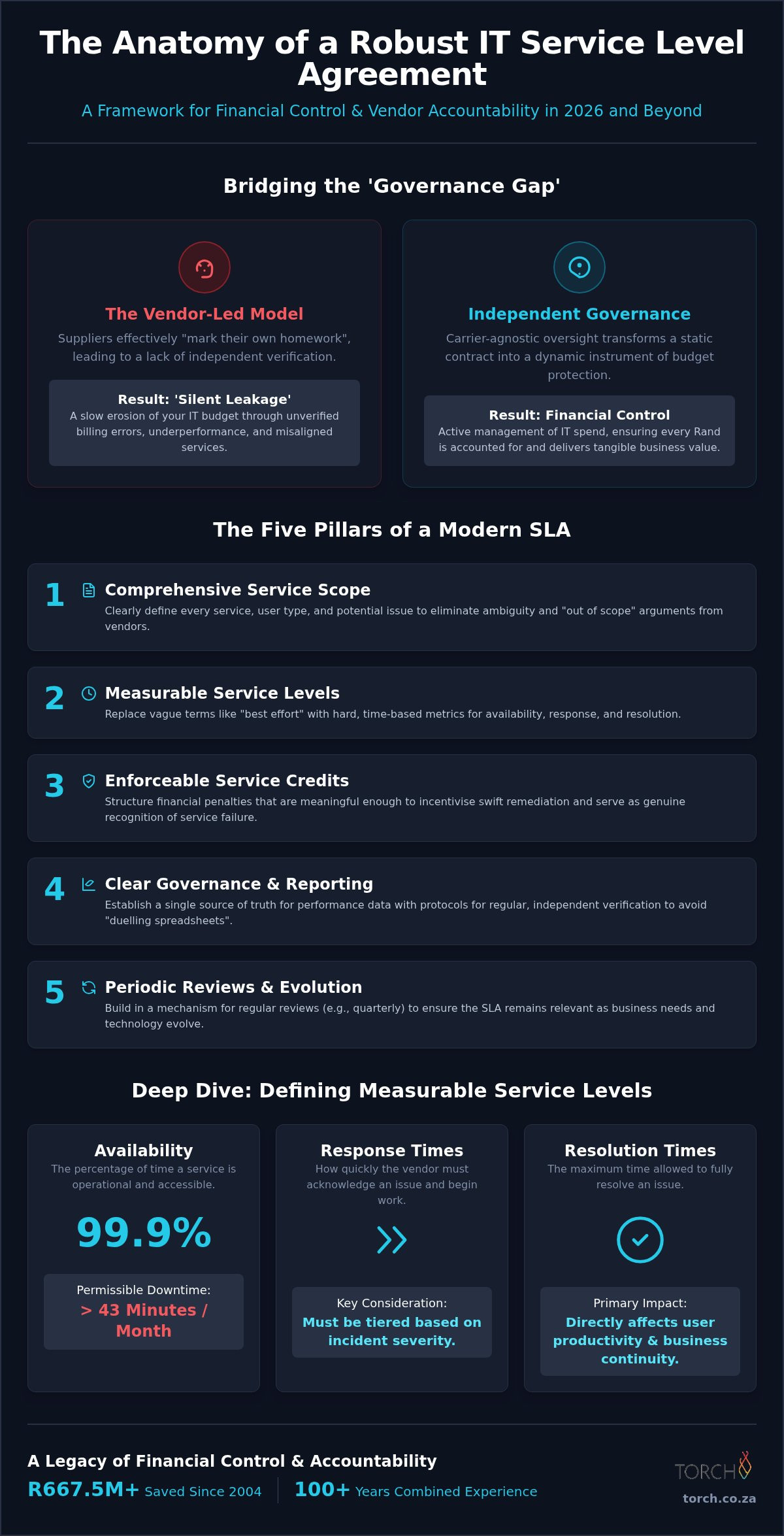
The core challenge is the ‘Governance Gap’: the chasm between what a contract promises and what is delivered and verified. A signed agreement often fails to prevent ‘silent leakage’—the slow, unverified erosion of your IT budget through billing errors, underperformance, and services that fail to meet business needs. This is where the vendor-led model, in which suppliers effectively mark their own homework, falls short. True financial discipline requires independent, carrier-agnostic governance.
With a perspective built on over 100 years of combined industry experience and having saved clients over R667.5M since 2004, we have seen that active oversight is the only way to transform a static SLA into a dynamic instrument of budget protection. It is the difference between passive acceptance and active management of your IT spend.
The Cost of Passive Vendor Management
An unmanaged IT estate, governed only by a seldom-referenced contract, is a direct route to financial leakage. Without rigorous oversight, enterprises are exposed to a range of issues, from paying for services that are no longer in use to accepting substandard performance that impacts productivity. Silent leakage is the accumulation of unverified costs hidden within complex IT invoices and vendor performance reports.
A common misconception is that a vendor-provided dashboard offers sufficient control. Whilst dashboards can visualise data, they rarely provide the context or validation needed to hold a supplier accountable. They show you what the vendor wants you to see, often omitting the granular detail required to identify discrepancies or enforce the penalty clauses outlined in the SLA. True control comes from independent data verification, not just data visualisation.
Establishing Commercial Optimisation from Day One
A robust SLA framework, implemented at the start of a vendor relationship, sets the stage for long-term budget health and predictable expenditure. It establishes clear, measurable benchmarks for performance and defines the commercial consequences of failure. This process begins with comprehensive contract auditing, a crucial step that often uncovers immediate savings opportunities by identifying historical overcharges or misaligned service tariffs.
By embedding principles of financial governance into the procurement process, you move from a reactive to a proactive stance. This approach is central to restoring confidence in your technology spend, ensuring every Rand is accounted for and delivers tangible business value. It is the foundation of a comprehensive strategy for IT FinOps services, turning your IT function from a cost centre into a strategic enabler.
The Anatomy of a Robust IT Service Level Agreement for 2026
A modern IT vendor SLA must be more than a list of services; it must be a precise and enforceable framework for performance, accountability, and risk management. As hybrid estates and complex multi-vendor environments become the norm, a generic template is no longer sufficient. For 2026 and beyond, a robust agreement rests on five non-negotiable pillars:
- Comprehensive Service Scope: Clearly defining every service, every user type, and every potential issue to eliminate ambiguity and “out of scope” arguments from vendors.
- Measurable Service Levels: Replacing vague terms like “best effort” with hard, time-based metrics for availability, response, and resolution that align with business continuity requirements.
- Enforceable Service Credits: Structuring financial penalties that are meaningful enough to incentivise swift remediation and serve as genuine recognition of service failure.
- Clear Governance & Reporting: Establishing a single source of truth for performance data, with protocols for regular, independent verification to avoid “duelling spreadsheets” during reviews.
- Periodic Reviews & Evolution: Building in a mechanism for regular reviews (e.g., quarterly) to ensure the SLA remains relevant as your business needs, technology, and user base evolve.
Defining Measurable Service Levels
The heart of any effective SLA lies in its metrics. Vague clauses like “best effort” or “prompt response” are unenforceable and leave your organisation exposed. Instead, a strong SLA quantifies performance with hard, time-based benchmarks. It is crucial to differentiate between three key metrics:
- Availability: The percentage of time a service is operational and accessible. A seemingly high figure like 99.9% uptime still equates to over 43 minutes of permissible downtime each month. Does this align with your operational needs during peak business hours?
- Response Times: How quickly the vendor must acknowledge a reported issue and begin work. This should be tiered based on the severity of the incident.
- Resolution Times: The maximum time allowed to fully resolve an issue. This is the metric that most directly impacts user productivity and business continuity.
These levels must be tailored to your specific operational realities. The resolution time for a critical system failure affecting your entire finance department should be far more stringent than for a minor software glitch impacting a single user.
Enforceable Service Credits and Penalties
Service credits are the teeth of an SLA. Without them, the agreement is merely a statement of intent. For these credits to be effective, they must be structured to genuinely incentivise the supplier to remedy failures expeditiously. A token penalty of a few hundred Rands for a system-wide outage provides no real motivation for improvement.
Meaningful recognition of failure is required for true vendor accountability. This means service credits should be significant enough to have a commercial impact on the vendor. Furthermore, the process for claiming these credits must be clear and based on objective, verifiable data. This is where an independent governance platform like SpotLight™ becomes indispensable, providing the undisputed evidence needed to trigger penalty clauses and ensure the terms of the agreement are consistently enforced.
Tracking Vendor Performance Metrics: Moving from Dashboards to Accountability
An SLA is only as effective as the governance framework that monitors it. Simply having metrics on paper is not enough; you need a systematic process for tracking, verifying, and acting on performance data. This moves your organisation from a passive recipient of vendor reports to an active manager of your technology estate. A structured, five-step approach ensures that your SLA translates into tangible value:
- Identify Critical Business Outcomes: Begin by defining what truly matters to your organisation. Move beyond vanity metrics (e.g., number of tickets closed) and focus on KPIs that drive business value, such as user productivity, system availability during core business hours, and mean time to resolution for critical incidents.
- Automate Data Collection: Relying on manual data gathering from vendor portals or spreadsheets is inefficient and prone to error. Implement purpose-built Business Intelligence (BI) models and real-time monitoring tools to automate the collection of performance data directly from the source.
- Establish a Single Source of Truth: To avoid time-wasting disputes over conflicting data, establish an independent, verified data repository. This single source of truth becomes the final arbiter in performance reviews, eliminating the “duelling spreadsheets” scenario where your data and your vendor’s data tell different stories.
- Conduct Regular Variance Analysis: Systematically compare actual performance against the agreed-upon SLA benchmarks. This variance analysis, conducted weekly or monthly, allows you to detect deviations early and address them proactively before they escalate into major service disruptions or budget overruns.
- Present Findings in Board-Level Reporting: Translate operational data into financial and strategic insights. Presenting clear, concise reports to the board that demonstrate the value of active vendor governance—from cost avoidance through service credits to risk mitigation—cements the strategic importance of IT financial management.
Key Performance Indicators (KPIs) vs Key Risk Indicators (KRIs)
A mature governance framework tracks both performance and risk. Whilst often used interchangeably, KPIs and KRIs serve distinct purposes:
- Key Performance Indicators (KPIs) measure operational efficiency and how well a vendor is delivering against their core service promises. Examples include automated user support resolution rates, first-call resolution percentage, and network latency.
- Key Risk Indicators (KRIs) act as an early warning system for potential threats to security, compliance, and financial stability. Examples include the number of unmanaged endpoints connected to the network, devices missing critical security patches, or significant, unexplained spikes in data usage that could indicate a breach.
While these KRIs focus on the digital realm, a comprehensive risk strategy also addresses physical security vulnerabilities. For businesses with international operations, professional security services London offers 24/7 monitoring and emergency response, ensuring that physical infrastructure is managed with the same level of accountability as the IT estate.
Effectively managing KRIs is essential for mitigating threats like ransomware, as the majority of entry points originate from unmanaged or non-compliant devices. A robust Unified Endpoint Management (UEM) strategy, enforced through the SLA, is critical for reducing this attack surface by ensuring every device adheres to corporate security policy.
The Role of Business Intelligence in Vendor Governance
In a complex enterprise environment, manual invoice matching and performance checking are low-value, time-consuming tasks that should be automated. Business Intelligence tools, when applied to vendor governance, transform this process. By integrating with vendor systems and internal financial platforms, BI can automate the validation of thousands of line items on an invoice against contractual rates and actual usage.
Furthermore, proprietary BI engines like TorchLight™ provide essential market benchmarking. This allows you to assess whether your SLA remains commercially competitive over time. Are you paying more than the market average for similar services? This data-driven insight provides powerful leverage during contract renegotiations. This is the essence of ‘active management’—using intelligence to move from reactive problem-solving to proactive optimisation of your entire technology estate.
Implementing Structural Control: Managing Vendor Risk Exposure
Signing a strong SLA is the first step. The ultimate goal, however, is to implement ‘structural control’—a permanent system of governance that ensures optimisation is sustained over the entire lifecycle of the vendor relationship. This framework ensures that the financial and operational discipline established on day one does not erode over time. It involves managing the ‘cradle-to-grave’ lifecycle of every IT asset, from procurement and deployment to support and eventual retirement.
In a hybrid work environment, consistent policy enforcement is paramount. Structural control ensures that security policies, usage limits, and device management protocols are applied to every user and every device, regardless of location. The SLA acts as the foundational document for this broader IT vendor management strategy, providing the legal and commercial authority to enforce these controls.
Closing the Governance Gap in IT Procurement
The journey from identifying a procurement need to operating a fully governed estate should be a swift and decisive process. Protracted internal debates and lengthy negotiations create vacuums where costs can spiral and risks can multiply. As demonstrated in our engagement with clients like the Tsogo Group, a focused, data-driven approach can move an organisation from an initial challenge to a final procurement decision in as little as six weeks.
This requires deep vendor engagement and sophisticated contract scenario modelling to forecast the total cost of ownership under different commercial and technical conditions. It also means integrating best practices from adjacent domains, such as learning from SaaS spend management to avoid auto-renewal traps and shelf-ware that drain the budget without delivering value.
Building a Culture of Accountability
This is where an active governance partner proves its value, moving beyond simply reporting issues to actively resolving them on your behalf. For many organisations, working with an experienced partner like ITS Canada Inc ensures that the technical execution of services aligns perfectly with the strategic goals defined in the SLA.
This shift from passive oversight to active management transforms the SLA from a document of potential conflict into a framework for a productive partnership. By establishing managed risk exposure and clear expectations from the outset, you create an environment where vendors are incentivised to perform, costs are predictable, and your technology estate becomes a secure, efficient platform for sustainable growth.