
For modern enterprise leadership, managing digital infrastructure has evolved beyond day-to-day administrative IT support. In an era characterised by distributed working arrangements, an expanding threat landscape, and severe scrutiny on technology expenditure, the physical and virtual assets deployed across an organisation represent both a primary operational risk and a frequent source of financial leakage. While many technology leaders understand device oversight through the narrow lens of mobile device management, forward-looking Chief Information Officers (CIOs) and Chief Financial Officers (CFOs) approach this challenge through a more comprehensive discipline: enterprise governance.
Understanding the full spectrum of unified endpoint management benefits requires moving beyond technical feature matrices. Realised at an executive level, Unified Endpoint Management (UEM) serves as an operational and financial control framework. It integrates security policies, asset lifecycle management, regulatory compliance, and cost allocation into a single architectural discipline. When implemented effectively, UEM bridges the operational gap between technical teams charged with protecting infrastructure and executive leadership responsible for capital stewardship and risk mitigation.
Defining Unified Endpoint Management in the Modern Enterprise
unified endpoint management represents the centralised, policy-driven governance of every device configured to access corporate networks, data repositories, and enterprise applications. This architecture encompasses traditional workstations, corporate-owned laptops, mobile smartphones, ruggedised handhelds, virtual machines, and Internet of Things (IoT) hardware under a unified control pane.
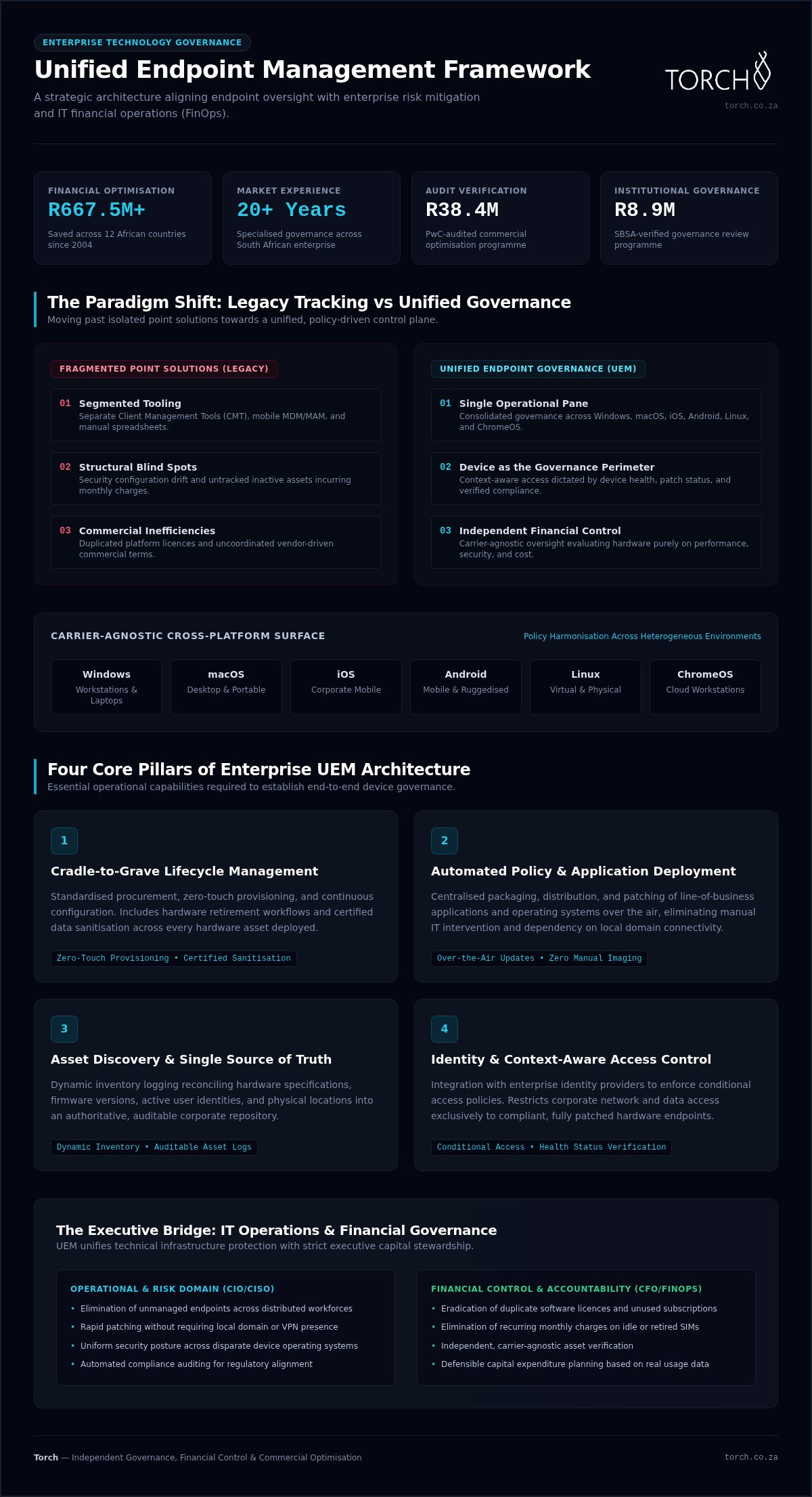
A strategic governance framework and technology architecture that consolidates the discovery, provisioning, security enforcement, software distribution, and lifecycle tracking of all enterprise endpoints into a single operational interface. Unlike legacy point solutions, UEM aligns endpoint visibility with enterprise security architecture and IT financial operations (FinOps), mitigating operational risk while eliminating unmanaged device expenditure.
Historically, enterprise device estates were managed through fragmented point solutions. Personal computers and corporate laptops fell under traditional Client Management Tools (CMT), which relied heavily on domain connectivity and corporate local area networks. Concurrently, the consumerisation of mobile technology prompted the rollout of Mobile Device Management (MDM) platforms, followed by Mobile Application Management (MAM) tools aimed at segregating corporate data on personally owned hardware. This fractured approach introduced operational friction, duplicate licensing fees, and critical visibility blind spots across disparate operating systems.
The primary advantage of UEM lies in its structural cohesion. By unifying management protocols across Windows, macOS, iOS, Android, Linux, and ChromeOS, enterprises eliminate the administrative silos that historically compromised oversight. When managed through an independent, carrier-agnostic governance model, UEM provides an objective layer of control that evaluates every connected asset purely against enterprise policy, performance benchmarks, and cost efficiency, rather than vendor-driven commercial incentives.
The Shift from MDM to Unified Governance
The transition from isolated device tracking to unified endpoint governance is an operational necessity driven by modern workplace dynamics. When organisations manage endpoints in isolation, structural blind spots inevitably emerge. A mobile phone managed by one platform, a remote laptop overseen by another, and corporate tablets managed via spreadsheets create an environment where security configurations drift, licensing counts duplicate, and inactive assets continue to incur monthly connectivity charges.
In the context of the dispersed African workforce, where cross-border operations and remote employee hubs are standard, maintaining consistent perimeter security using legacy network architectures is no longer viable. UEM redefines the enterprise perimeter by treating the endpoint itself as the primary governance checkpoint. Rather than relying on physical office networks, access control is dictated by device health, compliance verification, and identity context.
For organizations evaluating their transition path, understanding unified endpoint management vs MDM is a critical first step. To frame this evolution clearly from an executive perspective: Unified Endpoint Management is a strategic imperative for IT financial discipline, transforming disparate device tracking into a centralised mechanism for measurable cost containment and risk management.
Core Capabilities of a UEM Framework
An enterprise-grade UEM framework is distinguished by its capacity to provide total lifecycle oversight rather than superficial asset tracking. To achieve meaningful governance, the framework must deliver four core capabilities:
- Cradle-to-Grave Lifecycle Management: Standardised procurement, zero-touch provisioning, ongoing configuration, hardware retirement, and certified data sanitisation across every hardware asset.
- Automated Policy and Application Deployment: The ability to package, distribute, and update core line-of-business applications and operating system patches over the air without requiring manual IT intervention or local domain connectivity.
- Comprehensive Asset Discovery and Single Source of Truth: Dynamic inventory logging that reconciles hardware specifications, firmware versions, active user identities, and physical location into an accurate repository for auditing.
- Granular Identity and Context-Aware Access: Integration with identity providers to enforce conditional access policies, ensuring that only compliant devices running approved patch levels can interact with sensitive enterprise resources.
When these capabilities operate simultaneously, IT leadership gains complete operational oversight. The traditional operational friction associated with corporate hardware—lengthy imaging cycles, lost equipment, unresolved software vulnerabilities, and untracked peripherals—is replaced by automated, auditable workflows that respect both operational requirements and commercial constraints.
Strengthening Security Posture and Regulatory Compliance
Cybersecurity can no longer be treated as an isolated technical discipline disconnected from commercial realities. Corporate endpoints represent the primary interface between operational personnel and malicious threat actors. The vulnerability of these endpoints has escalated dramatically: industry telemetry demonstrates that approximately 85% of ransomware entry points originate from unmanaged or inadequately secured devices. When an endpoint lacks policy-driven oversight, unpatched software vulnerabilities, compromised credentials, and unauthorised application downloads quickly become open pathways into the enterprise network core.
In South Africa, the financial ramifications of an endpoint security breach are severe. According to the State of Ransomware 2025 report by Sophos, South African enterprises faced a median ransomware payment demand of R18 million, with the average total recovery cost reaching R24 million. These figures exclude the indirect expenses of regulatory scrutiny, brand erosion, litigation, and extended operational downtime. Within this operating environment, deploying unified endpoint management is not merely an operational convenience; it is a primary defensive safeguard protecting the organisation’s balance sheet.
A comprehensive UEM framework delivers distinct, auditable security benefits:
- Universal Zero Trust Baseline: Enforces continuous verification of device compliance before granting access to corporate networks, replacing implicit network trust with explicit, dynamic validation.
- Automated Vulnerability Remediation: Distributes operating system patches, application security updates, and firmware revisions automatically, shrinking the exposure window exploited by modern exploit kits.
- Containerisation and Selective Wiping: Encapsulates enterprise applications and corporate data within encrypted sandboxes on employee-owned devices (BYOD), allowing instant remote deletion of corporate intellectual property without impacting personal files.
- Real-Time Configuration Drift Detection: Identifies unapproved privilege escalations, disabled security controls, or jailbroken/rooted devices, initiating automated quarantine protocols to contain potential breaches.
- Standardised Regulatory Audit Reporting: Generates auditable compliance registers aligned with data privacy statutes, verifying that data encryption and access restrictions are uniformly applied across the entire estate.
Mitigating Ransomware and Data Loss Risks
Preventing ransomware requires systemic discipline rather than reactive measures. Vulnerability management cycles that rely on manual patch deployment or user compliance leave critical infrastructure exposed for weeks after security patches are released. UEM shortens this window of vulnerability through automated patch deployment pipelines. IT administrators can test updates in controlled deployment rings and subsequently execute mass deployments across distributed fleets, confirming installation success through centralised dashboards.
Furthermore, managing risk in modern enterprises requires balanced handling of Bring Your Own Device (BYOD) and Corporate-Owned Personally-Enabled (COPE) models. When corporate data resides on personal smartphones or laptops, traditional, blunt security policies often fail. Employees may resist intrusive monitoring software, creating an incentive to bypass controls entirely.
UEM resolves this tension through structural containerisation. By partitioning the operating system at the kernel level, enterprise data remains encrypted within a protected corporate space, governed by corporate policies such as disabled screen captures, mandatory multi-factor authentication, and restricted clipboard transfers. If a device is lost, stolen, or an employee departs the organisation, IT can execute an instantaneous selective wipe. This removes enterprise credentials, access profiles, and proprietary data immediately, leaving the employee’s personal photographs, messages, and applications untouched.
Governance and Audit Readiness
Regulatory compliance is no longer a periodic exercise conducted ahead of an annual review; it is an ongoing operational requirement. In South Africa, the Protection of Personal Information Act (POPIA) mandates that responsible parties take appropriate, reasonable technical and organisational measures to prevent the loss of, damage to, or unauthorised destruction of personal information, as well as unlawful access to or processing of that data.
Failure to protect endpoints carrying personal data creates significant liability under POPIA, exposing organizations to administrative fines up to R10 million, civil litigation from affected data subjects, and reputational damage. UEM directly addresses these legal requirements by embedding verifiable controls into the endpoint ecosystem:
- Mandatory Full-Disk Encryption: Automated enforcement and key-escrow management for BitLocker (Windows) and FileVault (macOS), ensuring data on lost hardware remains cryptographically unreadable.
- Comprehensive Audit Logging: Maintaining tamper-evident records of device compliance states, access attempts, security policy updates, and administrative interventions to provide demonstrable evidence of compliance during Information Regulator audits.
- Continuous Asset Attestation: Automated reporting confirming that devices processing confidential customer data adhere to baseline security parameters, including active firewall settings and up-to-date threat protection.
Through these mechanisms, UEM transforms regulatory compliance from a disruptive, high-friction audit preparation cycle into a continuous, background operational state.
Commercial Optimisation and Financial Governance Benefits
While the security enhancements provided by UEM are indispensable, the commercial impact on technology operational expenditure (OpEx) and capital expenditure (CapEx) is equally compelling. Unmanaged or loosely governed device fleets suffer from pervasive “silent leakage”—the ongoing, unscrutinised outflow of corporate capital caused by unassigned software subscriptions, unreturned hardware from exited personnel, sub-optimal device refresh intervals, and uncontrolled data allowances.
Historical enterprise audit data indicates that actively governed estates can achieve up to a 47.2% total cost reduction versus their unmanaged counterparts. This commercial return is achieved through two distinct, compounding disciplines:
| Governance Dimension | Cost Impact | Operational Mechanism |
|---|---|---|
| Active Lifecycle Management | 19.6% Reduction | Continuous subscription rightsizing, automated recovery of departed-user assets, eliminating zombie software licenses. |
| Independent Carrier-Agnostic Benchmarking | 27.5% Reduction | Contract restructuring based on empirical usage data, standardising cross-carrier data plans, tariff optimisation. |
| Combined Governed Impact | Up to 47.2% Total Savings | End-to-end structural control connecting endpoint health with financial accountability. |
For organizations seeking to justify this operational investment to executive leadership, detailed modeling is essential. Evaluating the commercial return through structured metrics is covered comprehensively in our guide on calculating the ROI of unified endpoint management.
Integrating UEM with IT FinOps
To capture sustainable savings, endpoint data must not remain locked inside an IT console. It must integrate directly into financial oversight workflows through IT FinOps. FinOps establishes an operating model where cross-functional teams take ownership of technology spend, driving business value through informed, data-backed decisions.
A UEM framework feeds real-time telemetry into enterprise FinOps models. In many large South African enterprises, an estimated 10% to 15% of software licensing expenditure is allocated to “ghost accounts”—licenses provisioned for employees who have moved roles, resigned, or whose usage patterns do not justify the tier of software assigned. By integrating UEM telemetry with procurement systems, finance teams gain visibility into true application utilization:
If an expensive software package installed on a workstation remains inactive for 60 consecutive days, the UEM platform can trigger an automated notification, harvest the license, and return it to the available corporate pool. This avoids purchasing additional software allocations during subsequent procurement cycles. Similarly, hardware assets are tracked with precision. Rather than following rigid, time-based hardware refreshes every 36 months—which frequently replaces fully functioning assets prematurely—UEM provides diagnostic data regarding battery degradation, memory utilization, and processor load. This allows enterprises to transition to condition-based hardware lifecycles, safely deferring capital expenditure without impacting user productivity.
Reducing Operational Overhead
The operational cost of maintaining a distributed computing fleet is heavily weighted toward manual IT support tickets. Onboarding a new knowledge worker historically required hours of technical effort: physically unpacking equipment, configuring base operating systems, manually installing business applications, applying individual security keys, and assigning network permissions. Conversely, employee departures often meant unrecovered assets and lingering administrative credentials.
UEM replaces these manual touchpoints with “zero-touch” automated deployment models (leveraging protocols like Apple Automated Device Enrollment and Windows Autopilot). Corporate hardware can be shipped directly from an original equipment manufacturer (OEM) or distributor to an employee’s residence. Upon unboxing and connecting to the internet, the endpoint automatically authenticates, contacts the UEM platform, pulls the user’s specific profile, applies corporate security baselines, and installs necessary business software without requiring IT intervention.
This automated provisioning reduces deployment labour costs significantly, accelerating time-to-productivity from days to hours. Furthermore, ongoing support burdens are mitigated through self-service capabilities. End users can access an enterprise portal to initiate safe application installations, request temporary network privileges, or initiate automated device health diagnostics, freeing internal senior engineering teams to focus on revenue-generating infrastructure initiatives.
Implementing a Governance-Led UEM Framework
Deploying a successful endpoint management strategy requires more than procuring software licenses. Many enterprises acquire market-leading tools only to find them functioning as expensive, under-utilised asset registers. This failure typically occurs because the software is deployed without establishing the underlying operational policies, organizational workflows, and financial checkpoints necessary to sustain control.
Effective governance requires an architecture that bridges the gap between passive reporting and operational remediation. The path from unmanaged operational complexity to sustained governance relies on a systematic, lifecycle-driven engagement model.
The Roadmap to Sustainable Optimisation
To successfully integrate endpoint control into enterprise operations, organisations must execute a structured, phased implementation roadmap:
- Estate Audit and Discovery: Deploy non-intrusive discovery agents to establish an uncompromising baseline of every active, dormant, and ghost device connected to corporate assets. Reconcile this technical inventory directly against carrier billing files, active directory accounts, and hardware asset registers.
- Policy Harmonisation and Architecture Design: Establish unified, role-based endpoint profiles that reconcile security mandates with commercial parameters. This includes defining tiered data access rules, password and MFA baselines, hardware refresh criteria, and selective wipe triggers.
- Carrier-Agnostic Governance Integration: Ensure that device management operates independently of telecom network providers. Carriers have a structural conflict of interest that disincentivises identifying idle data SIMs or highlighting over-provisioned mobile packages. Independent governance provides objective oversight across all providers.
- Embedded Operational Execution: Transition from static dashboards to hands-on, managed operational workflows. As unmanaged endpoints, outdated software packages, or out-of-policy expenses surface, dedicated governance teams resolve the deficiencies immediately rather than leaving them as unresolved items on an IT report.
Rather than managing this complexity internally with scarce technical resources, leading African enterprises leverage specialized managed UEM solutions. In this delivery model, the managed service partner assumes operational responsibility for device discovery, continuous policy enforcement, vulnerability patching, and asset disposal, backed by strict Service Level Agreements (SLAs).
Securing Executive Buy-In
Achieving board-level approval and executive sponsorship requires articulating the benefits of UEM in the language of the modern board room: managed risk exposure, regulatory protection, and capital efficiency. CFOs and audit committees are rarely swayed by technical specifications alone; they respond to clear business cases backed by empirical data.
When presenting the commercial justification for a UEM implementation, frame the initiative around core strategic imperatives:
- Quantified Risk Mitigation: Present the UEM deployment as a preventative control against severe financial loss, highlighting the elimination of unmanaged entry points where 85% of ransomware attacks originate, and referencing the R24 million average recovery cost incurred by breached peers.
- Immediate Cash Flow Recovery: Demonstrate how active endpoint rightsizing directly recovers capital, cutting waste by recapturing inactive software allocations and eliminating recurring subscriptions for inactive devices.
- Audit Assurance and Regulatory Compliance: Position the platform as an automated compliance mechanism that shields executive directors from liability under POPIA by ensuring verifiable, end-to-end data encryption and strict governance over corporate intellectual property.
With more than 20 years operating in the South African enterprise market and over R667.5 million saved for enterprise clients across 12 African countries since 2004, Torch provides the independent expertise necessary to transform endpoint management from an operational headache into a source of enduring financial control. Our framework integrates seamlessly within our Six Integrated Service Lines model, ensuring that endpoint management operates in direct harmony with Telecom Expense Management (TEM) and board-level IT FinOps governance.
Restore Visibility, Security, and Financial Control to Your IT Estate
Bridge the gap between endpoint administration and enterprise financial governance with an independent, carrier-agnostic assessment of your device fleet.
Frequently Asked Questions
How does UEM differ from traditional Mobile Device Management (MDM)?
Traditional Mobile Device Management (MDM) was developed specifically to manage smartphones and tablets running mobile operating systems such as iOS and Android. Its capabilities were largely limited to basic policy enforcement, device tracking, and remote locking or wiping. Unified Endpoint Management (UEM) unifies mobile device oversight with traditional desktop and server management (historically handled by Client Management Tools). UEM applies uniform security configurations, software deployment profiles, and identity-driven access rules across all devices—including Windows workstations, macOS laptops, mobile devices, ruggedised warehouse hardware, and virtual infrastructure—from a single pane of glass.
Can UEM help our organisation comply with POPIA regulations?
Yes. The Protection of Personal Information Act (POPIA) requires organisations to implement reasonable and appropriate technical and organisational safeguards to secure personal information under their control. A robust UEM solution directly supports POPIA compliance by enforcing mandatory device-level encryption (BitLocker, FileVault), managing containerised corporate partitions on personal devices, maintaining auditable access logs, preventing unauthorized data exfiltration, and providing the capability to execute immediate remote or selective wipes if an asset is lost, stolen, or assigned to a departing employee.
What are the primary security benefits of a Unified Endpoint Management solution?
The primary security benefit is the radical reduction of the enterprise attack surface. By centralising policy enforcement, UEM ensures that no unmanaged, unpatched, or compromised device can access corporate systems. Specific capabilities include automated operating system and third-party application patch management, dynamic Zero Trust conditional access validation, continuous monitoring for device configuration drift (such as jailbreaking or privilege escalations), and containerisation that segregates corporate intellectual property from personal data on employee hardware.
How does UEM contribute to IT FinOps and cost optimisation?
UEM integrates technical asset utilization with enterprise financial systems. By providing precise real-time data on application usage and device status, UEM allows IT and finance teams to identify and eliminate “ghost accounts” (unused software licenses), safely extend device refresh cycles based on actual hardware health rather than arbitrary time intervals, and recover equipment promptly when staff members leave the organisation. Audited operational estates demonstrate that active lifecycle governance delivered alongside independent benchmarking can reduce overall asset and connectivity expenditure by up to 47.2%.
Is UEM suitable for a hybrid workforce using both corporate and personal devices?
UEM is ideally suited for hybrid workforces operating under Corporate-Owned Personally-Enabled (COPE) or Bring Your Own Device (BYOD) frameworks. Through OS-level containerisation, UEM creates a distinct, encrypted boundary between corporate assets and private user data. IT administrators maintain total control over corporate applications, enterprise communications, and corporate files, while remaining completely unable to view personal browsing history, private messages, personal photographs, or personal applications. This preserves corporate security standards while protecting employee privacy.
Why is an independent, carrier-agnostic approach important for UEM?
Telecommunications carriers and mobile network operators have an inherent conflict of interest: their commercial model relies on the consumption of data, the addition of network lines, and the sale of bundled hardware packages. An independent, carrier-agnostic governance partner does not sell connectivity or hardware, allowing for objective validation of usage, strict contract benchmarking, and unbiased policy enforcement. Within the framework of our Six Integrated Service Lines, carrier independence ensures that endpoint management is driven entirely by security compliance, operational stability, and verified financial efficiency rather than carrier sales targets.