
Defining the Financial Framework for UEM ROI
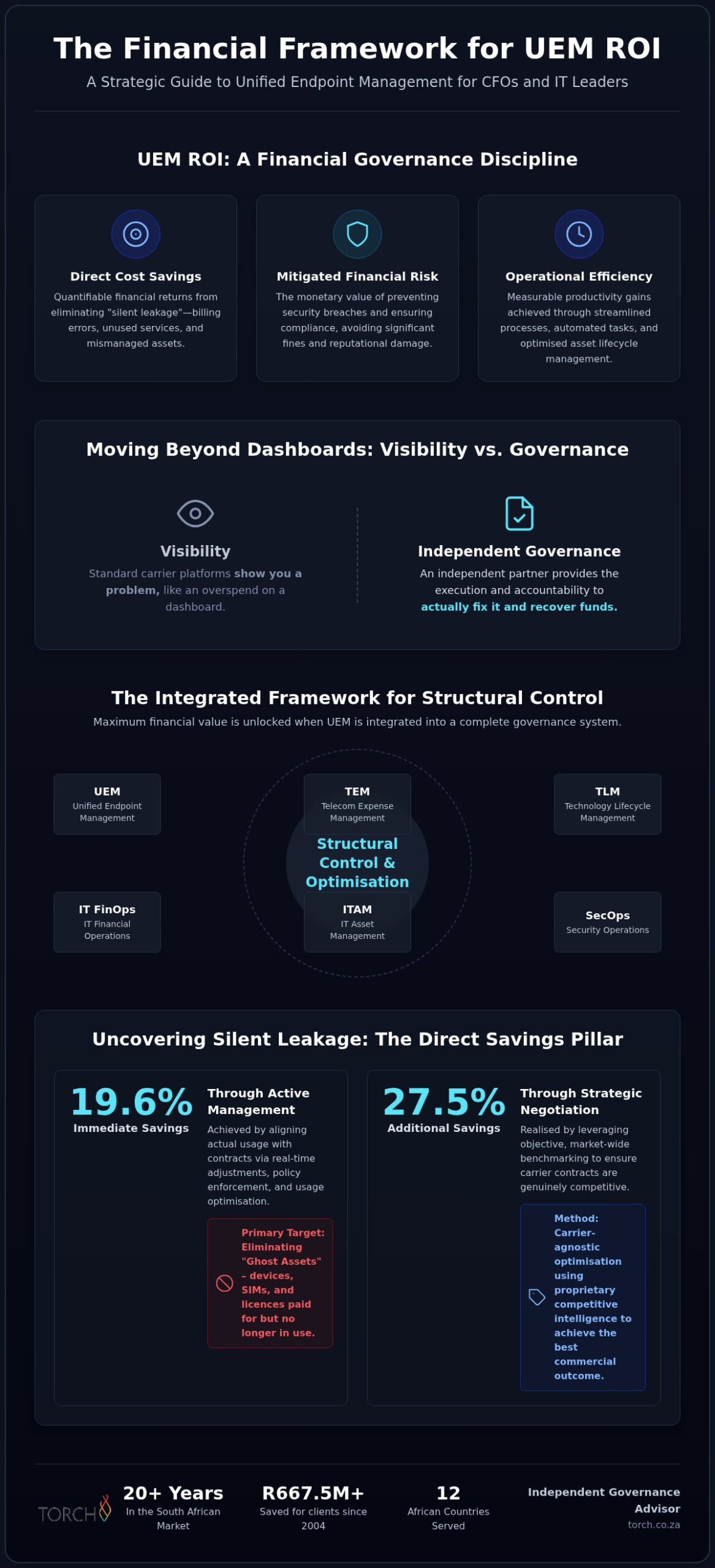
For Chief Financial Officers and IT leaders, calculating the ROI of Unified Endpoint Management (UEM) is not a technical exercise; it is a financial governance discipline. The true return extends far beyond basic productivity metrics. It is measured in direct cost savings, mitigated financial risk, and sustained operational efficiency. Most ROI calculators focus on abstract gains like “time saved,” which are difficult to present to a board. A strategic approach, however, begins with a clear-eyed analysis of existing governance gaps.
- UEM ROI Defined: The quantifiable financial return is the sum of three core components: direct cost savings from eliminating waste, the monetary value of mitigated security and compliance risks, and measurable gains in operational efficiency.
- Governance Gap Analysis: The first step in calculating the ROI of unified endpoint management is to identify where financial control is weak. This involves moving past surface-level dashboards to uncover hidden costs and unmanaged risks.
- Visibility vs. Governance: Many platforms provide visibility—they show you a problem. Independent governance, however, provides the execution and accountability required to fix it. Simply seeing an overspend on a dashboard does not recover the funds; an independent partner with the mandate to act does.
- The Role of an Independent Advisor: A carrier-agnostic advisor provides the objective financial oversight needed to validate IT spend. This approach introduces vendor accountability and ensures that all decisions are driven by your organisation’s commercial interests, not a vendor’s sales targets.
The Integrated Framework for Complete IT Governance
Unified Endpoint Management does not operate in a vacuum. Its maximum financial value is unlocked when it is integrated into a comprehensive governance framework. Where many organisations see disparate functions, a mature financial strategy sees an interconnected system for controlling costs and risk. Torch’s model integrates six service lines to create this structural control.
- An Interconnected System: True governance combines Unified Endpoint Management (UEM) with Telecom Expense Management (TEM), Technology Lifecycle Management (TLM), IT FinOps, IT Asset Management (ITAM), and Security Operations (SecOps). This integrated structure ensures that insights from one area inform actions in another, creating a resilient and cost-efficient technology estate.
- Achieving Structural Control: This integrated approach delivers the structural control necessary to sustain optimisation over time. It provides a robust, repeatable methodology for managing costs and mitigating risks, which is far more effective than periodic, reactive cost-cutting initiatives.
- Defining Independent Governance: In this context, independent governance is the objective validation and optimisation of your technology spend, executed by a non-vendor partner. It ensures every Rand is accounted for, justified, and delivers measurable value to the business.
Moving Beyond Carrier Dashboards
A common objection to investing in a UEM governance programme is, “We already have a dashboard from our carrier.” Whilst these portals offer a degree of visibility, they are fundamentally incapable of providing the independent oversight required for true commercial optimisation. A carrier’s primary objective is to protect its own revenue, not to find savings for its clients.
This creates a classic “fox guarding the henhouse” scenario, where the entity you are paying is also the one responsible for auditing its own billing. In contrast, an independent partner like Torch works exclusively for you. With a 20-year history in the South African market and over R667.5M saved for enterprises across 12 African countries, our sole focus is to restore financial control and confidence in your IT spend.
Uncovering Silent Leakage: The Direct Savings Pillar
The most immediate and tangible ROI from a governed UEM programme comes from identifying and eliminating “silent leakage.” This refers to the persistent, often unnoticed, financial drain from billing errors, unused services, and mismanaged assets. Unlike abstract productivity gains, these savings are reflected directly in your budget.
- Targeting Silent Leakage: In unmanaged estates, silent leakage is the primary source of financial waste. It includes paying for services for former employees, holding incorrect subscription tiers, and overlooked billing discrepancies that accumulate over time.
- Immediate Savings (19.6%): Through active management—such as real-time subscription adjustments, policy enforcement, and usage optimisation—organisations can capture immediate savings averaging 19.6%. This is a direct result of aligning actual usage with contractual commitments.
- The “Ghost Asset” Problem: A significant source of leakage is the “ghost asset”—devices, SIM cards, and software licences that are still being paid for but are no longer in use or even physically present. A robust UEM system, integrated with IT FinOps discipline, reconciles real-time endpoint data with carrier invoices to eliminate this waste.
Capturing the 27.5% Negotiation Gain
Beyond active management, a substantial portion of UEM ROI is generated through strategic commercial negotiation. Internal procurement teams often lack the specialised market intelligence to know if their carrier contracts are genuinely competitive. An independent advisor closes this gap.
- Data-Driven Benchmarking: Using proprietary competitive intelligence tools like TorchLight™, we provide objective, market-wide benchmarking. This data reveals how your current rates compare to best-in-market pricing, providing the leverage needed for effective renegotiation.
- Carrier-Agnostic Optimisation: Because we are carrier-agnostic, our recommendations are based purely on achieving the best commercial and technical outcome for your organisation. This process typically yields an additional 27.5% in savings.
- Further Reading: For a deeper dive into this discipline, see our Enterprise Guide to Telecom Contract Benchmarking.
Eliminating Wasteful IT Spend
The final component of direct savings is rigorous financial oversight. This involves a systematic process of invoice reconciliation and variance analysis, ensuring that you only pay for what you have contracted for and actually used.
- Invoice Reconciliation and Variance Analysis: This discipline involves meticulously checking every line item on every invoice against contractual rates and real-world asset data. It uncovers billing errors, incorrect tariffs, and unauthorised charges that would otherwise go unnoticed.
- Real-Time Budget Oversight: Platforms like SpotLight™ provide real-time visibility into budget-versus-actual spend across the entire organisation. This allows for proactive intervention, preventing cost centres from exceeding their budgets before the end of the month.
- A History of Results: By implementing this level of structural control, Torch has saved clients over R667.5M since 2004, demonstrating the immense financial potential locked within unmanaged technology estates.
Identifying these direct savings is the first step. To understand how a governed approach could impact your budget, a complimentary analysis can provide a clear, data-backed starting point for your ROI calculation.
Quantifying Risk: Ransomware and Compliance ROI
A complete UEM ROI calculation must also quantify the value of risk mitigation. For a CFO, risk is a financial metric. Unmanaged endpoints are a primary vector for cyberattacks and a significant source of compliance failures, both of which carry substantial financial penalties. Calculating this aspect of ROI involves a clear, five-step process.
- Quantify the “Cost of Risk”: First, analyse the potential financial impact of a data breach. For South African organisations, this includes a median ransomware demand of R18 million and average recovery costs (including downtime, remediation, and regulatory fines) of R24 million.
- Calculate the Probability of Entry: Research shows that 85% of ransomware entry points are unmanaged or poorly managed devices. By enforcing security policies, patching vulnerabilities, and controlling application access, UEM drastically reduces this probability.
- Factor in Business Interruption: Beyond direct costs, a security incident leads to significant business interruption. Quantify the cost of operational downtime, lost revenue, and supply chain disruption.
- Assign a Rand Value to “Compliance Readiness”: Calculate the cost of manual, labour-intensive audit preparation. A governed UEM programme automates reporting for regulations like POPIA, saving hundreds of hours and reducing the risk of human error.
- Compare Costs: Finally, compare the modest, predictable cost of a managed UEM service—you can learn more about Nubivio to see how such models operate—against the multi-million Rand financial exposure of an unmanaged estate. The ROI from risk mitigation alone often justifies the entire investment.
POPIA and the Financial Discipline of Security
Under South Africa’s Protection of Personal Information Act (POPIA), organisations are legally required to safeguard personal data. Endpoint devices are a critical part of this responsibility, as they store, access, and transmit sensitive information. Failure to comply can result in significant administrative fines and reputational damage.
- Mandatory Compliance Reporting: Endpoint compliance is not optional. UEM provides the tools for remote wipe capabilities, data encryption enforcement, and access control policies—all essential for protecting personal data and demonstrating due diligence to regulators.
- Reducing Managed Risk Exposure: The ability to remotely lock or wipe a lost or stolen device instantly contains a potential data breach. This single feature can prevent a minor incident from escalating into a major financial and legal crisis.
- Audit-Ready Reporting: A governed UEM platform generates the automated, accurate reports required to satisfy auditors. This replaces error-prone manual spreadsheets, freeing up internal teams and ensuring a defensible compliance posture.
Cradle-to-Grave Asset Governance
The financial value of knowing the precise location, status, and user of every corporate asset cannot be overstated. From procurement to retirement, managed IT asset governance prevents “asset drift”—the gradual loss of devices due to poor tracking—and ensures that the full value of each asset is realised.
- Preventing Asset Loss: A complete asset lifecycle management programme tracks every device, reducing theft, loss, and unauthorised use. This protects the capital investment in hardware and ensures resources are properly allocated.
- Streamlining IT Administration: By automating inventory management, policy deployment, and device decommissioning, UEM governance reduces the administrative burden on IT teams whilst simultaneously enforcing rigorous financial and operational accountability.
Implementing Independent Governance for Sustained ROI
Software alone is not a strategy. A UEM platform is a powerful tool, but without disciplined execution and ongoing accountability, its value diminishes over time. The initial savings achieved can quickly erode as new contracts are signed, employees change roles, and new technologies are introduced. Sustained ROI requires a shift from a tool-centric mindset to a governance-led approach.
- Execution Beyond Reporting: True governance involves more than just identifying problems on a dashboard. It requires an embedded team mandated to resolve those issues—correcting billing errors, renegotiating contracts, and enforcing policies. Torch staff operate within client organisations to provide this hands-on execution.
- The 47.2% Reduction: The result of this involved approach is a total cost reduction of up to 47.2% in actively governed estates compared to their unmanaged counterparts. This figure represents the combined impact of active management, strategic negotiation, and risk mitigation.
Technical efficiency is a key driver of ROI. To see how a managed IT services provider can support your infrastructure, you can visit JP Technical.
Bridging the Gap Between IT and Finance
One of the greatest challenges in justifying IT spend is translating technical metrics into financial value. An independent governance partner acts as a bridge between the IT department and the CFO’s office, ensuring that technology investments are presented in the language of business.
- Board-Level Reporting: We transform complex endpoint data into clear, board-level IT finance reports. These reports focus on financial performance, risk exposure, and budget-versus-actual analysis, enabling informed strategic decisions.
- Plain-English Professionalism: Communicating technical risk and financial opportunities requires clarity and credibility. By avoiding jargon and focusing on commercial outcomes, we ensure that recommendations are understood and supported by financial leadership. For more on this, explore our guide to FinOps for Cloud Cost Reporting.
Next Steps: Securing Your Estate
Calculating the ROI of Unified Endpoint Management begins with understanding your current governance posture. Moving from a reactive state of managing costs to a proactive strategy of commercial optimisation requires a clear view of your existing gaps and opportunities.
- Identify Governance Gaps: A brief diagnostic can quickly identify areas of silent leakage, compliance risk, and contractual weakness within your current technology estate.
- Build Your Business Case: With a clear understanding of the potential savings and risk reduction, you can build a compelling, data-driven business case to present to the board.
- Begin Your ROI Calculation: The first step is a no-obligation discussion to map out your specific environment and quantify the potential returns.
Frequently Asked Questions (FAQs)
- What is the typical ROI timeline for Unified Endpoint Management?
- The timeline for realising ROI from UEM has two phases. Direct savings from identifying and eliminating ‘silent leakage’—such as unused licences or ghost assets—can manifest in the first billing cycle. More substantial commercial optimisation, achieved through contract renegotiation and market benchmarking, typically delivers significant returns over the first six to twelve months.
- How does UEM help reduce our corporate mobile phone bill?
- UEM reduces mobile costs in several ways: by enforcing data usage policies to prevent overages, by identifying and decommissioning unused SIM cards, by optimising rate plans based on actual usage patterns, and by providing the data needed to negotiate more favourable contracts with carriers.
- Can we calculate ROI for employee-owned (BYOD) devices?
- Yes. For Bring Your Own Device (BYOD) environments, the ROI is primarily calculated based on risk mitigation. UEM allows you to secure corporate data on personal devices through containerisation and selective wipe capabilities. The ROI is measured by quantifying the cost of a potential data breach from an unsecured personal device and the value of ensuring POPIA compliance.
- What is “silent leakage” in the context of IT asset management?
- “Silent leakage” refers to ongoing, often unnoticed costs for IT assets and services that provide no value. Examples include paying for software licences for ex-employees, subscriptions for unused applications, or mobile connections for devices that are lost, stolen, or sitting in a drawer. It is a primary target for immediate ROI.
- Why do carrier dashboards fail to deliver the same ROI as independent governance?
- Carrier dashboards provide visibility, but they lack two key elements: independence and execution. A carrier cannot effectively audit its own revenue or act against its own financial interests. An independent governance partner works exclusively for you to turn insights into action—resolving billing disputes, negotiating contracts, and enforcing policies to generate real, verified savings.
- How does POPIA compliance factor into the financial ROI of UEM?
- POPIA compliance contributes to ROI by mitigating the significant financial risk of a data breach. The potential costs include regulatory fines, legal fees, and reputational damage. UEM provides essential security controls (like remote wipe and encryption enforcement) and automated audit trails, which reduce the probability of a costly breach and demonstrate due diligence to regulators. This risk reduction has a clear, quantifiable financial value.