
In the modern enterprise, technology is the engine of growth. Yet, for many Chief Financial Officers and IT Directors, the technology budget feels less like a strategic investment and more like a financial black box. Costs escalate, driven by complex cloud contracts, sprawling software-as-a-service (SaaS) portfolios, and intricate telecom billing, whilst clear accountability remains elusive. The pressure to reduce operational expenditure is immense, but without granular visibility, any attempt to cut costs risks disrupting critical business functions.
The core challenge is not a failure of procurement but a crisis of visibility. Wasteful IT spending thrives in the shadows created by decentralised purchasing, multi-vendor complexity, and accounting methods that are no longer fit for purpose. This guide provides a strategic framework to move beyond reactive cost-cutting. It will help you identify hidden technology costs, reclaim control of your budget, and implement a sustainable model of IT financial governance that drives value instead of just measuring expenditure.
The Visibility Crisis: Why Enterprises Struggle to Eliminate Wasteful IT Spending
Wasteful IT spending is best defined as the gap between purchased capacity and actual, value-driven utilisation. It is the cost of resources—from software licences and cloud instances to mobile data plans—that are paid for but deliver little to no return to the organisation. In today’s complex technology estates, this gap is widening, driven by several key factors that obscure true expenditure.
- The Rise of ‘Shadow IT’: When individual departments procure software and services outside of central oversight, it creates a fragmented and uncontrolled technology landscape. This decentralised approach inevitably leads to redundant subscriptions, unmanaged security vulnerabilities, and a complete loss of purchasing leverage.
- Complex Multi-Vendor Environments: A typical enterprise relies on dozens, if not hundreds, of technology vendors. Managing this web of contracts, invoices, and service levels manually is an impossible task, making it easy for redundant costs and billing errors to go unnoticed.
- Outdated Accounting Models: Traditional, static accounting methods are ill-equipped to track the dynamic, consumption-based nature of modern technology. An annual budget set in stone cannot adapt to the real-time fluctuations of cloud usage or SaaS subscriptions, leaving finance teams unable to distinguish necessary expenditure from genuine waste.
The True Cost of Shadow IT
Shadow IT is more than just a procurement headache; it represents a significant governance gap with direct financial and security implications. When departments independently purchase solutions, they often create duplicate capabilities that already exist within the organisation’s approved software stack. A marketing team might subscribe to a project management tool, unaware that the engineering department is paying for a different platform with 90% feature overlap.
This decentralised activity inflates the annual technology budget with unmanaged licences and introduces unvetted software into the corporate environment, increasing security and compliance risks. Bringing this spend back under central governance is not about restricting departmental autonomy but about establishing financial accountability and maximising the value of every technology investment.
Decoupling Growth from Expenditure
A common but flawed assumption is that IT costs must rise in direct proportion to headcount. This linear thinking leads to bloated budgets where every new employee automatically triggers a cascade of new software licences and hardware requisitions, regardless of their actual needs. True financial efficiency is achieved when an organisation can scale its operations without a corresponding linear increase in IT expenditure.
This requires a shift in procurement strategy, moving from blanket purchases to a model based on scalable, usage-based services. By establishing a clear baseline for ‘efficient spend per user’ and leveraging scalable solutions, enterprises can support growth whilst maintaining rigorous financial control.
This principle of decoupling growth from operational costs is also gaining traction in heavy industry globally, where organisations like supersmart.energy help mining and industrial firms implement decarbonisation and energy optimisation strategies to ensure sustainable, cost-effective expansion.
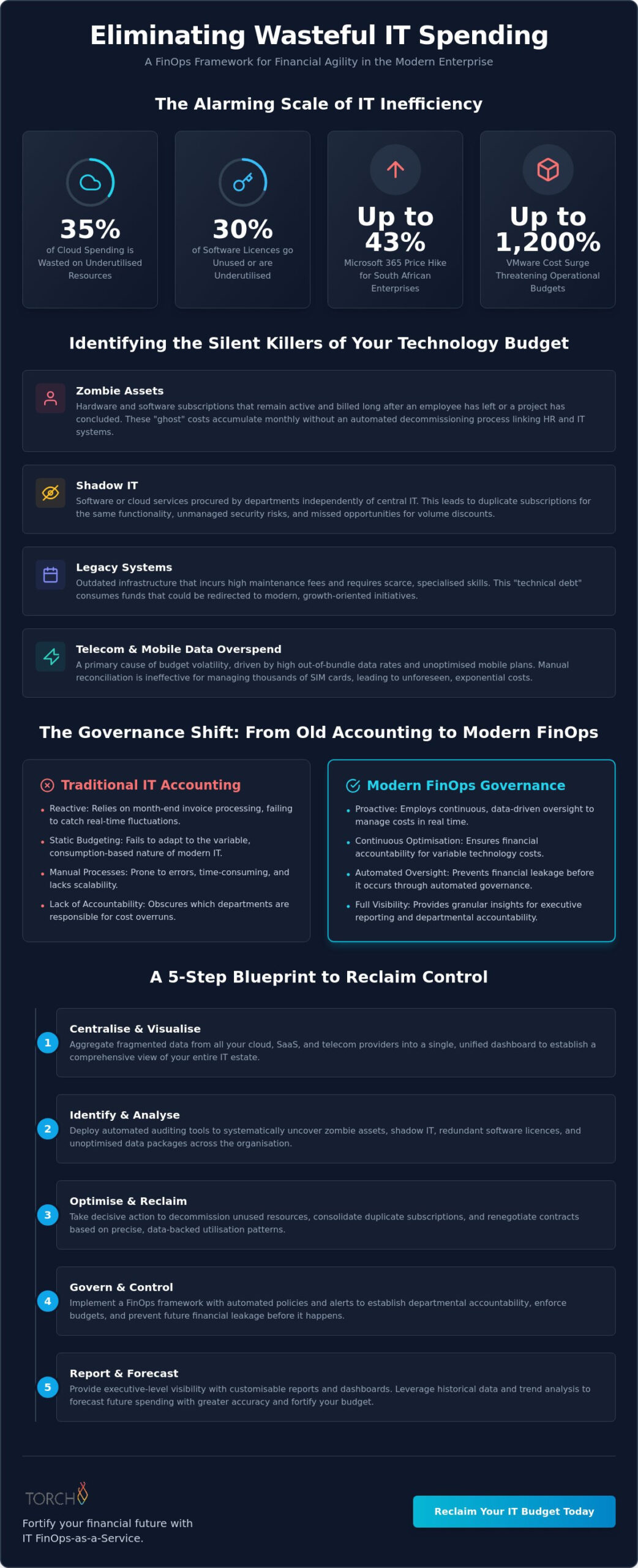
Identifying the Silent Killers of Your Technology Budget
Wasteful IT spending rarely announces itself. Instead, it accumulates through a series of small, often invisible, financial drains that collectively erode profitability. To effectively eliminate waste, leaders must first learn to identify these silent killers hiding within their technology budget. These are not one-time errors but systemic issues that, left unaddressed, become significant financial liabilities.
- ‘Zombie’ and ‘Orphaned’ Assets: These are the hardware and software assets that remain on the books but are no longer in use. This includes servers for decommissioned projects, software licences assigned to former employees, and mobile devices sitting in a storeroom, all whilst continuing to incur maintenance, support, or subscription fees.
- Telecom Billing Errors: The complexity of corporate telecommunications invoices makes them a prime area for overspending. Errors, unoptimised mobile data packages, and charges for disconnected lines are common, yet they are nearly impossible to detect through manual reconciliation.
- SaaS Bloat and Redundancy: The ease of acquiring SaaS solutions has led to ‘SaaS bloat’, where organisations pay for multiple applications with overlapping features. Paying for file sharing in Slack, Microsoft 365, and Dropbox simultaneously is a classic example of redundant spending hidden in plain sight.
- High-Cost Legacy Systems: Maintaining outdated, legacy systems can be a significant financial drain. The high costs of specialised support, custom maintenance, and the difficulty of integrating them with modern platforms often far outweigh the expense of migrating to a more efficient, contemporary solution.
Telecom and Mobile Data Overspend
For most large organisations, the monthly telecom invoice is a labyrinth of complex tariffs, line items, and obscure charges. ‘Out-of-bundle’ rates, particularly for mobile data and international roaming, can silently inflate a bill, whilst billing errors from carriers can persist for months or even years if left unchallenged. Managing a large fleet of corporate SIM cards and data profiles without a systematic approach is a direct path to overspending.
Given this complexity, manual auditing is no longer a viable strategy for large-scale enterprises. It is time-consuming, prone to human error, and lacks the analytical depth to identify optimisation opportunities. A structured, data-driven approach is essential for gaining control. For a deeper analysis of this specific challenge, see our Strategic Guide to Telecom Expense Management.
Cloud and SaaS Licence Redundancy
A primary driver of software waste is ‘shelfware’—licences that are purchased but never assigned or activated. This often occurs during large-scale enterprise agreement renewals, where organisations overestimate their needs and are left paying for hundreds or thousands of unused seats. Without an automated system for IT asset tracking, these licences remain on the balance sheet, consuming budget that could be reallocated to value-generating initiatives.
The solution lies in maintaining a clean, accurate, and real-time inventory of all software assets. This enables IT and finance leaders to compare feature sets across similar tools, identify consolidation opportunities, and implement a proactive process for reclaiming and reassigning underutilised licences before they become a sunk cost.
Governance Frameworks: FinOps vs. Traditional IT Accounting
To truly eliminate wasteful IT spending, enterprises need more than just a better auditing process; they need a fundamental shift in financial philosophy. The traditional ‘set and forget’ model of IT budgeting is obsolete. A new approach is required—one that treats technology spending not as a fixed, annual overhead but as a variable, dynamic driver of business value. This is the core principle of FinOps.
- The FinOps Philosophy: IT FinOps is a cultural practice and operational model that brings financial accountability to the variable spend model of modern technology. It is about making data-driven spending decisions in near real-time to maximise business value.
- Continuous Optimisation Cycles: Unlike traditional accounting, which reviews spending retrospectively, FinOps operates in a continuous cycle of monitoring, analysing, and optimising. This agility allows organisations to adjust their spending in response to changing business needs and consumption patterns.
- Cross-Functional Collaboration: FinOps breaks down the silos between IT, Finance, and Procurement. It establishes a shared language and a common set of metrics, ensuring that technology decisions are made with a clear understanding of their financial impact.
- Data-Driven Decision Making: At its core, FinOps replaces guesswork with empirical evidence. By providing clear, accessible data on technology consumption and cost, it empowers leaders to make informed decisions that align spending with strategic priorities.
The Shift to FinOps-as-a-Service
Implementing a robust FinOps practice internally requires specialised skills, dedicated resources, and sophisticated analytical tools. Recognising this, many enterprises are turning to FinOps-as-a-Service, outsourcing their technology financial operations to a specialised managed services partner. This approach offers several distinct advantages.
An independent partner provides an unbiased, objective audit of all vendor billing, free from any carrier or reseller influence. They bring a level of focus and expertise that is difficult to replicate in-house, leveraging purpose-built analytical models to uncover efficiencies that manual processes would miss. This model provides the commercial agility and deep insights needed to navigate modern digital transformation without sacrificing financial discipline.
Establishing an Endpoint Governance Framework
Financial efficiency and security governance are two sides of the same coin. An unmanaged device is not just a potential security threat; it is also a financial liability. A robust unified endpoint management (UEM) framework is therefore a cornerstone of any effective FinOps practice, directly linking asset lifecycle management to both cost control and risk mitigation.
When devices are not properly tracked, organisations continue to pay for software licences and security services for assets that are lost, stolen, or decommissioned. This lack of governance creates significant financial waste and, more critically, exposes the organisation to severe security risks. According to a 2025 Sophos report, 85% of ransomware entry points originate from unmanaged devices, with the median ransomware demand in South Africa now standing at R18 million. Proactive endpoint governance is not merely an IT task; it is a critical strategy for managing major financial risk exposure.
To mitigate these risks, many organisations partner with cybersecurity specialists like M.I.S. Support, Inc. to implement proactive security and managed IT solutions that protect their infrastructure from costly disruptions.
A 5-Step Blueprint to Eliminate Wasteful IT Spending
Moving from theory to practice requires a clear, actionable plan. This five-step blueprint provides a structured methodology for enterprises to systematically uncover and eliminate wasteful IT spending, establishing a foundation for continuous financial governance and optimisation.
- Step 1: Centralise All IT Spend Data: The first step is to break down data silos. Consolidate all technology-related invoices, contracts, and consumption data from every vendor—telecom, cloud, SaaS, and hardware—into a single source of truth. Without a unified view, it is impossible to see the complete picture of your expenditure.
- Step 2: Conduct a Comprehensive Vendor Contract Audit: Systematically review every recurring vendor contract. Identify auto-renewal clauses, outdated service-level agreements, and redundant services. This process establishes a clear baseline of your contractual commitments and often reveals immediate opportunities for consolidation and renegotiation.
- Step 3: Implement Automated Asset Tracking: Deploy automated tools to track the entire lifecycle of your IT assets, from procurement to disposal. This is the most effective way for most enterprises to identify underutilised software licences, orphaned cloud instances, and zombie hardware that are consuming budget without delivering value.
- Step 4: Optimise Telecom Billing Through Granular Analysis: Move beyond a cursory review of your telecom invoices. Conduct a granular, line-by-line analysis of usage patterns, carrier tariffs, and device assignments. This detailed scrutiny is essential for identifying billing errors and rightsizing data and voice plans to match actual employee needs.
- Step 5: Establish a Continuous Monitoring Cycle: Eliminating waste is not a one-time project; it is an ongoing discipline. Establish a continuous monitoring and reporting cycle to track key financial metrics, prevent ‘waste creep’, and ensure that your IT spending remains aligned with evolving business objectives.
Auditing Corporate Mobile Contracts
A rigorous audit of corporate mobile contracts is one of the most direct ways to reclaim a significant portion of your IT budget. By analysing detailed usage patterns, you can move users to the most cost-effective tariff tiers and eliminate features they do not use. A comprehensive telecom audit is not a minor adjustment; an independent GetMetrix analysis of South African financial services billing data reveals that fully governed telecom estates achieve total cost efficiencies of 47.2% compared to unmanaged environments. This is achieved through a combination of active management (19.6%) and independent, carrier-agnostic negotiation (27.5%).
Consolidating Vendor Billing
Managing hundreds of individual invoices each month places a heavy administrative burden on your finance department and obscures the holistic view of your technology spend. Consolidating vendor billing through a single managed partner simplifies this process dramatically. This approach not only improves procurement efficiency but also strengthens your negotiating position. By aggregating spend for redundant software tools under a single agreement, you can often leverage volume discounts that were previously inaccessible. For more on this, read our guide on how to consolidate IT vendor billing.
Fortifying Your Financial Future with an Independent Governance Partner
Eliminating wasteful IT spending is a strategic imperative that requires focus, expertise, and, above all, independence. The challenge for many enterprises is that they lack the internal resources and unbiased perspective to effectively audit and govern their complex technology estates. This is where a dedicated, independent managed advisory partner becomes essential.
As a carrier-agnostic and vendor-neutral partner, Torch Services operates with a single objective: to maximise the value of your technology investments. We do not accept commissions or incentives from any network operator or software vendor, ensuring that every recommendation we make is completely unconflicted and aligned solely with your financial interests. Our role is to provide the independent governance and commercial accountability needed to transform your IT budget from an unpredictable cost centre into a strategic asset.
The Torch Advantage in Expense Management
Our FinOps-as-a-Service model provides the executive-level visibility and control required to navigate the complexities of modern technology expense management. We go beyond basic reporting, applying purpose-built BI models and deep industry expertise to uncover hidden savings and optimisation opportunities that automated platforms and manual audits invariably miss.
Through our managed services, we implement robust endpoint governance to reduce waste and mitigate security risks. We conduct forensic-level telecom audits that hold carriers accountable for billing accuracy. We provide the strategic insight that empowers your leadership team to move from a reactive, cost-cutting posture to one of proactive, continuous financial excellence.
Next Steps for Your Enterprise
Gaining control over your technology spend begins with a clear understanding of your current governance posture. A high-level audit of your procurement workflows and billing reconciliation processes is the first step toward identifying critical control deficiencies. When selecting a partner to guide you on this journey, it is vital to choose one with a proven track record, deep local expertise, and an unwavering commitment to independent, client-first principles.
Take the first step towards financial clarity and control.
Request the Torch FinOps Readiness Assessment — a 20-minute diagnostic for CFOs.