
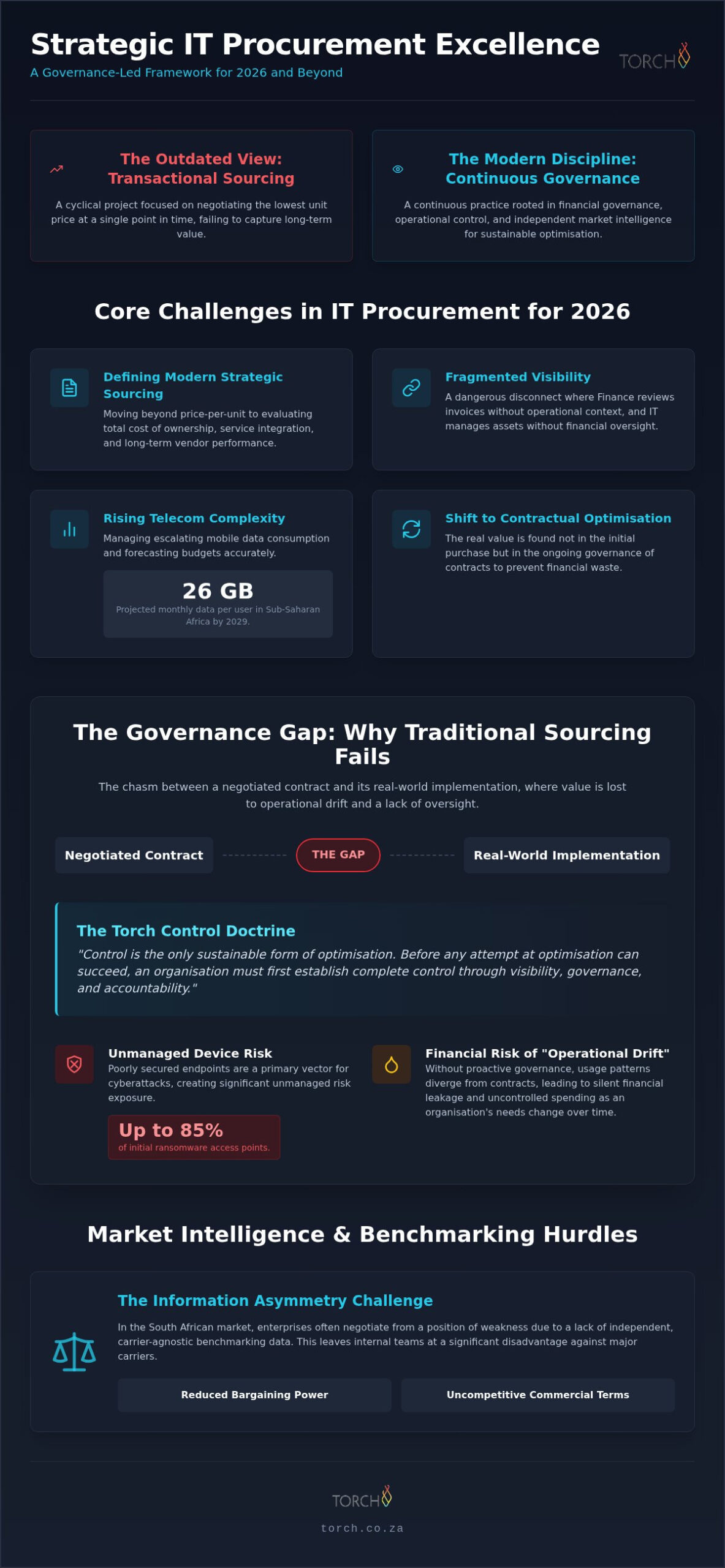
In the evolving landscape of enterprise technology, the term “strategic sourcing” is often misunderstood. For many organisations, it remains a cyclical project focused on negotiating the lowest unit price at a single point in time. However, as we approach 2026, this transactional view is becoming increasingly insufficient. True strategic sourcing in IT procurement is not an event; it is a continuous discipline rooted in financial governance, operational control, and independent market intelligence.
The core challenge for Chief Financial Officers (CFOs) and Chief Information Officers (CIOs) is no longer just about securing a favourable contract. It is about managing the entire lifecycle of technology assets, from mobile endpoints to complex cloud subscriptions, in a way that prevents financial leakage and aligns with strategic business objectives. Without a robust governance framework, even the most meticulously negotiated contract will fail to deliver its promised value, succumbing to operational drift, shadow IT, and billing inaccuracies.
This guide moves beyond academic definitions to provide a practical framework for achieving procurement excellence. It explores the structural gaps that undermine traditional sourcing efforts and outlines a governance-led approach that empowers South African enterprises to regain control, restore board-level confidence, and drive sustainable commercial optimisation.
Core Challenges in IT Procurement and Sourcing for 2026
The practice of Strategic Sourcing in IT procurement has evolved significantly. It is no longer a simple exercise in purchasing hardware or renewing software licences. Instead, it has become a complex function responsible for managing a hybrid ecosystem of managed services, cloud infrastructure, and a sprawling mobile workforce. This shift introduces several fundamental challenges that legacy procurement models are ill-equipped to handle.
While the strategic focus has shifted towards governance and lifecycle management, the foundational requirement for high-quality hardware remains; for a reliable source of IT equipment in the South African market, you may visit Computech-Solutions.
- Defining strategic sourcing in the context of modern technology managed services: Moving beyond price-per-unit negotiations to evaluating the total cost of ownership, service integration, and long-term vendor performance.
- The problem of fragmented visibility: Finance departments often review invoices without operational context, while IT departments manage assets without a clear view of the financial implications, creating a dangerous disconnect.
- Rising complexity in telecom estates: With mobile data consumption in Sub-Saharan Africa projected to reach 26GB per user per month by 2029, according to the Ericsson Mobility Report, the complexity of managing these estates and forecasting budgets is escalating rapidly.
- The shift from transactional purchasing to long-term contractual optimisation: The real value is not found in the initial purchase but in the ongoing governance of contracts to ensure they adapt to changing business needs and prevent financial waste.
The Visibility Gap: A Strategic Imperative
Many organisations believe they have visibility because they have access to vendor-provided dashboards. However, this is a common misconception. True visibility is the foundation of financial control, and it requires a single, independently verified source of truth that reconciles asset data with financial expenditure. Without it, procurement teams are operating with incomplete or biased information, leading to significant financial leakage.
- Why “looking at dashboards” is not the same as having financial control: Vendor portals are designed to report on consumption, not to highlight billing errors or opportunities for optimisation. They often lack the granularity needed to allocate costs accurately to the correct cost centre or business unit.
- The impact of unmanaged endpoints on procurement data accuracy: Devices that are not centrally managed and tracked create ghost assets in billing systems, leading to organisations paying for services that are no longer in use.
- How to identify “silent financial leakage” before it impacts the bottom line: This requires a systematic process of invoice auditing and reconciliation against a trusted asset inventory, a task that is often beyond the capacity of internal teams.
Market Intelligence and Benchmarking Hurdles
Effective negotiation is impossible without access to accurate, independent market intelligence. In the South African market, this data is particularly difficult to obtain. Enterprises often find themselves in an information asymmetry, where major carriers hold all the cards, leaving internal procurement teams at a significant disadvantage.
- The difficulty of accessing independent, carrier-agnostic benchmarking data in South Africa: Without a clear understanding of what constitutes a “good” rate, organisations cannot be certain they are receiving competitive terms.
- Why internal procurement teams often lack the leverage to challenge major carriers: Carriers are aware of the high switching costs and operational disruption involved in changing providers, which reduces the enterprise’s bargaining power.
- The role of competitive intelligence in securing better rates: An independent advisor with deep market insights can model different scenarios and use data-driven arguments to negotiate from a position of strength, ensuring terms are aligned with market realities.
The Governance Gap: Why Traditional Sourcing Fails
The most significant failure in modern IT procurement is the governance gap—the chasm between a negotiated contract and its real-world implementation. Strategic sourcing breaks down when it is treated as a one-time project. Without continuous oversight, operational realities will inevitably diverge from the commercial agreement, leading to uncontrolled spending and increased risk. This is where the “Torch Control Doctrine” becomes critical: control is the only sustainable form of optimisation.
- Understanding the “Torch Control Doctrine”: This principle asserts that before any attempt at optimisation can succeed, an organisation must first establish complete control over its technology estate through visibility, governance, and accountability.
- How unmanaged devices create risk: Research consistently shows that unmanaged endpoints are a primary vector for cyberattacks. For instance, some industry reports have suggested that up to 85% of initial ransomware access points originate from poorly secured or unmanaged devices.
- The financial risk of “operational drift” in long-term technology contracts: As an organisation’s needs change, usage patterns shift. Without proactive management, the original terms of a contract can become misaligned and inefficient, leading to systemic overspending.
- Why carriers should never be responsible for validating their own revenue: Relying on a vendor to audit their own invoices is a fundamental conflict of interest. Independent validation is essential for ensuring billing accuracy and accountability.
Commercial Control vs Operational Reality
A contract is merely a statement of intent. Its value is only realised when it is enforced through rigorous governance that aligns with actual employee behaviour and business processes. Too often, organisations sign multi-year agreements without the mechanisms to ensure compliance or manage the contract’s lifecycle effectively, leaving them exposed to predictable and preventable financial losses.
- Scenario modelling: The ability to map commercial outcomes against actual employee behaviour is crucial. For example, a “best value” data plan is worthless if employees are consistently exceeding limits and incurring significant out-of-bundle charges.
- The risk of auto-renewal traps in enterprise telecom contracts: Many contracts contain clauses that trigger automatic renewal, often on less favourable terms, if notice is not given within a specific window. Without diligent tracking, this can lock an organisation into another expensive, multi-year term. For a deeper analysis, explore our guide on enterprise telecom contract negotiation strategies.
The Cost of Unmanaged Shadow IT
Shadow IT—technology procured and used without the knowledge or approval of the IT department—is a major threat to strategic sourcing. It fragments spending, duplicates services, and creates significant governance gaps. When employees are free to purchase their own software subscriptions or use unauthorised devices, any centralised procurement strategy is fundamentally undermined.
- How shadow IT spending undermines strategic procurement efforts: It prevents the organisation from leveraging its full purchasing power and makes it impossible to maintain a single source of truth for assets and costs.
- Securing the estate: Integrating security governance into the sourcing process is no longer optional. Every procurement decision must be viewed through a risk management lens. Unmanaged devices acquired outside of approved channels are not just a financial concern; they are unpatched, unmonitored entry points that expand the organisation’s attack surface, creating vulnerabilities that bad actors can exploit for ransomware and data breaches.
- Link to further reading: To understand how to integrate security and financial governance, see our Hybrid Endpoint Security: 2026 Strategic Governance Guide.
A Framework for Strategic IT Procurement Excellence
Moving from a reactive, transactional approach to a proactive, governance-led model requires a structured framework. This five-step process provides a clear path for enterprises to establish control, eliminate waste, and build a sustainable foundation for ongoing commercial optimisation. It is a methodology designed to deliver defensible financial data and restore confidence in IT spend management.
- Step 1: Establish a single source of truth for all IT assets and subscriptions. This involves creating a comprehensive, accurate inventory of every device, user, and service, which serves as the baseline for all subsequent activities.
- Step 2: Conduct a deep-dive billing audit to uncover historical overspending. By systematically reconciling the last 12-24 months of invoices against the asset inventory, it is possible to identify billing errors, ghost assets, and other forms of financial leakage.
- Step 3: Implement real-time governance visibility for budget vs actual oversight. This moves beyond static monthly reports to provide dynamic, ongoing monitoring of spend against budget, enabling proactive intervention before overspending occurs.
- Step 4: Execute carrier-agnostic negotiations based on stress-tested data. Armed with a complete and accurate understanding of the estate and independent market benchmarks, the organisation can negotiate from a position of strength.
- Step 5: Embed ongoing governance to prevent future financial leakage. This final step transforms procurement from a project into a continuous process, with embedded controls and regular reviews to ensure the estate remains optimised.
Leveraging Proprietary Intelligence
Executing this framework effectively requires specialised tools and expertise. A simple reporting dashboard is not enough. Success depends on the ability to translate raw data into actionable commercial intelligence and to embed execution directly into the procurement lifecycle. This is where proprietary platforms and managed services provide a distinct advantage.
- Using tools like TorchLight for market benchmarking and contract scenario modelling: TorchLight provides access to our proprietary database of market rates, allowing for precise benchmarking of existing contracts and modelling of future negotiation outcomes.
- How SpotLight provides real-time visibility into cost centre allocation: SpotLight offers a live, granular view of technology spend, enabling finance teams to accurately allocate costs and hold business units accountable for their consumption.
- The importance of “embedded execution” over simple reporting: The true value lies not in generating reports but in actively managing the estate—disputing billing errors, reclaiming funds, and implementing optimisation changes on behalf of the client.
Vendor Accountability and Performance Metrics
A strategic sourcing framework must include robust mechanisms for holding vendors accountable. This means moving beyond standard Service Level Agreements (SLAs), which often fail to capture true business impact, and implementing a more holistic approach to vendor performance management.
- Moving beyond SLAs to meaningful vendor performance management: This involves tracking metrics that matter, such as billing accuracy, dispute resolution times, and the proactive identification of optimisation opportunities.
- The role of independent advisors in resolving billing discrepancies: An independent partner can manage the entire dispute resolution process, from identification to credit recovery, freeing up internal teams and ensuring a persistent, data-driven approach. Learn more about our approach to telecom vendor management services.
Restoring Confidence: Managed Governance as the Solution
For many overburdened CFOs and CIOs, the prospect of building and maintaining such a rigorous governance framework internally is daunting. The resources, specialised skills, and proprietary tools required are often beyond their reach. This is where a managed service model, or IT FinOps-as-a-Service, becomes the logical solution, providing the expertise and execution capability needed to bridge the governance gap.
- The transition from procurement as a “project” to “FinOps-as-a-Service”: This shifts the focus from periodic negotiations to a continuous, managed service that provides ongoing optimisation and financial control.
- How independent financial oversight restores board-level confidence in IT spend: When the board knows that a trusted, independent partner is validating every line item of IT spend, confidence in financial reporting and forecasting is fully restored.
- The benefits of a risk-share savings model in Telecom Expense Management (TEM): This commercial model ensures complete alignment of interests, as the managed service provider is compensated based on the actual, realised savings they deliver.
- Empowering CFOs with defensible financial data and accurate forecasting: With a single source of truth and real-time visibility, CFOs can finally move from reactive budget management to proactive, strategic financial planning.
Bridging the Finance-IT Divide
One of the most valuable outcomes of a managed governance service is its ability to bridge the historical divide between Finance and IT. By providing a common language and a shared, trusted data set, it fosters collaboration and aligns both departments toward the common goal of commercial optimisation and operational excellence.
- How managed services relieve overburdened internal procurement teams: By outsourcing the time-consuming tasks of auditing, dispute management, and reporting, internal teams are freed to focus on more strategic initiatives.
- The value of “plain-English” professional reporting for non-technical executives: Complex data is translated into clear, concise business insights that enable informed decision-making at the executive level.
- Case study summary: For example, in our engagement with the Tsogo Group, we established complete estate visibility and decision-readiness within six weeks, demonstrating the power of a focused, expert-led approach to transform procurement outcomes.
Next Steps for Strategic Governance
The journey toward strategic sourcing excellence begins with an honest assessment of your organisation’s current state. It requires a willingness to look beyond surface-level metrics and confront the underlying governance deficiencies that create financial and operational risk. The first step is to acknowledge that control must precede optimisation.
- Evaluating your current “FinOps Readiness” and control deficiencies: A critical self-assessment can identify the most significant gaps in visibility, accountability, and process.
- The importance of independent advisory in the South African financial services sector: In a market dominated by a few major players, the role of an independent, carrier-agnostic advisor is more critical than ever to ensure fair terms and transparent billing.
- Final recommendation: Focus on control to achieve sustainable optimisation. Lasting results are not achieved through one-off negotiations but through the implementation of a continuous, disciplined governance framework that protects the organisation’s financial interests day in and day out.